The Pforzheim Pedigree: Why the Ickler Case Matters
To understand the Archimede DeckWatch, one must first understand the Ickler family. In the world of horology, we often obsess over the movement—the 'beating heart'—while the case is relegated to a mere vessel. This is a mistake. The case is the interface between the machine and the human body. In Pforzheim, Germany, Ickler has been manufacturing cases since 1924, supplying some of the most prestigious names in the industry. Archimede is their in-house brand, and the UA7929-H1.1 is the purest expression of their metal-working prowess.
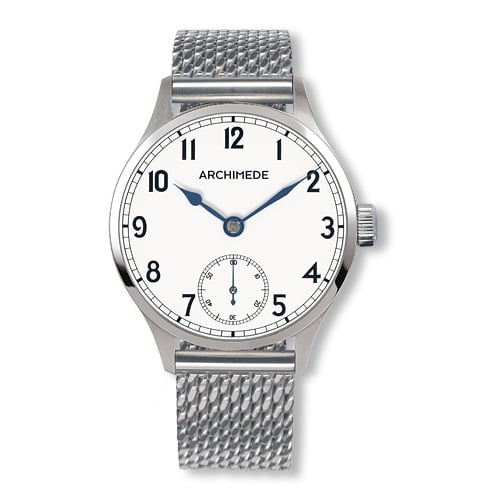
The DeckWatch case is a three-piece construction in brushed stainless steel, with a polished bezel that provides just enough flash to transition from a casual office environment to a formal dinner. When you run your finger along the transition from the lug to the case flank, you feel a crispness that is usually reserved for watches costing three times as much. There are no soft edges here, no lazy polishing. It is architectural, deliberate, and distinctly German.
Case Architecture: The 42mm Paradox
On paper, 42mm is a polarizing size. In an era where the 'neo-vintage' trend has pushed enthusiasts back toward 36mm and 38mm, 42mm can feel like a relic of the early 2010s. However, the DeckWatch justifies its scale through its historical context. Marine chronometers were large, high-precision instruments designed for maximum legibility on the rolling deck of a ship. By keeping the bezel thin and the dial expansive, Archimede honors that heritage.
The magic trick of the UA7929-H1.1 is its thickness—or lack thereof. At 10.5mm, it is remarkably svelte for a watch with such a large diameter. This thinness allows the watch to 'hug' the wrist, slipping under a bespoke shirt cuff without a struggle. During my week of wear, I found that the watch felt more like a 40mm piece in terms of vertical presence, even if the 51mm lug-to-lug length reminded me of its true size whenever I looked at it head-on. For those with a wrist circumference under 6.5 inches, the lugs may hang over the edge, but for the average collector, the ergonomics are surprisingly refined.
The Dial: A Study in Legibility and Light
The dial of the DeckWatch is a masterclass in high-contrast design. The base is a soft, silver-white with a fine texture that prevents glare. The Arabic numerals are printed in a deep, inky black, utilizing a font that evokes the maritime clocks of the 19th century. But the stars of the show are the hands. These are not painted blue; they are heat-blued steel. Depending on the angle of the light, they shift from a near-black to a vibrant, electric cobalt. This is a detail that sophisticated collectors look for, as it requires precise temperature control during the manufacturing process—a far cry from the cheap chemical bluing found on entry-level pieces.
The sub-seconds dial at 6 o'clock is slightly recessed, adding a layer of three-dimensionality to an otherwise flat surface. There is no date window to clutter the symmetry, a decision I applaud. In a daily-wear context, the lack of lume might seem like a drawback, but the sheer contrast between the hands and the dial makes it readable in even the dimmest twilight. This is a watch designed for the light of day, for the clarity of navigation.
The Movement: The Ritual of the Manual Wind
Inside the UA7929-H1.1 beats the ETA 6498-1. Originally designed as a pocket watch movement, its large diameter is what necessitates the 42mm case size. For the young collector, this movement offers a tactile connection to horological history. There is no rotor to obscure the view through the sapphire caseback; instead, you are treated to a full view of the bridges, the balance wheel, and the winding gears.
The act of winding this watch every morning became a highlight of my week. The crown is generously sized and deeply knurled, providing excellent grip. Each click of the ratchet is audible and felt through the fingertips—a mechanical heartbeat coming to life. The 6498 is a slow-beat movement (18,800 vph), and watching the large balance wheel oscillate is a meditative experience that a high-beat automatic simply cannot provide. It is a robust, reliable caliber that will likely outlive its owner if properly maintained.
Seven Days on the Wrist: A Field Report
Monday: The watch felt large initially, especially coming off a weekend wearing a 36mm vintage piece. However, by noon, the weight (or lack thereof) made it disappear. It paired perfectly with a navy blazer and grey flannels.
Wednesday: I wore the DeckWatch during a day of heavy typing and meetings. The flat caseback and the 22mm leather strap kept the watch centered on my wrist. I noticed several colleagues glancing at the blued hands—it has a 'stealth wealth' quality that invites curiosity without being ostentatious.
Friday: Transitioning to a more casual denim-and-sweater look, the DeckWatch held its own. While it leans toward the dressier side of the spectrum, its tool-watch DNA (the brushed case, the clear numerals) makes it versatile enough for a Friday night at a dimly lit bistro.
The Weekend: This is where the 50m water resistance is a slight limitation. While perfectly fine for a rainy walk or washing your hands, I wouldn't take it near a pool. But for a weekend gallery hop? Perfection.
The Competition: Where Does Archimede Stand?
The primary rival to the Archimede DeckWatch is undoubtedly the Stowa Marine Classic. Stowa has a slightly more direct historical claim to the 'Marine' name, but Archimede wins on the case. The Ickler case feels more modern, more precisely machined, and offers a slightly different aesthetic with its brushed finishes. Laco’s Cuxhaven is another contender, though it carries a more rugged, 'flieger-adjacent' vibe. For the buyer who values the 'Made in Germany' label and wants the best possible case for their dollar, Archimede is the clear winner.
Investment and Longevity
At roughly $1,000 USD, the DeckWatch is positioned in the 'entry-level luxury' bracket. It is not a watch that will appreciate in value like a steel sports Rolex, but it is a watch that represents an incredible 'value-per-gram' of horology. Because it uses a standard ETA movement and a high-quality Ickler case, its longevity is virtually unlimited. It is a 'buy it for life' object. For the young collector, this is an ideal first 'serious' watch—one that will still look relevant and function perfectly twenty years from now.
Final Thoughts
The Archimede DeckWatch UA7929-H1.1 is a reminder that good design is timeless. It doesn't need integrated bracelets or ceramic bezels to be compelling. It relies on the fundamentals: a great case, a legible dial, and a soul-stirring mechanical movement. If you can appreciate the ritual of the morning wind and have the wrist to carry its 51mm span, there is no better way to spend a thousand dollars in the current market. It is a watch that rewards the wearer every time the light hits those blued hands—a small, mechanical joy in an increasingly digital world.