The Pforzheim Lineage: More Than Just a Label
When discussing German horology, the conversation often gravitates toward the heavyweights of Glashütte. However, to overlook Pforzheim is to ignore the industrial heart of German watchmaking. Since the late 18th century, Pforzheim has been the center of the jewelry and watch industry in Germany, earning the moniker 'Goldstadt' (Gold City). It is here that the Ickler family has operated since 1924, honing a craft that many modern brands have outsourced: the manufacturing of the watch case.
The Archimede Klassik is the beneficiary of this century-old expertise. Unlike many 'microbrands' that select cases from a catalog in the Far East, every Archimede case is designed, milled, and finished in-house by Ickler. This vertical integration allows for a level of quality control and design specificity that is palpable the moment you hold the Klassik. The case is not merely a container for the movement; it is the primary attraction.
Case Architecture: The Ickler Masterclass
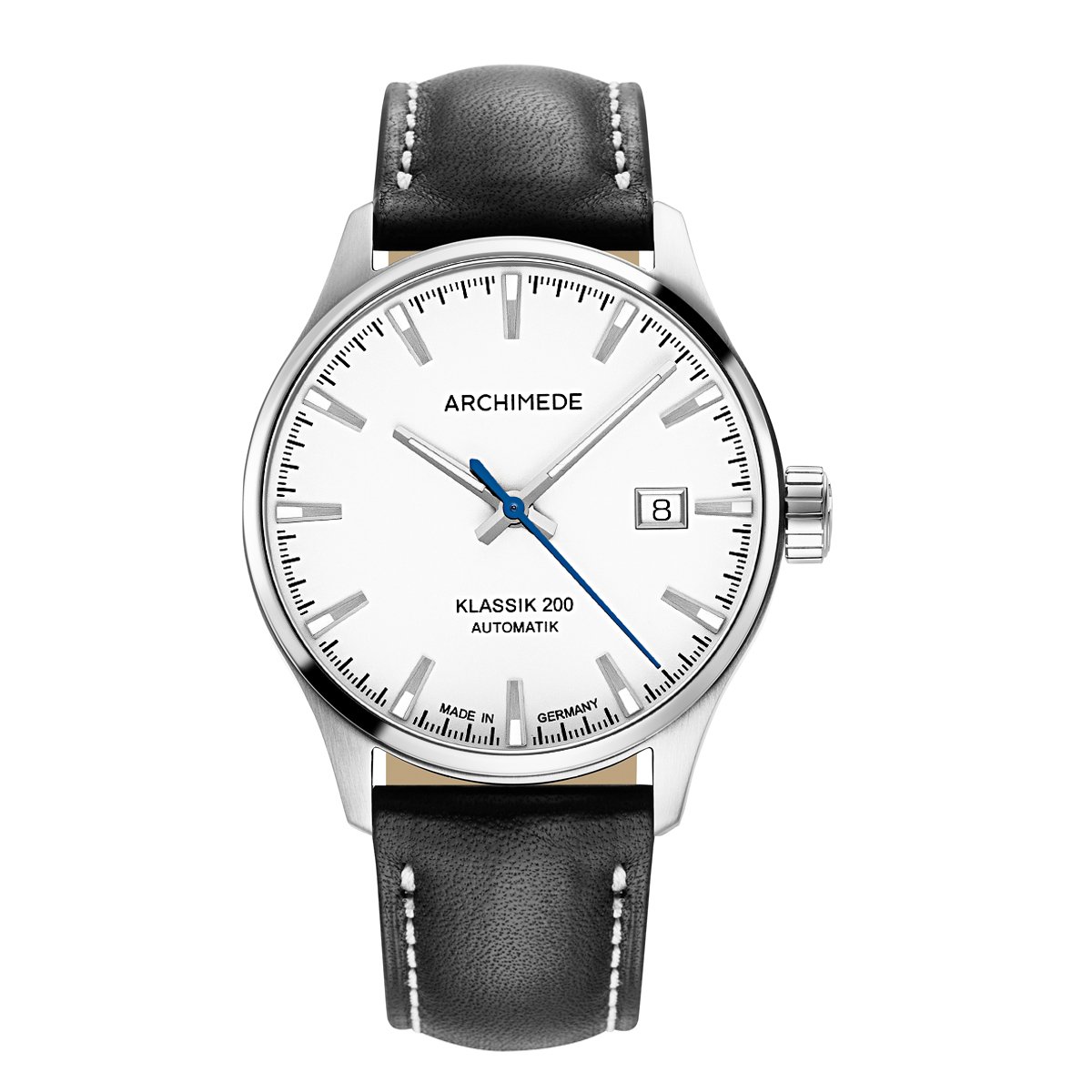
The Klassik 42 features a three-piece case construction consisting of the bezel, the mid-case, and the screw-down case back. The mid-case is the standout element, featuring a vertical brushing that is incredibly fine—almost silken to the touch. This contrasts sharply with the high-polish finish on the bezel and the tops of the lugs. The transition between these finishes is razor-sharp, a hallmark of precision milling that one usually associates with brands like IWC or Sinn.
At 9.8mm thick, the Klassik achieves a profile that is increasingly rare in an era of bulky sports watches. This slimness is achieved through clever engineering of the case back and the choice of the Sellita SW200-1 movement, which allows the watch to sit remarkably flat on the wrist. The lugs are tapered and curved downward, ensuring that the 51mm lug-to-lug length wears smaller than the numbers suggest, accommodating a variety of wrist sizes with ease.
Dial and Hands: The Beauty of Restraint
The dial of the Klassik is a study in legibility and proportion. Available in silver, black, and blue, the silver variant is perhaps the most 'German' in its execution. It features a subtle graining that catches the light without being reflective. The hour markers are printed in a clean, sans-serif typeface that leans into the Bauhaus tradition without being a direct copy of the Nomos aesthetic.
The hands are the focal point of the dial. In the silver-dial version, Archimede uses heat-blued steel hands. This is a traditional horological technique where steel is heated to a specific temperature until it oxidizes to a deep, iridescent blue. At this price point, many brands use 'chemically blued' or painted hands, which lack the depth and light-play of true heat-blued steel. The lance-shaped hands are perfectly proportioned, with the minute hand extending precisely to the edge of the minute track, a detail that demonstrates Archimede's attention to technical accuracy.
The Movement: A Reliable Heart
Powering the Klassik is the Sellita SW200-1, a Swiss-made automatic movement that has become the industry standard for reliable, high-frequency performance. While some purists may lament the lack of an in-house caliber, the choice of the SW200-1 is a pragmatic one. It ensures that the watch remains affordable and, more importantly, serviceable for decades to come. Any competent watchmaker in the world can find parts for and repair an SW200-1.
Archimede does not simply drop the movement into the case. They add a custom rotor with a sunray finish and the Archimede logo, visible through the sapphire case back. The movement operates at 28,800 vibrations per hour (4Hz), providing a smooth sweep of the seconds hand. During our testing, the movement showed excellent stability across various positions, a result of the in-house regulation performed by Archimede’s watchmakers in Pforzheim.
On the Wrist: Ergonomics and Versatility
Wearing the Archimede Klassik is an exercise in understated elegance. It is a 'chameleon' watch—on a black alligator strap, it is a formal dress watch that holds its own in a boardroom; on a tan calfskin strap, it becomes a sophisticated daily driver for the creative professional. The lack of a bezel (in the traditional dive-watch sense) means the dial takes up most of the 42mm diameter, giving the watch a significant presence despite its thinness.
The crown is appropriately sized—large enough to operate easily but small enough not to dig into the back of the hand. The winding action is smooth, and the date click at midnight is crisp. While the 50m water resistance means you shouldn't take it diving, it is more than sufficient for the daily rigors of a modern lifestyle, including the occasional rainstorm or hand-washing.
The Value Proposition for the Modern Collector
In a world where 'luxury' is often equated with 'expensive,' the Archimede Klassik challenges the status quo. It asks the collector to look past the logo and focus on the tactile reality of the object. When you compare the finishing of an Ickler case to that of a mass-produced luxury watch costing three times as much, the value becomes undeniable.
For the young collector, the Klassik is an ideal entry point into German horology. It offers a tangible connection to a family-run manufacture and a level of technical execution that rewards close inspection with a loupe. It is a watch for those who know that true sophistication lies in the details—the sharpness of a lug, the depth of a blued hand, and the history of a city dedicated to the art of the machine.
Final Thoughts
The Archimede Klassik is not a watch that shouts. It doesn't need to. Its quality is evident in the silence of its operation and the precision of its form. By focusing on their core competency—case making—and pairing it with a reliable Swiss movement and clean German design, the Ickler family has created a modern classic. It is a testament to the fact that in the world of horology, integrity is the ultimate luxury.