The Architecture of the Ickler Case
To understand the Archimede Klassik 36, one must first understand the Ickler family. Since 1924, Ickler has been synonymous with high-quality case manufacturing in Pforzheim, Germany. While many brands in the entry-to-mid luxury segment outsource their cases to Far East suppliers, Archimede remains one of the few that maintains complete control over the metallurgical process. The reference UA4929-A3.21 showcases this vertical integration through a three-piece case construction that is as robust as it is refined.
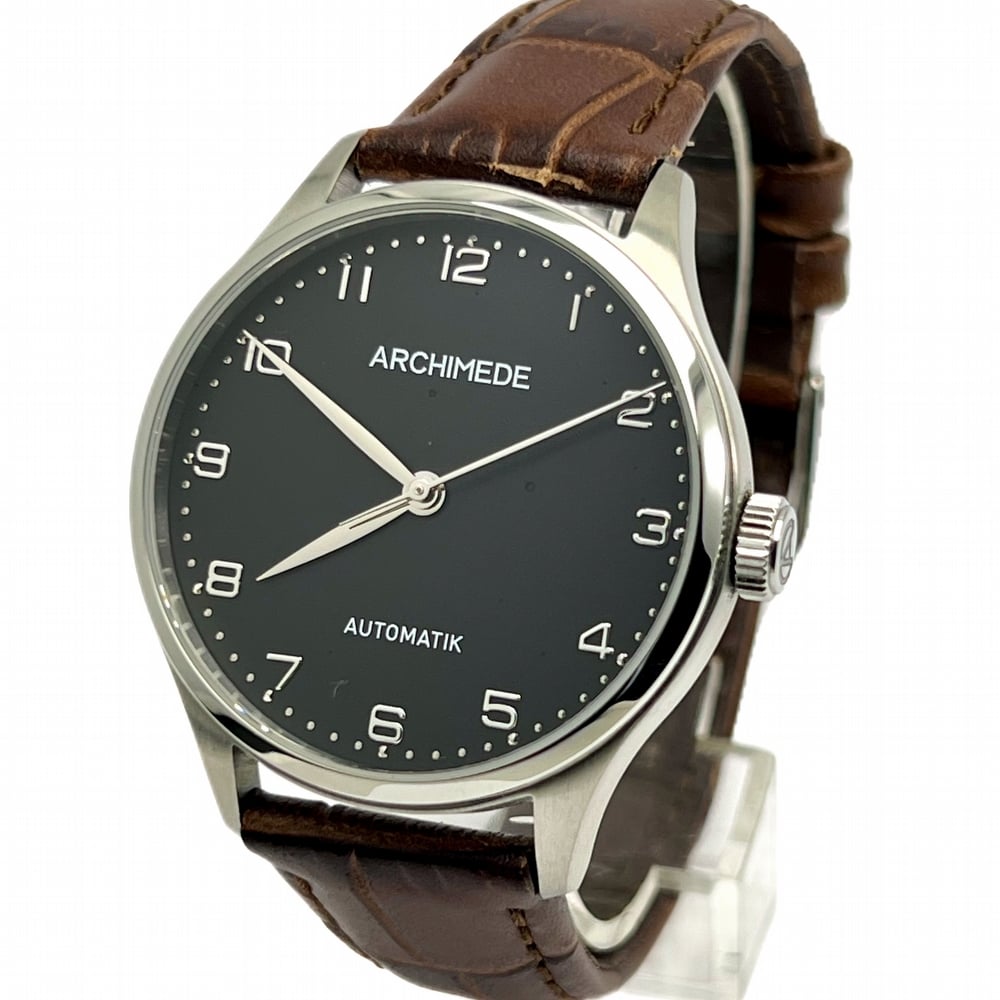
The case of the Klassik 36 is finished with a combination of brushed and polished surfaces. The bezel is thin and polished, which serves to maximize the visual real estate of the dial, making the 36mm diameter feel slightly larger on the wrist. The mid-case features a fine horizontal brushing that is remarkably consistent, a hallmark of Ickler's machining precision. The lugs are integrated seamlessly into the mid-case, tapering elegantly to a 18mm width. This attention to detail in the casing is what separates Archimede from its peers; there are no sharp edges where there shouldn't be, and the tolerances between the case components are exceptionally tight.
The Dial and the Art of Heat-Bluing
The dial of the UA4929-A3.21 is a silvered canvas that emphasizes legibility. It features a subtle graining that catches the light without being reflective. The hour markers are printed in a clean, sans-serif font that leans into the Bauhaus aesthetic without fully committing to the austerity of a Nomos. However, the true stars of the dial are the hands. Unlike many watches at this price point that use chemically blued (painted) hands, the Klassik 36 utilizes genuine heat-blued steel hands.
The process of heat-bluing involves heating the steel hands to approximately 290 degrees Celsius until a thin layer of magnetite forms on the surface, creating a deep, iridescent cornflower blue. This is a time-consuming process that requires precise temperature control. In low light, the hands appear almost black, but as they catch the light, they reveal a vibrant blue that provides a stunning contrast against the silver dial. The date window at 6 o'clock is well-proportioned and maintains the symmetry of the dial, a design choice that is often botched in smaller-diameter watches.
The Movement: Engineering Over Ego
Inside the Klassik 36 beats the Miyota 9015. While some purists may lament the absence of a Swiss ETA or Sellita movement, the choice of the 9015 is a calculated engineering decision. At only 3.9mm thick, the 9015 is significantly slimmer than the workhorse ETA 2824-2 (4.6mm). This delta in thickness is what allows Archimede to achieve the 9.1mm total case profile of the Klassik 36.
Technically, the 9015 is a high-beat movement, oscillating at 28,800 vibrations per hour (4Hz), which results in a smooth sweep of the seconds hand. It features hacking seconds and hand-winding capabilities. The movement is visible through a display back, and while the finishing is industrial, it is clean. One quirk of the 9015 is its unidirectional winding system; the rotor spins freely in one direction, which can occasionally be felt or heard on the wrist. For many, this 'rotor wobble' is a charming reminder of the mechanical heart beating within, though it is a point of note for those accustomed to the near-silent bidirectional winding of Swiss counterparts.
Wrist Feel and Daily Versatility
The 36mm diameter is often called the 'Golden Ratio' of watch sizing. On the UA4929-A3.21, this diameter works in harmony with the 43mm lug-to-lug distance to create a watch that is balanced and unobtrusive. It is a 'daily driver' in the truest sense. Whether paired with a navy blazer or a simple knit sweater, the watch remains contextually appropriate. The lack of lume on the dial further pushes it toward the dressier end of the spectrum, yet the brushed case and robust Ickler construction ensure it can handle the rigors of daily life.
The water resistance is rated at 50 meters. While this is not a diving watch, it is more than sufficient for the occasional splash or rainstorm. The sapphire crystal is flat and features an anti-reflective coating on the interior, which further enhances the clarity of the silver dial. For the collector who values understated elegance, the wrist presence of the Klassik 36 is unimpeachable.
Comparative Analysis: The German Landscape
In the world of German horology, Archimede sits in a unique position. It lacks the brand recognition of Nomos or Sinn, yet it offers a level of value that is arguably superior. A Nomos Tangente, while featuring an in-house movement, will cost nearly three times as much as the Klassik 36. Stowa, another Pforzheim neighbor, offers the Antea, but the Klassik 36’s Ickler case is often cited by enthusiasts as having a more refined finishing and a more contemporary lug design.
The Klassik 36 is for the collector who has moved past the need for 'brand flex' and instead finds satisfaction in the quality of the machining. It is a watch for those who appreciate that the case is as much a part of the movement as the gears themselves. It is a testament to the enduring quality of Pforzheim manufacturing and a reminder that luxury does not always require a five-figure price tag.
Final Thoughts
The Archimede Klassik 36 (UA4929-A3.21) is a rare find in the modern market. It refuses to compromise on its classical proportions and doubles down on the technical strengths of its parent company. By focusing on the essentials—a world-class case, heat-blued hands, and a reliable, slim movement—Archimede has created a timepiece that is both timeless and technically impressive. For the sophisticated collector, it is a masterclass in horological restraint.