A tool watch without the theatre
Most watches at this price are designed to be photographed. The Archimede Outdoor 39 is designed to be worn — knocked against a door frame, rinsed under a tap, and forgotten about until the light goes amber. That is not a criticism. It is the entire point, and it is a rarer thing than the marketing language of the category usually suggests.
Archimede is a small German brand operating out of Pforzheim, the town on the edge of the Black Forest that has been the centre of German case and jewellery manufacturing for more than two centuries. The company behind it, Ickler, has spent the better part of a century making cases for other people. When a workshop whose reputation rests on bezel fits, crystal seats and crown threads turns its attention to a complete watch, you get a very specific set of priorities: the case comes first, the movement is bought in and proven, and the dial is clean rather than spectacular.
The Outdoor 39, reference UA8237B-A2.1-H, sits at the centre of that philosophy. It is a stainless steel field watch with a Sellita automatic, a sapphire crystal and no ambition whatsoever to be a dress watch in disguise. What follows is an assessment of what it does well, where corners have sensibly been cut, and whether it earns a place in a young collector's rotation.
The Ickler inheritance
Pforzheim's watchmaking history is a case-making history. While Swiss and Saxon brands built movements, the Black Forest built the metal that surrounded them, and Ickler has been part of that story since 1924. For decades the family business supplied cases to other brands — the kind of unglamorous industrial work that builds deep technical competence and no consumer recognition at all.
The Archimede name, revived in the early 2000s, was the family's route to selling a complete watch rather than a component. That history explains almost everything about the Outdoor 39. The case is not merely competent; it is the work of people who have spent generations solving the specific problems of machining stainless steel to tolerances that a crown must thread into and a crystal must seal against.
Archimede's outdoor line has long been associated with Ickler's surface-hardening treatment, which pushes the steel well beyond the scratch resistance of a standard brushed case. It is the sort of specification that never appears in a lifestyle photograph and matters enormously after three years of daily wear. For a collector who buys one watch and wears it constantly, that single detail is worth more than any amount of applied indices.
The movement: Sellita SW200-1
Archimede buys its movements, and it makes no apology for doing so. The Outdoor 39 runs a Sellita SW200-1, the Swiss ébauche that has become the default automatic of the independent European watch industry since ETA's supply restrictions tightened.
The SW200-1 is a descendant of the ETA 2824-2 architecture. It beats at 28,800 vibrations per hour, carries a power reserve of around 38 hours, hacks for precise setting, and offers a quick-set date. It is not a movement anyone will photograph through a display back, and Archimede sensibly does not pretend otherwise. Finishing is industrial: rhodium-plated bridges with straight Geneva striping, functional rather than decorative.
What matters more is that the SW200-1 is comprehensively understood. Parts are available. Every competent watchmaker has serviced hundreds. The movement's weaknesses — a rotor bearing that can become noisy with age, a date mechanism that dislikes being quick-set near midnight — are well documented and easily managed. For a watch intended to be used hard and kept for a decade, being boring in the best sense is a genuine virtue.
Archimede does not submit this reference for chronometer certification, and it is not an in-house calibre. Neither omission bothers me. At this price, money spent on certification would have to come out of the case, and the case is precisely where this watch earns its keep.
Case, dial and the details that matter
The Outdoor 39 is a 39mm stainless steel watch rated to 200 metres, with a sapphire crystal and a screw-down crown. Those figures describe a serious everyday tool rather than a desk ornament, and they are the right ones to lead with, because everything else about the design is subordinated to them.
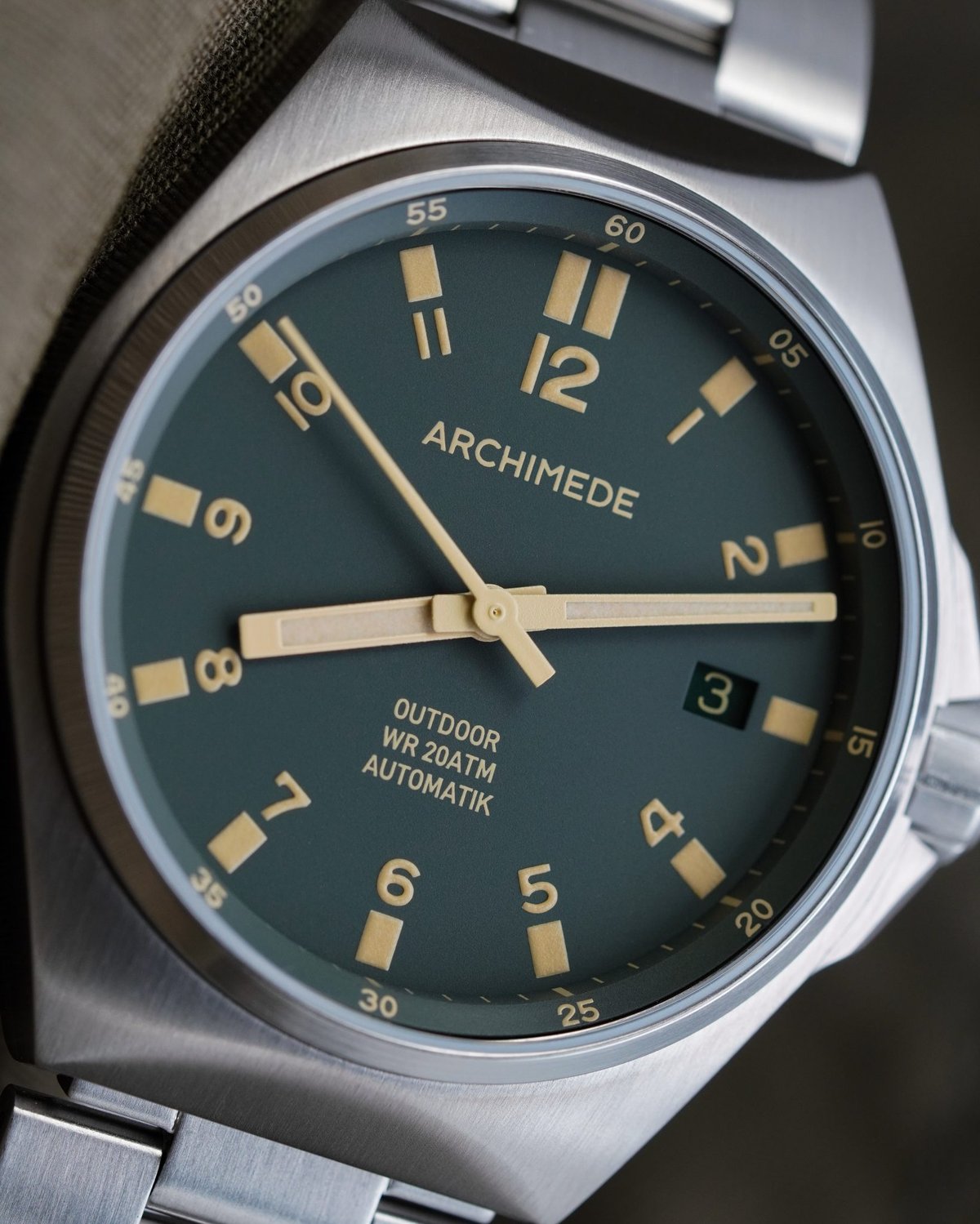
The dial is matte black, with high-contrast luminous numerals and a restrained handset that favours readability over flourish. There is a date at three o'clock, framed cleanly and small enough not to disturb the symmetry of the layout. Nothing about the design is decorative. The lume is Super-LumiNova, applied generously enough to be genuinely useful in a dark room or on an unlit path, which is more than can be said for a great many watches with luminescent ambitions.
The case is where the Ickler DNA shows through. Surfaces are brushed rather than polished, with crisp transitions between the planes and a bezel that sits flush against the crystal without the faint gaps that betray cheaper assembly. The crown threads smoothly and engages with a precision that is disproportionately satisfying. It is not a case that will win design awards, but it is a case built by people who care about the difference between a good fit and a perfect one.
The sapphire crystal is a sensible choice for a watch with this remit. Acrylic would have been more in keeping with the vintage field-watch idiom, but the Outdoor 39 is not a heritage exercise — it is a working object, and it should not require polishing every few months.
On the wrist
At 39mm the Outdoor 39 is the rare tool watch that disappears under a cuff and still reads legibly across a room. The case is slender in profile for the water resistance on offer, and the weight distribution is dominated by the case rather than the strap, which keeps the head from sliding around on the wrist during the day. The lugs curve down sharply, so the watch sits flat rather than perching, and the short, no-nonsense strap tapers enough to keep the whole assembly close to the arm.
On a 17cm wrist the proportions feel deliberate rather than compromised. Archimede has resisted the urge to make the dial busy, and the result is a watch that reads as smaller than it measures until you check the numbers — the highest compliment a field watch can receive. The one caveat is the leather strap. It is well made and immediately comfortable, but it is the least weather-resistant element of an otherwise thoroughly outdoor-friendly package, and buyers who intend to use the 200 metres of water resistance should budget for a rubber or fabric alternative from the outset.
Wrist presence is moderate. This is a watch that will be noticed by people who know watches and ignored by everyone else, which is precisely the register most field watches should occupy. It does not compete with a dive watch for wrist real estate, and it does not need to.
Accuracy and daily life
The Sellita SW200-1 is not a chronometer and Archimede makes no rate claims for this reference. In practice, examples of this movement typically settle somewhere in the region of a few seconds a day once broken in, with positional variation that will be noticeable to anyone who tracks their watch against a reference clock but irrelevant to anyone who sets it once a week.
Expect the watch to run slightly fast when new and to quieten over the first few months. Because it hacks, precise setting against a time signal is straightforward. And because the movement is ubiquitous, regulation is neither expensive nor difficult — a point worth weighing against brands that use proprietary calibres and charge accordingly for service.
Day to day, the watch asks nothing of its owner. The 38-hour reserve means it will stop if left on a bedside table over a weekend, which is the one practical argument for a winder or for a rotation habit. The date is easy to set, the crown is comfortable to operate, and the sapphire crystal shrugs off the abrasion that would haze an acrylic or mineral counterpart within a year.
Service and long-term ownership
Archimede does not publish a fixed service interval, and the honest answer is that the watch will tell you when it needs attention: declining amplitude, a slowing rate, or a rotor that has become audible. A five-to-seven year rhythm is typical for a movement of this type in regular use.
The good news is that the SW200-1 is serviceable by any competent independent watchmaker, not just the brand's own network. Costs vary considerably by region, but an independent service will generally come in well below what a Swiss maison would charge for a comparable automatic. For a watch at this price point, that accessibility is a substantial part of the value proposition — it means the watch can be kept running indefinitely without ever requiring an uneconomical repair bill.
How it fits into a collection
The Outdoor 39 is at its best as a daily wearer. It works with a shirt in an office, with a jacket at the weekend, and with hiking kit on a hillside, and it does so without ever looking as though it has been borrowed from another context. The matte dial and brushed case keep it quiet enough for professional environments, while the water resistance and legibility make it a legitimate travel companion — one watch for a week away, no case required.
It is not a formal watch, and it should not be asked to be one. If your collection has a single dress piece and a single sports piece, this sits comfortably in the latter role with a broader remit than most. If you are buying your first serious mechanical watch, the Outdoor 39 is a more honest introduction to the hobby than a fashion-led diver, because it teaches you what good casework feels like without charging you for a story.
Value, variants and alternatives
The Outdoor 39 sits in the region of $950 to $1,300 depending on strap or bracelet, which places it above the mainstream field-watch offerings from Hamilton and below the hardened-steel specialists from Sinn and Damasko. That is a deliberate and defensible position. What the price buys is a German-made case of genuine quality and a proven Swiss movement wrapped in a design that will not date.
Within the line, the leather-strap version reviewed here is the most versatile and the least sensible for actual outdoor use. The steel bracelet turns the watch into a slightly more formal daily wearer; the rubber strap is the correct choice for anyone who intends to swim in it. The hardened case means the watch will hold its appearance far better than its price suggests, and used examples trade at a sensible discount to retail without the speculative froth that distorts so much of the entry-level market.
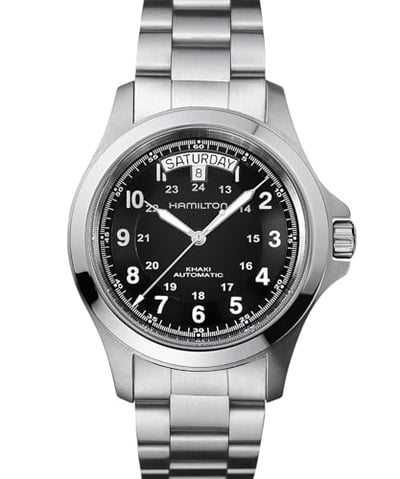
The obvious alternatives are the Sinn 556 and the Damasko DS30, both of which offer a similar German engineering ethos at a higher price and with a stronger collector following. Hamilton's Khaki Field Automatic remains the mainstream benchmark, softer in the case and less distinctive in finishing but far easier to find on a high street. Each is a legitimate choice; the Archimede's argument is that it puts more of your money into the metal than any of them.
The verdict
The Outdoor 39 is not trying to win a beauty contest, and it should not be judged as though it were. It is a well-proportioned, honestly built German field watch whose case quality punches well above its price and whose movement will still be serviceable in twenty years.
There will be collectors for whom a standard-grade Sellita and a matte black dial are simply not enough — who want an exhibition back, an in-house calibre, or a name that draws a comment at dinner. Those collectors should look elsewhere, and they will pay considerably more for the privilege.
For everyone else, the Outdoor 39 offers something increasingly rare: a watch that spends its budget on the things you touch every day rather than the things you read about in a press release. It is the sort of purchase that looks unremarkable in a photograph and feels entirely correct on the wrist.