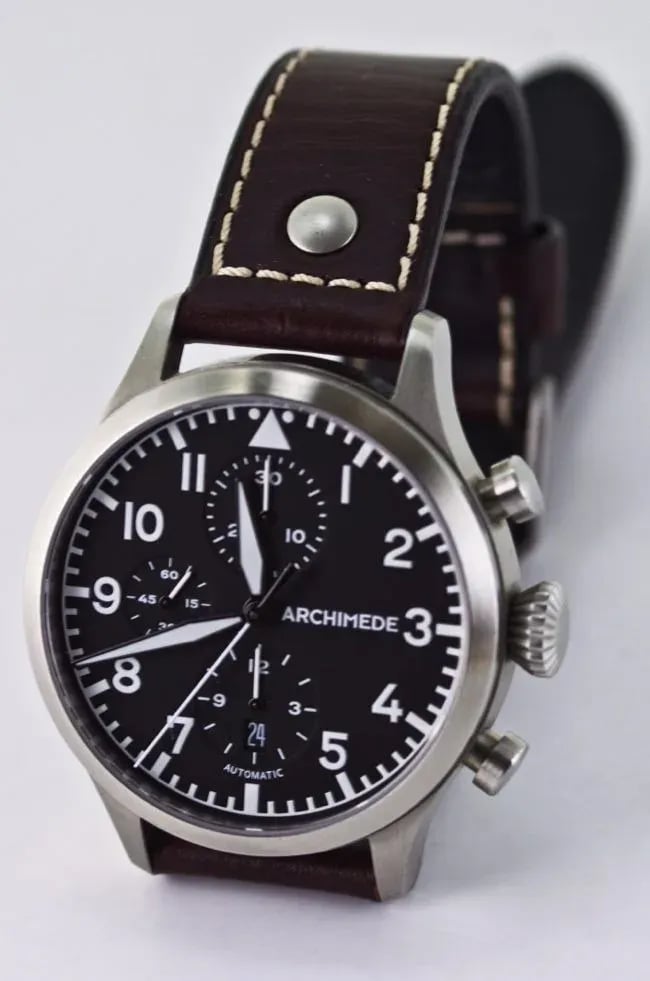
There is a certain kind of collector who wants a pilot chronograph without the ceremony. Not a safe queen, not a boardroom flex, not a watch that requires a paragraph of explanation at dinner. The Archimede Pilot Chrono, reference UA7939B-C1.1, is built for that collector: a German flieger with a Valjoux 7750, a legible instrument dial, and a price that keeps it in daily rotation. It is the sort of watch that looks correct with a field jacket, a sweatshirt, or a plain oxford, and it does not apologize for being a tool.
Archimede is not trying to out-IWC IWC. The brand's value proposition is simpler and more honest: German assembly through the Ickler family, proven Swiss chronograph architecture, and a design language rooted in aviation rather than luxury marketing. The Pilot Chrono is not a limited edition or an auction trophy. It is a working chronograph with a clean cockpit layout, and that is precisely why it deserves attention.
In a market crowded with vintage-inspired fliegers and overpriced homage-adjacent pieces, the Archimede keeps its feet on the ground. It gives you the essential pilot-watch cues, a robust automatic chronograph movement, and enough visual authority to feel like a real instrument. The question is whether the whole package still makes sense for a sophisticated young collector. Short answer: yes, if you buy it for the right reasons.
Brand Context: Ickler, Pforzheim, and the Modern Flieger
Archimede lives inside a useful corner of German watchmaking. The Ickler family has been making cases in Pforzheim since 1924, and that industrial DNA matters here. The modern Archimede brand is not pretending to be a Geneva maison. It is a direct, enthusiast-focused operation that leans on German assembly and established Swiss movements. That is why the Pilot Chrono can offer a Valjoux 7750 chronograph without the markup attached to more famous pilot-watch names.
The flieger genre is easy to get wrong. Too much faux patina and it becomes costume. Too much polishing and it stops looking like an instrument. Archimede's Pilot Chrono stays on the correct side of that line. The design is spare, legible, and purposeful. It references the classic observation-watch formula without turning into a vintage cosplay exercise. For young collectors who came up through streetwear, outdoor gear, and tool watches, that balance is appealing. It is a watch with a point of view, but it does not demand that your entire wardrobe agree.
There is also the matter of availability and ownership. Archimede is not a boutique-only brand with a waiting list. It sells to people who research movements, compare case finishing, and ask practical questions about service. That makes the Pilot Chrono a connoisseur's value play rather than a flex. The person wearing it usually knows exactly why they chose it, which is often more interesting than the watch itself.
Movement: The Valjoux 7750 Workhorse
The heart of the Pilot Chrono is the ETA/Valjoux 7750, one of the most consequential automatic chronograph movements ever made. It is a cam-and-lever design, not a column wheel, and it has powered everything from affordable tool watches to high-end chronographs. The architecture is robust, the parts network is deep, and most competent watchmakers have seen one before. That matters for a watch that is meant to be worn and serviced rather than stored in a safe.
On paper, the movement runs at 28,800 vph and offers roughly 44 hours of power reserve. The chronograph uses a tri-register layout, and the day-date function gives the dial an extra layer of practicality. This is not haute horlogerie finishing. You will not find hand-bevelled levers or a dramatic sapphire display back worth staring at for hours. What you get instead is a proven automatic chronograph that starts, stops, and resets with mechanical certainty. For a pilot watch, that is the right trade-off.
The 7750 also shapes the wearing experience. It is a tall movement, and it gives the watch a substantial, toolish stance. Collectors who are used to slim three-handers will notice the difference immediately. But the payoff is a chronograph with a confident wrist presence and a movement that can be maintained without drama. The Pilot Chrono is not COSC-certified, so do not expect chronometer paperwork. A healthy example should still keep time within a few seconds per day in normal wear, and regulation can improve that. Sample variation exists, as it does with any mechanical watch, so buy from a reputable seller and ask about timing if you are particular.
Dial, Case, and Pilot-Watch Design
The dial is the reason to choose the Pilot Chrono over a generic field chronograph. Archimede uses the classic flieger vocabulary: high-contrast markers, bold hands, a clear chapter ring, and a pilot triangle at twelve. The black dial is deliberately readable, not busy. Even with the chronograph registers and day-date display, the eye knows where to go. That is harder to achieve than it looks. Many chronographs become instrument panels in the worst sense, with too many overlapping scales and fussy text. Archimede keeps things clean.
The stainless-steel case is finished for utility rather than jewelry-store sparkle. It has the kind of presence that works with a leather strap and casual clothing, and it does not feel precious in the way a dress chronograph might. The sapphire crystal is the correct choice for a daily wearer, and the Super-LumiNova lume gives the watch the low-light legibility you expect from a pilot design. The leather strap and pin buckle complete the traditional flieger look. None of these details are revolutionary, but they are coherent. The watch knows what it is.
One of the smartest things about the Pilot Chrono is that it does not over-index on vintage. There is no artificial aged lume, no fake patina, and no forced scarcity. The design feels contemporary enough for daily wear while still honoring the aviation template. That makes it easy to pair with modern clothing. It works with denim, nylon, knitwear, and casual tailoring. It is not a formal watch, and it should not pretend to be. But as a daily chronograph with a point of view, it is very easy to live with.
On the Wrist
The Pilot Chrono wears like a proper flieger chronograph. The stainless-steel case has visual heft, the dial reads from a glance, and the leather strap keeps the package from feeling overly technical. It is not a slim dress watch, and the 7750 architecture gives it a tall, toolish stance that can catch on a tight cuff. On a normal wrist, the balance is good because the lugs and strap taper keep the head from feeling top-heavy. The watch sits with authority rather than delicacy.
That is not a flaw if you understand the brief. This is a pilot chronograph, not a concealed dress piece. It is meant to be seen and read. The day-date display adds daily practicality, and the chronograph registers give the dial enough visual depth to stay interesting over time. The pin buckle is simple and period-correct, though collectors who prefer micro-adjustment may eventually look for an aftermarket strap. A well-fitted leather strap makes a big difference here. If the strap is too long or too stiff, the watch can feel more cumbersome than it needs to.
Compared with more polished pilot chronographs, the Archimede feels honest and slightly rugged. That is a compliment. It does not try to be a luxury object first and a tool second. It feels like a watch you can wear to the airport, to a casual dinner, or to a desk job without worrying about whether it matches the occasion. The wrist presence is strong, but it is not cartoonish. It reads as capable rather than loud.
Accuracy and Daily Ownership
The Pilot Chrono is not COSC-certified, and Archimede does not market it as a chronometer. A healthy Valjoux 7750 should keep time within a few seconds per day in normal wear, with sample variation and regulation mattering more than the spec sheet. The chronograph should start, stop, and reset crisply. If the pushers feel mushy or the reset does not snap back cleanly, budget for service. These are mechanical instruments, and the 7750 rewards regular use.
Daily ownership is straightforward. The automatic movement means you can wear it, set it, and forget it as long as it stays on rotation. The day-date display is useful, and the chronograph is there when you need it. The sapphire crystal and stainless-steel case are practical for regular wear, and the leather strap is easy to replace if you want a different look. The main ownership consideration is service. The Valjoux 7750 is widely serviceable, but Archimede or an experienced independent is the safer route. Confirm current turnaround and cost before purchase, especially if you are buying a used example.
Collectors often ask whether the 7750 is too common to be interesting. That misses the point. Common means supported. Common means a watchmaker can fix it. Common means you are not hostage to a single service center. For a pilot chronograph that is meant to be worn, common is a feature. The Pilot Chrono is not trying to be a rare collector piece. It is trying to be a reliable daily chronograph with a clear design identity. On that front, it succeeds.
Value, Collecting, and Investment
Archimede pricing moves with currency and distributor, but the Pilot Chrono typically lands in the value tier of German pilot chronographs. That is the entire appeal. You are getting a stainless-steel case, sapphire crystal, Super-LumiNova, a leather strap, and a Swiss automatic chronograph movement for far less than the obvious luxury-brand alternatives. The watch does not hold value like a Rolex or a limited-edition IWC, and it is not supposed to. It holds value like a well-regarded enthusiast watch: steady, liquid enough on the secondary market, and easy to recommend to someone who actually wears their watches.
From a collecting standpoint, the Pilot Chrono is a good gateway into German fliegers. It teaches you what you like about the genre without asking you to commit serious capital. If you later move up to a Sinn, a Laco, or an IWC, the Archimede remains a useful reference point. It also makes a strong one-watch candidate for someone who wants a chronograph with character but does not want to baby it. The pre-owned market is friendly to buyers, which means you can often find a clean example for meaningfully less than retail. That is good news for wearers and bad news for flippers.
Auction history is not the story here. The Pilot Chrono is a modern enthusiast watch, not an auction trophy. Its value comes from use, not from provenance. If you are looking for a safe deposit box asset, look elsewhere. If you are looking for a watch that makes a daily chronograph rotation more interesting, this is a sensible buy. The best reason to own one is that you will actually wear it.
Alternatives and Homages
The most obvious alternative is the Sinn 356 Flieger Chronograph. It offers a similar German pilot-chrono brief with a Valjoux-derived movement and a more technical case. The Sinn is more expensive and more aggressively engineered, but the Archimede holds its own on design and value. The IWC Pilot's Watch Chronograph is the aspirational benchmark. It is more polished, more expensive, and more status-driven. If you want the flieger look with luxury-brand recognition, IWC is the move. If you want the flieger experience without the markup, Archimede makes more sense.
Laco is another natural comparison. The brand has deep German aviation history and a comparable instrument-panel aesthetic. Depending on the model, Laco can be more vintage-focused or more value-oriented. The Archimede differentiates itself with the 7750 chronograph layout and a clean, modern execution. For collectors who want a chronograph rather than a three-hand flieger, the Pilot Chrono is a strong option.
Homages are worth discussing because the flieger genre is full of them. The Tisell Pilot Chronograph offers a similar tri-register layout at a much lower price, but finish and movement are a step below. The Parnis Pilot Chronograph captures the look at an entry-level price, though it is not a substitute for German assembly or 7750 serviceability. The Steinhart Nav B-Chrono is a more expensive homage-adjacent option with Swiss movement and cockpit-style legibility. None of these watches invalidate the Archimede. They simply show how much of the flieger formula is visual. The Archimede's advantage is the complete package: design, movement, assembly, and after-sales practicality.
Final Verdict
The Archimede Pilot Chrono is the rare modern flieger that feels built for use rather than display. It delivers the Valjoux 7750 experience, German case-making, and a clean pilot layout without asking IWC money. It is not the slimmest chronograph, the most decorated movement, or the most hyped watch in its class. It is simply a well-judged tool watch with enough character to stay interesting and enough practicality to stay in rotation.
Buy it if you want a legible chronograph with honest materials, proven mechanics, and a design that respects the flieger tradition. Skip it if you need a slim dress chronograph, a certified chronometer, or a watch that signals status to people who do not know watches. The Archimede is for the collector who values the story, the movement, and the daily wear. On those terms, reference UA7939B-C1.1 is a quiet winner.