Armin Strom Dual Time GMT Resonance Review: A Week on the Wrist
Armin Strom is not a name that appears in every boardroom, and that is precisely the point. The Swiss independent has spent the last two decades turning a small Burgdorf workshop into a manufacture known for skeletonised movements and, more importantly, resonance. The Dual Time GMT Resonance is the brand's most travel-oriented expression of that obsession: two time zones, two balances, and a single resonance clutch that keeps them beating in sympathy.
Reference ST25-DT.90 is the stainless steel version, limited to 25 pieces. It is not a watch for someone who wants a quiet three-hander. It is a watch for someone who wants a mechanical conversation piece that can still be worn daily. Over a week on the wrist, I wanted to know whether the resonance and the GMT function made daily life easier or just more complicated.
The short answer: it is a demanding watch, but a rewarding one. It asks for attention when setting and winding, and it gives back a level of finishing and technical intrigue that few watches at any price can match. If you are a young collector with a taste for independent horology, this is exactly the kind of watch that separates a collection from a shopping list.
The Armin Strom Story
Armin Strom was founded in 1967 in Burgdorf, Switzerland. The original Armin Strom was a watchmaker known for skeletonisation and hand-finishing, but the modern chapter began in 2006, when Serge Michel and Claude Greisler took over the brand. Since then, Armin Strom has become a fully integrated manufacture in Biel/Bienne, producing its own movements and, most notably, its own resonance mechanisms.
Resonance is the idea that two oscillators placed close together will eventually synchronise through tiny vibrations transmitted through a shared base. It is a horological party trick with real chronometric benefits: the two balances average out each other's errors. Armin Strom has built several resonance watches, including the Mirrored Force Resonance and the Pure Resonance. The Dual Time GMT Resonance takes that technology and adds a second time zone, making it one of the few resonance watches designed for actual travel.
Movement: Calibre ARF21 and the Resonance Clutch
The Dual Time GMT Resonance is powered by the Calibre ARF21, a manual-winding movement developed and built in-house. It runs at 25,200 vibrations per hour and offers a power reserve of 110 hours, or roughly four and a half days. That is generous for a manual-wind watch, and it means you can take it off for a weekend without having to reset everything on Monday morning.
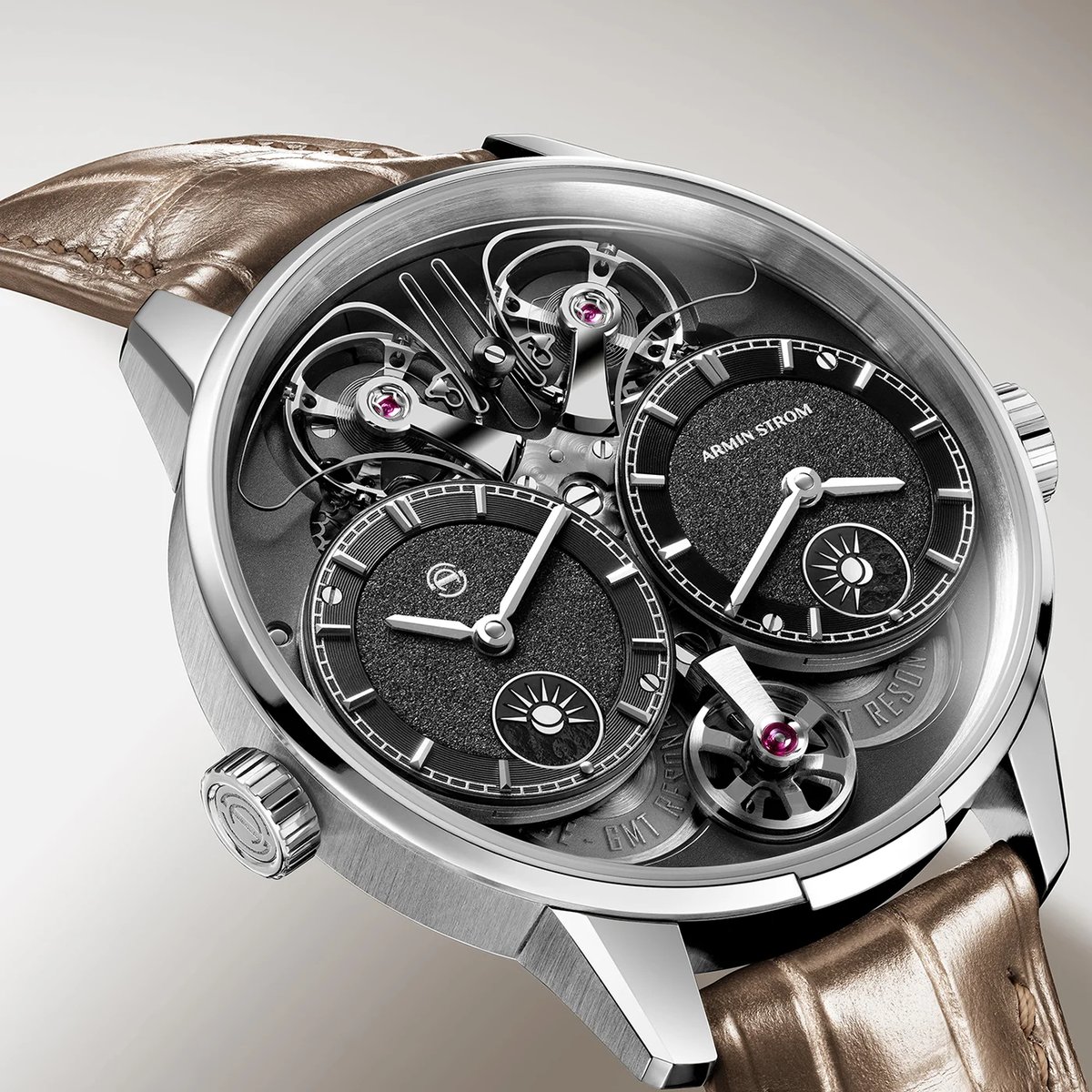
The architecture is the star. Two independent balances are linked by a resonance clutch spring. Each balance has its own escapement and its own gear train, and each drives one of the two time displays. The left dial shows local time, while the right dial shows home time. A GMT function means the second time zone is displayed in a 24-hour format, so you can tell day from night at a glance. There are also day/night indicators, which make the watch genuinely useful for travellers rather than just decorative.
Finishing is exemplary. The bridges are hand-frosted, the screws are polished, and the openworked dial reveals the movement without turning it into a messy skeleton. Armin Strom does not chase COSC certification, but the resonance system is designed for stability. In practice, a well-regulated ARF21 should run within a few seconds per day, and the resonance effect helps keep it there even as the power reserve drops.
Case, Dial, and Strap
The case is stainless steel, which is a deliberate choice. At this price point, many brands would default to gold or platinum, but stainless steel keeps the watch more wearable and more under the radar. It also puts the focus on the movement and the dial. The crystal is sapphire, front and back, so you can enjoy the resonance mechanism from both sides. There is no lume, which is fine for a dressy travel watch, but it does mean this is not a night-time tool.
The dial is a two-register layout. Each sub-dial has its own hour and minute hands, and the GMT and day/night indications are integrated cleanly. Legibility is good in daylight, though the small hands and busy background can be a challenge in low light. The strap is leather, and the clasp is a pin buckle. That might seem old-fashioned at this price, but it keeps the watch light on the wrist and avoids the bulk of a deployant. The alligator leather is supple from day one and suits the formal side of the watch.
Wearing It: A Week on the Wrist
On the wrist, the Dual Time GMT Resonance feels substantial but not heavy. The absence of a rotor means the weight is concentrated in the case and movement, and the watch sits flat against the wrist. The pin buckle allows for fine adjustment, which is important because the leather strap will stretch slightly over the first few days. I found it comfortable enough for full days at a desk, and it slipped under a shirt cuff without drama.
The two dials take some getting used to. You have to decide which time zone goes where, and setting the watch is a ritual rather than a quick grab-and-go. The crown is used to wind and set the local time, while a corrector or second crown handles the home time and GMT. Armin Strom does not hide the complexity, and that is part of the charm. If you want a watch that you can set once and forget, this is not it. If you enjoy the interaction, it is deeply satisfying.
Comfort is excellent overall, but the watch is not invisible. It has a strong presence, and the openworked dial attracts comments. The stainless steel case is finished with a mix of brushing and polishing, and it picks up light in a way that makes the watch feel more expensive than its material might suggest. The strap is comfortable, but I would consider a second strap in a more casual leather or rubber for summer. Armin Strom does not publish a lug-to-lug measurement for this reference in every channel, so trying it on before buying is essential.
Accuracy and Daily Use
Accuracy is where the resonance concept earns its keep. Two balances in resonance tend to stabilise each other, so the watch is less affected by positional variation than a single-balance movement. In daily wear, I would expect it to run within a few seconds per day, and it should hold that rate even when the power reserve is low. That is not a guarantee, but it is the promise of the architecture.
The 110-hour power reserve is a practical advantage. You can wind it on Monday morning and it will still be running on Friday evening. The manual winding action is smooth, and the crown is easy to grip. The GMT function is simple to use once you understand the layout: the right dial is home time, the left dial is local time, and the 24-hour indication tells you whether it is day or night at home. For a frequent traveller, that is more useful than a date window.
Water resistance is not the point here. This is not a sports watch, and you should treat it accordingly. Keep it away from the pool and the shower. The sapphire crystal is scratch-resistant, but the leather strap is not. If you want a daily wearer that can handle everything, look elsewhere. If you want a daily wearer that handles everything except water and impact, this works.
Occasions and Wrist Presence
This is a watch for formal occasions, dressy dinners, travel, and daily wear in an office environment. It is not a sports watch, and it is not a beach watch. It is a thinking person's travel watch. The two dials and the exposed movement give it a wrist presence that is hard to ignore. On a scale of 1 to 5, I would give it a 5/5. It is a conversation starter, and it looks like nothing else in the room.
That presence cuts both ways. If you want to fly under the radar, this is not the watch. If you want to signal that you know independent horology, it is perfect. The stainless steel case keeps it from being too flashy, but the movement and dial are pure theatre. It is the kind of watch that makes other collectors ask questions, and that is exactly what Armin Strom is going for.
Reference Variants, Family, and Alternatives
The reference ST25-DT.90 is the stainless steel, black-dial version limited to 25 pieces. Armin Strom has produced other Dual Time GMT Resonance variants in precious metals, but the stainless steel model is the most wearable and the most understated. Within the Armin Strom family, the closest siblings are the Dual Time Resonance, the Mirrored Force Resonance, and the Pure Resonance. Each explores resonance in a different way, but the Dual Time GMT Resonance is the most practical for travel.
Other notable Armin Strom models include the Gravity Equal Force, the Mirrored Force Resonance, the Tourbillon Skeleton, and the Pure Resonance. If you like the brand but want something simpler, the Gravity Equal Force is a good starting point. If you want maximum resonance drama, the Mirrored Force Resonance is the one.
Similar watches from other brands include the F.P. Journe Chronomètre à Résonance, which is the original modern resonance watch and a direct rival in spirit. The A. Lange & Söhne Lange 1 Time Zone is a German dual-time dress watch with impeccable finishing, though it lacks resonance. The Vacheron Constantin Overseas Dual Time is a more sporty alternative from a major maison. None of them offer exactly what Armin Strom does, which is why the brand has a cult following.
If you want a budget homage, there is no direct one. The closest you can get in spirit is a Pagani Design PD-1662 GMT, which offers a dual-time display for around $250. It will not have resonance, finishing, or independent manufacture, but it will tell you the time in two zones. That is the difference between a tool and a piece of horological art.
Investment Value and Service
The Armin Strom Dual Time GMT Resonance ST25-DT.90 has a retail price in the range of $115,000 to $125,000. That is a serious sum for a stainless steel watch, but it is in line with other independent resonance watches. The limited production of 25 pieces helps support value, and the technical significance of the movement makes it a watch that collectors remember. Pre-owned prices have been stable, typically in the $90,000 to $110,000 range. There is no major auction history yet, but that is not unusual for a modern independent.
My hold recommendation is simple: buy it because you love it, not because you expect to flip it. Limited editions from independent brands can appreciate, but they can also sit on the secondary market if the brand falls out of fashion. Armin Strom has a strong following and a real manufacturing story, so the long-term outlook is positive. Just do not treat it as a savings account.
Service is a consideration. Armin Strom recommends servicing through its manufacture in Biel/Bienne, and authorized-only service is the safe route. The movement is complex, and independent watchmakers may not have the tools or parts to work on a resonance mechanism. The service interval is not published in a way that we can confirm for this reference, but expect it to be a multi-year commitment. The cost will be significant, as it is for any high-complication independent watch.
Pros and Cons
Pros:
- Genuine resonance movement with two balances and a GMT function.
- Excellent hand-finishing and independent manufacture.
- Limited to 25 pieces, making it rare and collectible.
- 110-hour power reserve and comfortable manual-winding action.
- Stainless steel case keeps it wearable and understated.
Cons:
- No lume and limited water resistance make it a fair-weather watch.
- Service requires factory return and will be expensive.
- Very expensive for a stainless steel watch.
- Two-dial layout takes time to read and set.
- Pin buckle may feel basic at this price.
Final Verdict
The Armin Strom Dual Time GMT Resonance ST25-DT.90 is a thinking collector's travel watch. It pairs two time zones with two balances linked by resonance, and it does so with a level of finishing that rewards close inspection. It is not for everyone: it is complex, expensive, and not particularly practical for swimming or sports. But for the right wrist, it is a daily-wear independent with real soul. If you have the means and the curiosity, it is one of the most interesting watches you can put on your wrist.