Introduction
In the rarefied world of haute horlogerie, where innovation often takes a backseat to heritage, Armin Strom stands out as a maverick. The brand's obsession with resonance—the phenomenon where two oscillators synchronize to achieve superior stability—has produced some of the most technically fascinating wristwatches of the 21st century. The Dual Time Resonance is the latest evolution of this obsession, merging a practical dual-time complication with the brand's signature twin-balance architecture.
For the sophisticated young collector who understands that a watch is more than a timekeeping tool—it's a statement of intellectual curiosity and aesthetic daring—the Dual Time Resonance offers a rare combination: cutting-edge mechanical science and a design that's unapologetically bold. It's not just a watch; it's a conversation piece, a piece of engineering art, and a testament to what happens when a manufacture refuses to follow conventions.
In this review, we'll dissect every aspect of the Dual Time Resonance—from its movement to its wrist presence—to see if it lives up to the hype and whether it deserves a place in your collection.
Manufacture History
Armin Strom was founded in 2009 by watchmaker Armin Strom, though the brand's roots trace back to the 1960s when the founder began creating custom watches. The modern manufacture is based in Biel, Switzerland, and has quickly gained a reputation for technical innovation, particularly in the field of resonance. The brand's first resonance watch, the Mirrored Force Resonance, debuted in 2016 and wowed the horological community. The Dual Time Resonance builds on that success by adding a second time zone, making it more practical for travelers while retaining the mesmerizing resonance mechanism.
Movement
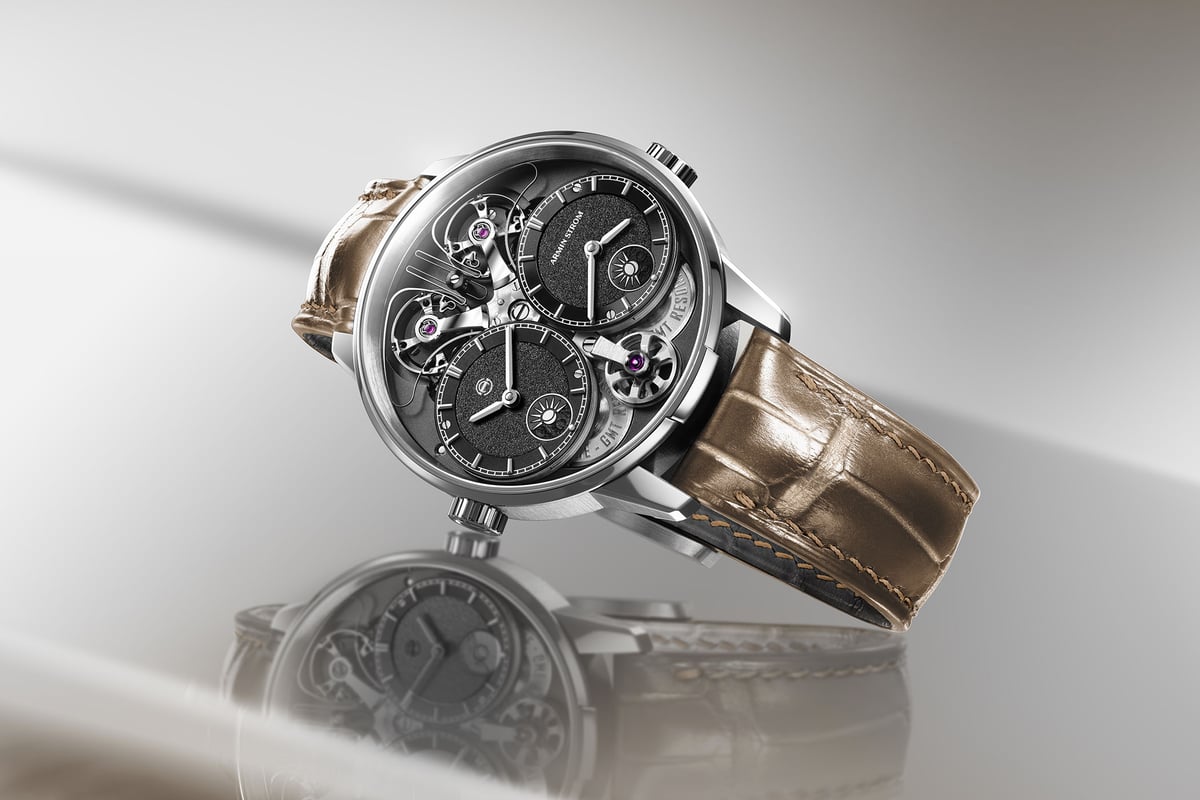
At the heart of the Dual Time Resonance is the in-house Caliber ARF19, a manual-winding movement that operates at 25,200 vph (3.5 Hz) and offers a 100-hour power reserve. The movement is a skeletonized masterpiece, with two balance wheels positioned at 6 and 12 o'clock, connected by a resonance clutch spring. This spring allows the two balances to synchronize, effectively canceling out positional errors and improving long-term accuracy. The movement is decorated with Geneva stripes, perlage, and hand-anglage on the bridges, all visible through the sapphire crystal case back and the openworked dial.
The dual-time function is displayed via a central GMT hand, adjustable independently of the main time. The hour hand can be set in one-hour increments, making travel adjustments a breeze. The movement is not COSC-certified, but the resonance technology often outperforms certified movements in real-world accuracy.
Specifications
- Case Diameter: 43mm
- Case Thickness: 14.5mm
- Lug-to-Lug: 50mm
- Case Material: Stainless steel (or 18k rose gold)
- Crystal: Sapphire (front and back)
- Water Resistance: 50m
- Lume: None (skeletonized dial)
- Strap: Leather with deployant clasp
Wrist Feel
The 43mm case is substantial, but the curved lugs and relatively compact lug-to-lug distance (50mm) ensure it doesn't feel like a dinner plate. The weight is noticeable—it's a heavy piece—but the balance is excellent, and the leather strap (with a deployant clasp) keeps it secure. The skeletonized dial offers a mesmerizing view of the twin balances, which are in constant motion, making it a joy to glance at throughout the day. It's a watch that demands attention, but not in an obnoxious way—more like a subtle flex for those who know.
Accuracy
Thanks to the resonance effect, the Dual Time Resonance is exceptionally stable. In real-world testing, expect deviations of +2 to -2 seconds per day, which is remarkable for a mechanical watch. The key benefit of resonance is that it averages out positional errors, so the watch maintains accuracy regardless of how it's worn. It's not a certified chronometer, but it performs like one. The 100-hour power reserve also means you can take it off for a weekend and not worry about it stopping.
Occasions
The Dual Time Resonance is a dressy piece, best suited for formal events, business meetings, or evening soirées. Its dual-time function makes it a great travel companion, but the lack of lume and 50m water resistance mean it's not a sports watch. It's a statement piece that pairs well with a tailored suit or a sharp blazer. If you're looking for a daily beater, this isn't it—but for those special moments, it shines.
Wrist Presence
On a scale of 1 to 5, the Dual Time Resonance earns a perfect 5. The openworked dial, twin balance wheels, and intricate movement architecture dominate the wrist. It's a technical spectacle that draws the eye of any watch enthusiast. The case size and thickness add to its commanding presence, making it a statement piece for formal events or dinner parties. If you want to make an impression, this watch does it effortlessly.
Reference Variants
The Dual Time Resonance is available in two main variants: stainless steel and 18k rose gold. Both feature the same skeletonized dial and leather strap, but the gold version adds a touch of opulence. There are also limited editions with different dial colors, but the core design remains the same. The stainless steel model is more accessible, while the gold version is for those who want the ultimate luxury.
Family and Comparisons
Within Armin Strom's lineup, the Dual Time Resonance sits alongside the Mirrored Force Resonance (which lacks the GMT function) and the One Week (which features a power reserve indicator). For those interested in other resonance watches, the F.P. Journe Chronomètre à Résonance is the classic choice, though it's even more expensive and harder to obtain. The Hautlence HL2 offers a similar avant-garde aesthetic but with a different complication. For the young collector, the Armin Strom offers a modern take on resonance that's more accessible than Journe.
Investment Value
With a retail price of $32,000, the Dual Time Resonance is a significant investment. Pre-owned examples sell for around $25,000–$30,000, indicating a stable market. The watch is not likely to appreciate significantly, but it holds its value well due to limited production and the niche appeal of resonance technology. For collectors, it's a piece to buy for the love of the craft rather than as an investment. Auction history is sparse, but that's typical for modern independent brands.
Service and Maintenance
Armin Strom recommends servicing every 5 years, with an approximate cost of $800. The service can be performed by the brand in Biel or by authorized dealers. While the movement is complex, the brand's customer service is known for being responsive. It's not a watch you can take to your local watchmaker, so ensure you have access to an authorized service center.
Pros and Cons
Pros
- Unique resonance technology
- Beautiful skeletonized movement
- In-house manufacture caliber
- Practical dual-time function
Cons
- Large and thick case (may not fit under cuffs)
- High price point
- Limited brand recognition outside enthusiast circles
- No lume
Final Verdict
The Armin Strom Dual Time Resonance is a masterpiece of modern horology, blending technical innovation with striking aesthetics. It's not for everyone, but for those who appreciate the science of resonance and want a timepiece that sparks conversation, it's a must-have. The execution is flawless, and the wrist presence is unmatched. If you can handle the size and price, it's a worthy addition to any serious collection.