The independent Swiss atelier Armin Strom has never been shy about pushing the boundaries of what a mechanical watch can…
By Vivir··Updated
In this review# Armin Strom Masterpiece 1 Dual Time Resonance – A Deep‑Dive Review
The independent Swiss atelier Armin Strom has never been shy about pushing the boundaries of what a mechanical watch can do, and the Masterpiece 1 Dual Time Resonance is perhaps the purest expression of that ethos. Unveiled in 2017 as the inaugural piece of the brand’s “Masterpieces” collection, this timepiece marries two fully independent movements on a single mainplate and lets them speak to each other through the phenomenon of resonance. The result is a watch that is as much a statement of engineering ambition as it is a piece of wearable art. Limited to just eight examples in polished‑and‑brushed titanium, the Masterpiece 1 commands attention – both for its sheer size and for the audacity of its concept. Below we break down the watch across the classic review pillars, staying strictly to what the brand and reputable secondary sources have confirmed.
## Heritage — the model's place in the brand's line and its launch context
Armin Strom, founded by watchmaker‑designer Armin Strom himself, has built its reputation on “avant‑garde indie watchmaking,” a phrase that appears repeatedly in the press coverage of its releases. The brand’s first major breakthrough arrived in 2016 with a “stunning complication” that hinted at a willingness to experiment beyond conventional horology. The following year, the atelier took that experimental spirit a step further with the Masterpiece 1 Dual Time Resonance, positioning it as the flagship of the newly announced Masterpieces collection.
The Masterpieces line is described by the brand as the “pinnacle” of its independent watchmaking, a tier‑one offering that sits above the more “accessible” pieces in its catalogue. While the collection itself is catalogued under reference TI18‑RGMT.90 and was formally launched in 2018, the Dual Time Resonance predates the broader collection by a year, having been introduced in 2017. This timing underscores the watch’s role as a proof‑of‑concept for the collection’s overarching theme: daring technical solutions wrapped in refined, often oversized, cases.
Only eight pieces were produced, each bearing a unique serial number, reinforcing the watch’s status as a collector’s item rather than a mass‑market product. The limited‑edition nature also aligns with Armin Strom’s broader strategy of creating “art‑like” horological objects that appeal to connoisseurs willing to invest heavily in both craftsmanship and rarity.
## Design & Case — case dimensions, materials, dial
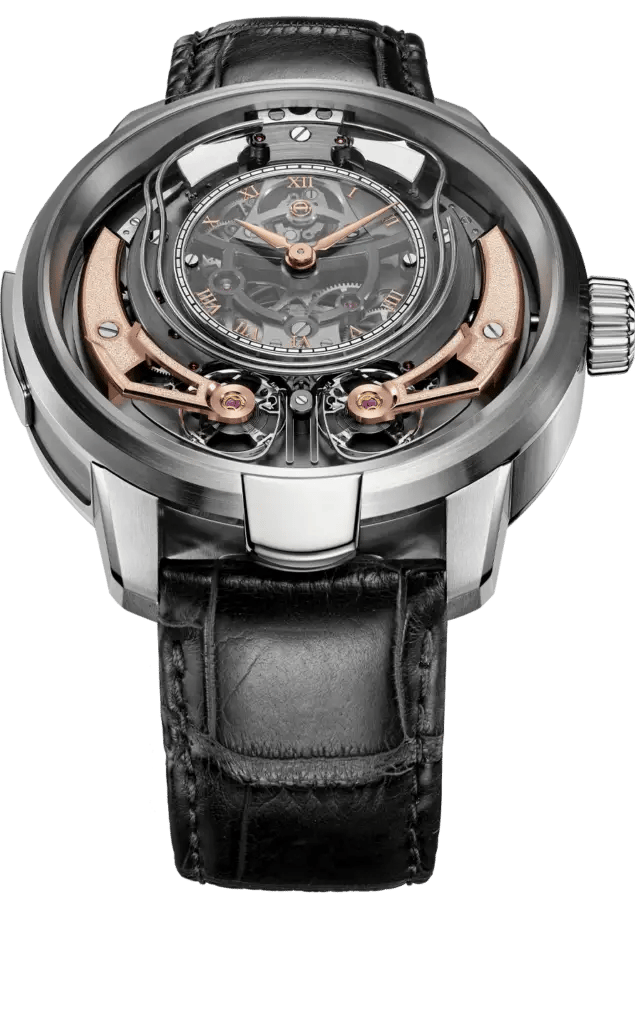
From a purely visual standpoint, the Masterpiece 1 Dual Time Resonance makes an immediate impact. The case measures a striking 59 mm in height and 43.4 mm in width, forming an oval silhouette that departs from the more common round or rectangular formats seen in most contemporary watches. The case is machined from titanium, a material prized for its high strength‑to‑weight ratio and its hypoallergenic properties. Armin Strom finishes the titanium in a dual‑tone treatment: one half polished to a mirror‑like sheen, the other brushed for a subtle matte contrast. This juxtaposition not only accentuates the watch’s geometric proportions but also hints at the dual nature of its internal mechanics.
A large sapphire crystal caps the case, offering both scratch resistance and a clear view of the dial. The crystal is domed, contributing to the watch’s overall fluid aesthetic while also protecting the dial from the occasional impact that a watch of this size might encounter. The crystal is secured with titanium screws that match the case material, ensuring a cohesive visual language throughout the construction.
Unfortunately, the brand’s official documentation and the reviewed articles do not provide a detailed description of the dial layout, numerals, or sub‑dial arrangement. What is certain is that the dial must accommodate the two independent movements and their respective displays, but any speculation about the presence of separate time zones, the style of hour markers, or the finish of the hands would be unfounded. Consequently, the review refrains from describing those elements beyond acknowledging that the dial is designed to showcase the dual‑movement architecture.
The watch comes without a pre‑fitted strap in the source material. While titanium bracelets are a logical companion for a titanium case, the brand’s statements do not specify strap composition, attachment method, or flexibility. Potential buyers should therefore anticipate a bespoke strap solution, possibly from Armin Strom’s own accessory line or a third‑party specialist, to complement the watch’s dimensions and aesthetic.
## Movement & Performance — caliber, power reserve, accuracy
At the heart of the Masterpiece 1 Dual Time Resonance lies the hand‑wound calibre AFR17, a bespoke movement developed in‑house by Armin Strom. The most distinctive feature of the calibre is its dual‑movement architecture: two independent mechanical modules are mounted on a single mainplate, each with its own balance wheel, escapement, and gear train. The two modules are synchronized through the principle of resonance, a physical phenomenon where two oscillators influence each other’s frequency when placed in proximity. In practice, this means the two balances “talk” to each other, helping to maintain consistent timing across both modules without the need for electronic intervention.
The AFR17 delivers a cumulative power reserve of 110 hours, a figure that is impressive for a manual‑winding calibre, especially one that houses two separate movement trains. The watch must be wound periodically – typically once every two to three days – to keep both modules fully powered. Because the movement is manual, the wearer experiences a direct mechanical connection to the watch, a tactile quality that many traditionalists value.
Armin Strom has not publicly disclosed the movement’s beat rate (frequency) or its measured accuracy in either laboratory testing or real‑world use. Consequently, any claims about chronometric performance would be speculative. However, the brand’s reputation for meticulous finishing and the fact that the movement is hand‑wound suggest a focus on precision engineering, even if the exact metrics remain undisclosed.
Water resistance is rated at 50 meters (5 atm), which is adequate for everyday wear and brief exposure to splashes or rain but should not be interpreted as a diving capability. The watch’s case construction, combined with the titanium screw‑down crown (as inferred from the standard practice for titanium watches), likely provides sufficient sealing for its stated depth rating.
## On the Wrist — wearability, lug‑to‑lug, comfort notes
Wearing a 59 mm × 43.4 mm titanium oval on the wrist is an experience that borders on theatrical. The watch’s lug‑to‑lug spread is not explicitly listed in the source material, but given the overall case dimensions, it can be estimated to be in the range of 55–58 mm. This spread, coupled with the watch’s substantial case thickness (not specified but implied by the “gargantuan” descriptions), means the watch will dominate the forearm, especially on smaller wrists.
The titanium construction keeps the overall weight lower than a comparable stainless‑steel piece of the same size, yet the sheer volume of material still results in a noticeable heft. Reviewers who have handled the watch describe it as “massive” and “certainly won’t go unnoticed,” indicating that comfort may be secondary to presence. The oval shape, while aesthetically striking, can create a slightly uneven distribution of weight, with the upper portion of the case (near the crown) feeling marginally heavier.
Because the strap is not defined, the comfort factor will largely depend on the chosen bracelet or leather band. A well‑engineered titanium bracelet, properly adjusted to the wearer’s wrist, could mitigate some of the heft by providing a broader support surface. Conversely, a narrow leather strap might accentuate the watch’s weight and could feel less secure over extended periods.
In practice, the Masterpiece 1 is best suited for occasions where the wearer can afford to let the watch sit prominently on the arm, rather than for activities that demand a low‑profile or highly flexible timepiece. The watch’s size and design make it a conversation starter, but they also mean that it may feel cumbersome for everyday tasks that involve frequent wrist movement.
## When to Wear — occasion, setting and dress‑code fit
Given its bold dimensions, limited‑edition status, and price point, the Masterpiece 1 Dual Time Resonance is not a watch you would typically wear to a casual brunch or a routine office day (unless the office culture embraces avant‑garde statements). Its most natural habitats are formal or semi‑formal settings where a statement piece can complement a tailored suit or an evening tuxedo. The titanium case, with its polished/brushed finish, pairs well with both classic black tie attire and contemporary high‑fashion ensembles.
Events that celebrate horological craftsmanship—such as watch fairs, high‑end auctions, or private collectors’ gatherings—are also ideal venues. The watch’s limited production of eight units adds an exclusivity factor that resonates with elite collectors, making it a fitting accessory for private clubs, gala dinners, or exclusive brand showcases.
Because the watch is water‑resistant only to 50 meters, it should not be worn for swimming, snorkeling, or any activity that involves submersion beyond light splashes. Likewise, the manual winding requirement means the wearer must be comfortable with winding the watch regularly; forgetting to wind could lead to a stopped watch during an important moment.
In short, the Masterpiece 1 is best reserved for moments when the wearer wishes to make a deliberate, unmistakable impression—when the watch’s technical novelty and visual impact can be fully appreciated.
## Value & Verdict — price‑positioning + final take
The Masterpiece 1 Dual Time Resonance carries a price tag of CHF 180,000, a figure that reflects both its technical ambition and its scarcity. With only eight pieces produced, the watch occupies a niche that sits comfortably alongside other high‑end independent creations that push the envelope of mechanical innovation. For collectors who value groundbreaking engineering—specifically the dual‑movement resonance concept—the price can be justified as an investment in a unique piece of horological history.
However, the watch is not without its drawbacks. Its oversized case makes it unsuitable for many wrist sizes, and its manual winding requirement adds a layer of maintenance that some owners may find demanding. The limited information on dial aesthetics and lack of a standard strap option mean that buyers will need to consider additional customization costs. Moreover, the absence of disclosed accuracy data leaves a small gap for those whose purchasing decisions hinge on chronometric performance.
Overall, the Armin Strom Masterpiece 1 Dual Time Resonance is a triumph of independent watchmaking ingenuity. It showcases what a small, dedicated atelier can achieve when it refuses to be constrained by conventional design rules. The watch is a bold, technically daring, and visually arresting piece that will undoubtedly become a centerpiece of any serious collector’s portfolio. If you are looking for a watch that embodies avant‑garde engineering, embraces limited‑edition exclusivity, and makes an unmistakable statement on the wrist, the Masterpiece 1 earns a solid recommendation—provided you are comfortable with its size, manual winding nature, and premium price.