Brand context: Biel/Bienne and the resonance thesis
Armin Strom is a Swiss independent with a layered history. The name goes back to watchmaker Armin Strom and his workshop, which dates to 1967. The modern company was established in Biel/Bienne in 2008, and it has spent the years since building a reputation for skeletonized movements, unusual architecture, and a stubborn interest in resonance. That focus matters here. The Mirrored Force Resonance is not a one-off showpiece; it is the brand's core technical statement.
Biel/Bienne is often described as the quiet engine room of Swiss watchmaking. It is a place where movement makers, case specialists, and finishing workshops sit close together. Armin Strom uses that ecosystem while keeping movement design and assembly in-house. The result is a brand that feels more like a small manufacture than a marketing label. The Mirrored Force Resonance Zeitgeist carries that identity on the dial, where the movement is the dial.
The movement: twin balances, one conversation
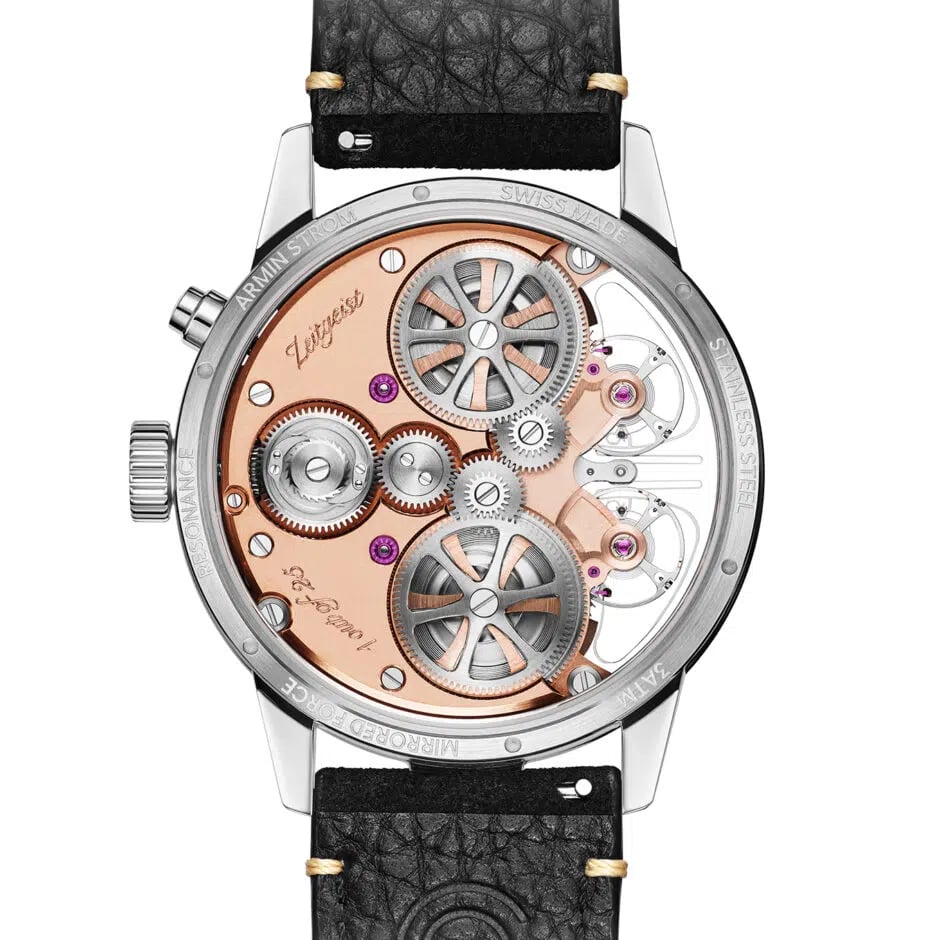
The heart of the watch is the Calibre ARF15, a manual-winding movement built around two independent going trains. Each train has its own balance wheel and hairspring. A resonance clutch spring links the two oscillators, allowing them to influence each other and settle into a shared rhythm. This is the mechanical version of two clocks on the same wall eventually agreeing on time. Armin Strom did not invent resonance, but the brand has made it a signature, and the Mirrored Force Resonance is the cleanest demonstration of the idea.
The movement runs at 25,200 vibrations per hour and carries a 48-hour power reserve. It has 43 jewels. Those numbers are not outrageous by modern standards, but the architecture is the point. The twin gear trains are mirrored, the bridges are openworked, and the finishing is done to a standard that rewards close inspection. You can see the balance wheels working, the spring breathing, and the two seconds displays ticking through their mirrored routines. The watch is not COSC certified, and that is fine. Resonance is about stability and mechanical harmony, not a certificate on a card.
The manual-winding format is part of the ritual. You wind it, you set it, you watch the two regulators find their rhythm. It is not a grab-and-go watch, but it is not meant to be. The absence of a date keeps the dial clean and the movement focused. The complication list is short on paper: hours, minutes, small seconds, and resonance. On the wrist, that short list feels like more than enough.
Case, dial, and specifications
The Zeitgeist uses a stainless steel case measuring 43.4mm across and 12.65mm thick. It is a substantial watch, but not a cartoonish one. The case has the kind of mixed finishing that independent collectors expect: brushed surfaces, polished bevels, and a profile that looks carved rather than stamped. Water resistance is 50 meters, which is enough for daily life and not enough for a swimming session. The crystal is sapphire, and there is no lume. This is a watch for interiors, not for night dives.
The dial is openworked, with the twin balance wheels and mirrored gear trains doing the visual work. The Zeitgeist edition adds its own limited-edition finish to the platform, but the core layout remains the same: a highly architectural face with small seconds displays and a clear view into the resonance system. The hands are legible against the open background, though this is not a watch for someone who wants maximum contrast and instant reading. It is a watch for someone who likes to look at their wrist and see a mechanism at work.
The strap is leather, and the clasp is a pin buckle. That combination keeps the watch from feeling overly technical on the wrist. A bracelet would change the character entirely. The leather strap lets the case stand out and keeps the package dressier than a sports watch. The 50-meter water resistance and lack of lume tell you what kind of object this is. It is high horology with a daily-wear attitude, not a tool watch with a fancy movement.
On the wrist
At 43.4mm wide and 12.65mm thick, the Mirrored Force Resonance Zeitgeist sits with real presence. The case is not thin, but it is also not slab-like. The lugs curve down toward the wrist, and the strap integrates cleanly with the case. On a medium wrist, it feels like a statement piece without crossing into oversized territory. On a smaller wrist, it will wear large. That is not a flaw; it is the nature of a watch built around a visible movement and a pair of balance wheels.
The weight is balanced, and the manual-winding crown is easy to reach. The openworked dial means light plays across the movement in different ways depending on the angle. In a meeting, it looks like a piece of engineering. In low light, it becomes a dark, sculptural object with flashes of polished steel. The lack of lume is noticeable at night, but this is not a watch you buy for a camping trip. It is comfortable enough for a full day at a desk and special enough for an evening out. The leather strap helps the watch settle quickly, and the pin buckle is simple and secure.
Accuracy and daily behavior
The Calibre ARF15 is not COSC certified, so do not expect chronometer paperwork. In real-world use, a well-regulated example should hold a steady rate, and the resonance system is designed to support consistency between the two oscillators. Owners should expect a small daily variance and should not treat this watch like a quartz reference. The bigger point is stability. The twin balances are meant to influence each other, and that shows up in how the watch behaves over time rather than in a single day's number.
The manual-winding routine is part of ownership. You will wind it regularly, and you will likely enjoy it. The 48-hour power reserve gives you a buffer for a day off the wrist, but this is not a watch you leave in a drawer for a week and then grab on the way out. It rewards attention. The absence of a date is a deliberate choice, and it keeps the dial and the movement visually coherent. If you need a date, this is not the watch for you. If you want a clean, mechanical object with a visible heartbeat, it is exactly right.
Collecting case: variants, alternatives, and value
The Mirrored Force Resonance family includes the First Edition, which introduced the twin-balance resonance platform, and the Manufacture Edition, which continued the concept with the brand's evolving finishing language. The Zeitgeist is the limited-edition variant in this review, and it makes sense for collectors who want the resonance architecture with a more specific visual identity. These are not mass-produced watches. They are built in small numbers, and that scarcity is part of the appeal.
If you are shopping the category, the obvious benchmark is the F.P. Journe Chronomètre à Résonance. It is the reference point for modern resonance watchmaking, and it carries a very different dial language and a much larger collector base. The Greubel Forsey Double Balancier Convexe is another high-horology twin-balance study, tilted and architectural in a way that feels more aggressive. The De Bethune DB28 is a different flavor of independent watchmaking, but it appeals to the same collector who wants an openworked, futuristic object with a serious movement. None of these watches are direct substitutes. They are different arguments for why independent watchmaking matters.
There are no direct homages worth your time. The resonance mechanism is not the kind of thing that translates well to a cheap copy, and the finishing standard is a major part of the experience. If you see a low-cost watch claiming resonance, look closely at what is actually oscillating. The Mirrored Force Resonance Zeitgeist is not a logo play. It is a technical object, and that is why it holds a specific place in a collection.
Investment and ownership
Armin Strom is a niche independent, and the Mirrored Force Resonance Zeitgeist trades in a relatively thin market. The watch has a real technical story, limited production, and strong finishing, which supports its value among collectors who know the brand. It is not a liquidity machine like a steel sports Rolex, and it should not be bought as a short-term flip. The better case is a long hold: buy it because you want the resonance system, the independent craftsmanship, and a watch that starts conversations with people who know what they are looking at.
Pricing for the Zeitgeist sits in the high five figures, with pre-owned examples moving through specialist dealers and private sales. Public auction data is limited, and there is no long track record of marquee results for this exact edition. That means condition, box and papers, and provenance matter. A complete set with service history will always be easier to move than a loose watch. The price range is roughly $65,000 to $85,000 depending on condition and completeness, and the trend is stable rather than explosive. The value is in the engineering and the scarcity, not in hype cycles.
Service should go through Armin Strom or an authorized partner. The resonance mechanism is not a standard movement, and independent watchmakers should not be asked to improvise. The watch is a long-term ownership proposition, and that should be part of the budget. If you are the kind of collector who keeps watches for years and enjoys the ritual of winding and setting, this fits. If you want a set-and-forget daily, look elsewhere.
Final verdict
The Armin Strom Mirrored Force Resonance Zeitgeist is a confident, technical, and deeply independent watch. It takes the brand's resonance thesis and puts it in a limited-edition package that feels aimed at collectors rather than casual buyers. The case is wearable, the movement is fascinating, and the dial gives you something new to see every time you look down.
It is not for everyone. It is manual-wind, it has no date, it has no lume, and it costs real money. But for the collector who wants a high-horology object with a genuine mechanical idea at its center, it is a compelling choice. The Zeitgeist is not just a watch about time. It is a watch about how time is kept, and that is a much more interesting conversation.