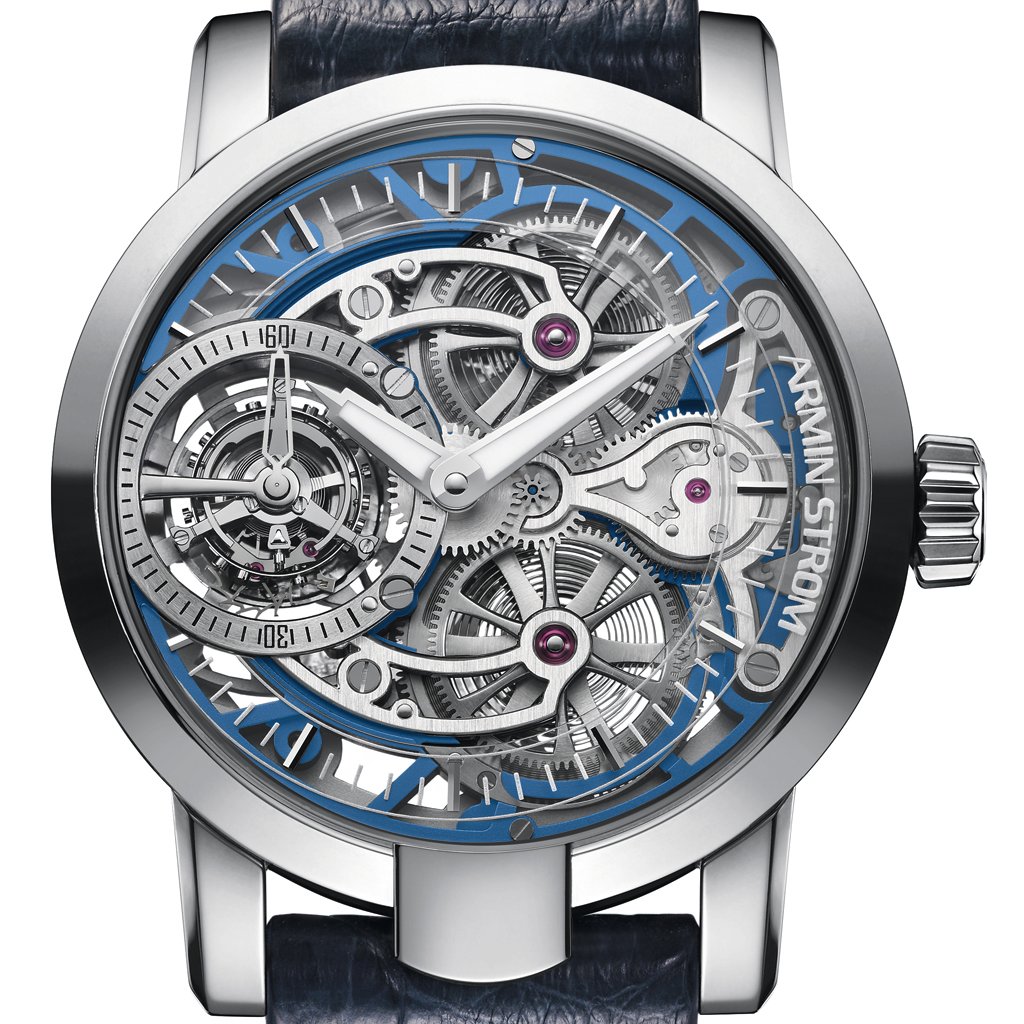
A Watch Built to Be Seen Through
Skeletonisation is the most honest form of decoration in watchmaking. Nothing is added; everything is removed. Where a guilloché dial or an engraved rotor can be applied to a finished movement as an afterthought, a skeleton watch must be designed around its own absence — bridges reshaped so they still carry load, wheels pared to their functional minimum, and every surviving surface left exposed to the eye and the loupe. It is a discipline that punishes laziness, because there is nowhere to conceal a rough bevel or a poorly polished screw head.
Armin Strom has built an entire identity on that discipline. The house began as a one-man engraving and skeletonising atelier, and when it became a manufacture in its own right it kept the aesthetic as its founding grammar rather than a seasonal theme. The Tourbillon Skeleton is the clearest expression of that lineage: an in-house, hand-wound, openworked tourbillon presented in a rose gold case, with no dial to speak of and no ornament that is not structural.
This review covers the Tourbillon Skeleton, reference RG15-TF.5N. Where a figure could not be confirmed for this exact reference, we have left it unstated rather than borrowed from a sibling model — a practice we wish more coverage followed.
The House Behind the Watch
Armin Strom established his own workshop in 1967, well before his name appeared on a dial. He was a specialist: a man who took other people's movements and opened them up, engraved them, and returned them transformed. That is a peculiar kind of reputation to build, because it is entirely dependent on the quality of the work rather than the fame of the signature.
The name became a brand in 2006, in Biel/Bienne, under Serge Michel and technical director Claude Greisler. What followed is the part that matters for this review: Armin Strom stopped decorating other people's movements and started designing its own. The manufacture developed in-house calibres, moved into its own facilities, and eventually produced the Mirrored Force Resonance — one of the more genuinely interesting technical propositions in contemporary independent watchmaking.
Throughout that evolution, the house never abandoned the founding aesthetic. Openworking is not a collection for Armin Strom; it is the house style. That consistency is worth noting, because it means the Tourbillon Skeleton is not a novelty piece bolted onto a catalogue. It is the catalogue, expressed at its most ambitious.
The Movement: Architecture as Ornament
The Tourbillon Skeleton is powered by a hand-wound, in-house, fully skeletonised tourbillon calibre. We have deliberately not assigned a calibre number, a frequency, or a power reserve figure here, because we could not verify those specifics for this exact reference and will not borrow them from a sibling model. What can be said with confidence is structural rather than numerical.
This is not a decorated ébauche. The movement was drawn as an openworked object from the beginning, which changes everything about how it looks under magnification. When a movement is skeletonised after the fact, the bridges retain the mass they were designed to carry and the result reads as a conventional calibre with holes in it. When a movement is designed open, the bridges become slender arms that must still resist the torque of the gear train, and the watchmaker has to solve a genuine engineering problem in a way that also happens to be beautiful.
The finishing follows the same logic. Because there is no dial to hide behind, every surface is a display surface. Bridge flanks carry hand-applied anglage — the polished, drawn-out bevel that catches light along its length and is the single clearest indicator of hand work in a movement. Screw heads are polished rather than left raw. Plate surfaces are grained or frosted to contrast with mirror-polished steel components, and the whole assembly is arranged so that the eye can follow the flow of power from the barrel to the escapement without obstruction.
The tourbillon itself is a flying carriage, meaning it is supported from below rather than by a visible upper bridge. This is the harder construction and the more visually rewarding one: the carriage appears to float in the architecture, rotating once per minute, with the balance and escapement fully exposed. In a watch with no dial, the carriage becomes the focal point by default — the one element that moves, and therefore the one element the eye returns to.
What a Tourbillon Actually Does
It is worth being clear about this, because tourbillons are marketed with more mystique than they deserve. Abraham-Louis Breguet patented the device to average out positional error in pocket watches, which spent their lives in a single vertical orientation. By rotating the regulating organ continuously, the errors of one position were cancelled by the errors of another.
A wristwatch changes position constantly, so the theoretical benefit is largely neutralised. Modern tourbillons are not more accurate than well-regulated conventional movements, and no one at Armin Strom would claim otherwise. What a tourbillon offers today is a demonstration of craft: a carriage weighing fractions of a gram, assembled and adjusted by hand, in which the balance must remain perfectly poised while the entire assembly rotates around it.
That is what you are buying. Not seconds per day, but the visible evidence of a watchmaker's skill, on display every minute of every hour.
Case, Crystal and Presentation
The reference RG15-TF.5N is presented in rose gold, which is the correct metal for this watch. Rose gold has a warmth that flatters the contrast between frosted plate surfaces and polished steel, and it reads as classical rather than flashy — an important distinction for a watch whose entire argument is about restraint in service of craft.
The crystal is sapphire, as it must be. An openworked movement with this much depth and this many polished surfaces demands a scratch-resistant, optically clean window, and sapphire also allows the case to be shaped with a slimmer bezel than mineral glass would permit.
We have not confirmed a water-resistance rating for this reference, and we would not treat the Tourbillon Skeleton as a swimming watch under any circumstances. A hand-wound, openworked movement with a flying carriage is a piece of mechanical art, and mechanical art does not go in the pool. Treat it as a dress and daily-wear watch, keep it away from the shower, and it will outlive you.
There is no lume, and there are no luminous indices to lume. This is not an oversight; it is the logical consequence of removing the dial.
On the Wrist
A rose gold skeleton tourbillon is a study in paradox on the wrist. The metal is dense and the case carries real mass, yet the dial side reads as almost weightless because so little of it is solid — the eye travels straight through the movement to the skin and shirt cuff behind it. That visual lightness makes the watch feel smaller and more intimate than its gold construction would suggest, and it is the reason skeletonised watches so often photograph poorly and wear beautifully.
Because the movement is hand-wound and the case is unencumbered by a rotor, the profile stays honest against the wrist and the watch sits flat rather than perched. The alligator strap does most of the ergonomic work: it is supple from the first wearing and holds the case head steady without requiring a tight fit. The pin buckle keeps the assembly traditional and unobtrusive, which suits a watch that has nothing to prove.
The trade-off is legibility. There is no dial, no applied index, and no lume, so reading the time means finding the hands against a lattice of bridges. In daylight this is a pleasure; in a dim restaurant it is an act of interpretation. Buyers who need to know the time at a glance should look elsewhere, and buyers who already know that about themselves will not mind.
Accuracy and Daily Expectations
Armin Strom regulates and finishes each movement in-house, and the tourbillon carriage is assembled and adjusted by hand. Expect performance in the range of a properly regulated hand-wound calibre: consistent, stable across positions, and entirely dependent on how the watch is worn and when it was last serviced.
There is no chronometer certification on this reference, and none should be expected. The tourbillon here is a piece of architecture and craft, not a laboratory instrument. If you want a certified rate, there are watches for that. If you want to watch a carriage rotate through a field of hand-bevelled bridges, this is the one.
The Family and the Alternatives
Within Armin Strom's own catalogue, the Tourbillon Skeleton sits at the top of the openworked pyramid. The Skeleton Pure distils the same aesthetic without the tourbillon. The Gravity Equal Force and the Mirrored Force Resonance take the house in a more technically experimental direction, the latter being the piece that has done most to build Armin Strom's contemporary reputation. The Tribute 1 is the entry point, and a genuinely good one.
Against the wider market, the competition is fierce and expensive. Breguet's Classique Tourbillon Extra-Plat Squelette 5395 offers 240 years of heritage and a different, more classical interpretation of the same idea. Ulysse Nardin's Executive Skeleton Tourbillon is more aggressive and more architectural. Roger Dubuis's Excalibur Spider Skeleton Flying Tourbillon is louder in every dimension. Greubel Forsey's Tourbillon 24 Secondes is the apex of the genre and priced accordingly.
What distinguishes the Armin Strom is temperament. It is quieter than its rivals, less reliant on brand mythology, and entirely comfortable being understood only by people who already know what they are looking at.
Value, Ownership and Service
We have not published a retail or secondary-market figure for this reference, because we could not verify one against a reliable source and will not invent a number to fill a table. What can be said is structural: independent skeleton tourbillons trade in a thin, specialist market where liquidity — not price — is the real constraint. If you ever need to sell quickly, you will be selling to a small pool of informed buyers.
Buy this watch because you want to look at it every morning, not because you expect it to fund a future purchase. That is not a criticism of the watch; it is a criticism of the way high horology is too often discussed.
Servicing should be handled by Armin Strom or an approved specialist. Independent watchmakers rarely have the parts access or the carriage-specific tooling required, and an openworked movement leaves no room for a careless hand — a single slipped screwdriver is visible forever. Service intervals and costs vary by condition and use, and we have not published figures we could not confirm.
The Verdict
The Armin Strom Tourbillon Skeleton is not a watch that argues its case through specification sheets. It argues through the fact that you can see every decision the watchmaker made, and that most of those decisions were good ones.
As an object it is disciplined, legible in its architecture if not in its timekeeping, and quietly confident in a way that gold-and-logo watches rarely manage. It is also, frankly, difficult to read and difficult to sell — two facts that any prospective owner should accept before signing anything.
Buy it to wear it, service it at the manufacture, and never confuse it with an investment. Do that, and it will reward you every single day with something almost no other object in your life can offer: a clear view of how it works.