The Pursuit of the Perfect Pulse
In the world of mechanical horology, time is not a fluid stream but a series of discrete, energetic events. The challenge for any watchmaker is ensuring that each of these events—each tick of the escapement—receives the exact same amount of energy. In a standard mechanical watch, this is an impossible dream. As the mainspring unwinds, the torque it exerts drops. This drop in torque leads to a decrease in the balance wheel's amplitude, which in turn alters the rate of the watch. This is the fundamental problem of isochronism.
The Arnold & Son Constant Force (Ref. 1FCBJ.E01A.C246J) is a machine designed specifically to conquer this physical limitation. It does so through the inclusion of a remontoire d'égalité—a secondary hairspring located within the gear train that is wound at regular intervals by the mainspring. This spring then discharges a consistent, unvarying amount of energy to the escapement. The result is a movement that maintains a steady heart rate from the moment it is fully wound until the very end of its power reserve.
A Legacy of Marine Precision
To understand the Constant Force, one must understand the history of John Arnold. In the 18th century, the British government offered the 'Longitude Prize' to anyone who could develop a method for determining a ship's longitude at sea. While John Harrison is often credited with the breakthrough, it was John Arnold who refined the marine chronometer into a production-ready instrument. Arnold’s innovations in the detent escapement and helical balance springs laid the groundwork for modern precision timekeeping.
The modern Arnold & Son manufacture, located in La Chaux-de-Fonds, takes this legacy seriously. They do not merely print a name on a dial; they build movements that reflect the architectural and philosophical goals of those early marine chronometers. The Ref. 1FCBJ.E01A.C246J is the culmination of this lineage, bringing the constant force mechanisms once found in massive deck clocks down to the scale of the wrist.
The Architecture of Symmetry: Calibre AS5119
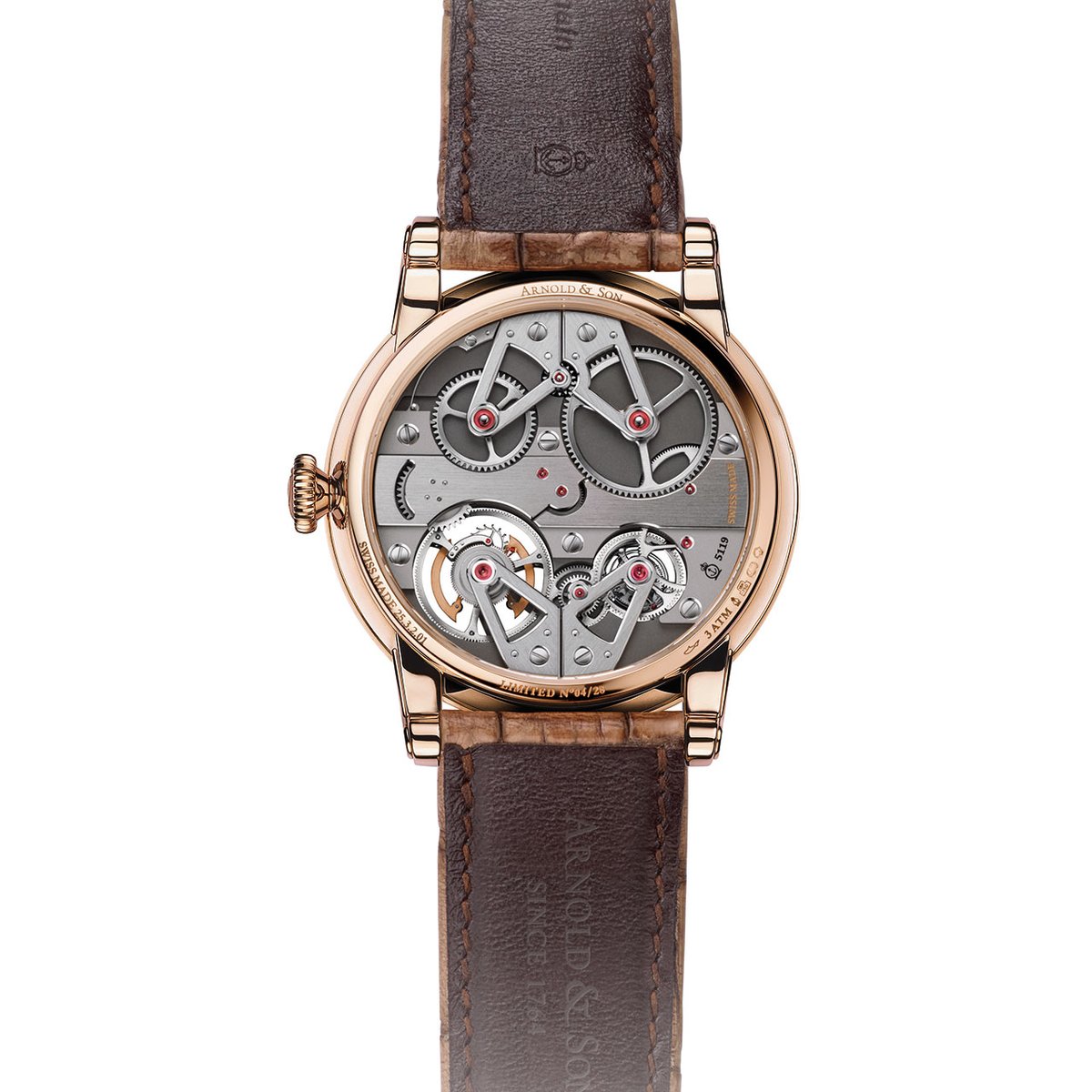
The Calibre AS5119 is a visual feast for the technical purist. Unlike traditional movements that hide their complexity behind a solid dial, the Constant Force is entirely skeletonized, revealing a layout that is obsessively symmetrical. At the top of the movement, two large barrels sit side-by-side. These barrels are connected in series; the first provides the power, while the second ensures a smoother delivery of torque.
At 7 o'clock, the viewer can see the remontoire d'égalité in action. It consists of a small, visible hairspring that is 'armed' once every second. This mechanism serves a dual purpose. First, it provides the constant force to the escapement. Second, it drives the 'True Beat' seconds complication. In a standard mechanical watch, the seconds hand sweeps in small increments (the frequency of the balance). In the Constant Force, the hand jumps precisely once per second, mimicking the movement of a quartz watch or, more accurately, a traditional marine chronometer. This jumping action is the visual proof of the constant force mechanism at work.
The finishing of the AS5119 is exemplary. The bridges are treated with a dark NAC grey coating, providing a sharp contrast against the red gold wheels and the polished steel components. Every edge is hand-chamfered and polished to a mirror finish, a process that requires dozens of hours of manual labor. The use of circular graining on the wheels and 'Côtes de Genève' on the mainplate further emphasizes the high-horology pedigree of the piece.
The Case: 46mm of Red Gold Authority
The choice of 18k red gold for the case material is a deliberate nod to the luxury and warmth of historical chronometers. At 46mm, the case is undeniably large. However, this diameter is a functional requirement. To achieve the level of skeletonization and the symmetrical layout of the double barrels and the remontoire, the movement requires significant real estate. A smaller case would have compromised the visual clarity of the complications.
The case features a stepped bezel and a large, fluted crown that is a joy to operate. Winding the watch is a tactile experience; the resistance of the double barrels is smooth and consistent, and the power reserve indicator at 9 o'clock provides a clear readout of the 90 hours of autonomy. The sapphire crystal is box-domed, allowing light to flood the movement from the sides, which highlights the depth and three-dimensionality of the caliber.
Wrist Feel and Ergonomics
On the wrist, the Arnold & Son Constant Force is a statement piece. It does not disappear under a sleeve, nor should it. The weight of the gold is substantial, giving the watch a 'center of gravity' that makes it feel secure. The hand-stitched alligator strap is of exceptional quality, and the pin buckle—also in 18k red gold—is robust and well-finished.
For the sophisticated young collector, the appeal lies in the watch's transparency. It is a conversation starter not because of a logo, but because of its visible mechanics. When the remontoire fires every second, the movement of the spring is visible to the naked eye. It is horological theatre of the highest order.
The Verdict
The Arnold & Son Constant Force Ref. 1FCBJ.E01A.C246J is a rare bird in the forest of luxury watches. It eschews the common tropes of the industry—it is not a diver, it is not a chronograph, and it does not rely on a celebrity ambassador. Instead, it relies on the purity of its engineering and the strength of its architectural design. For those who value isochronism and the historical significance of the marine chronometer, there are few watches that can compete with the Constant Force. It is a masterclass in stability, a triumph of finishing, and a worthy successor to the name of John Arnold.