The Architecture of Precision
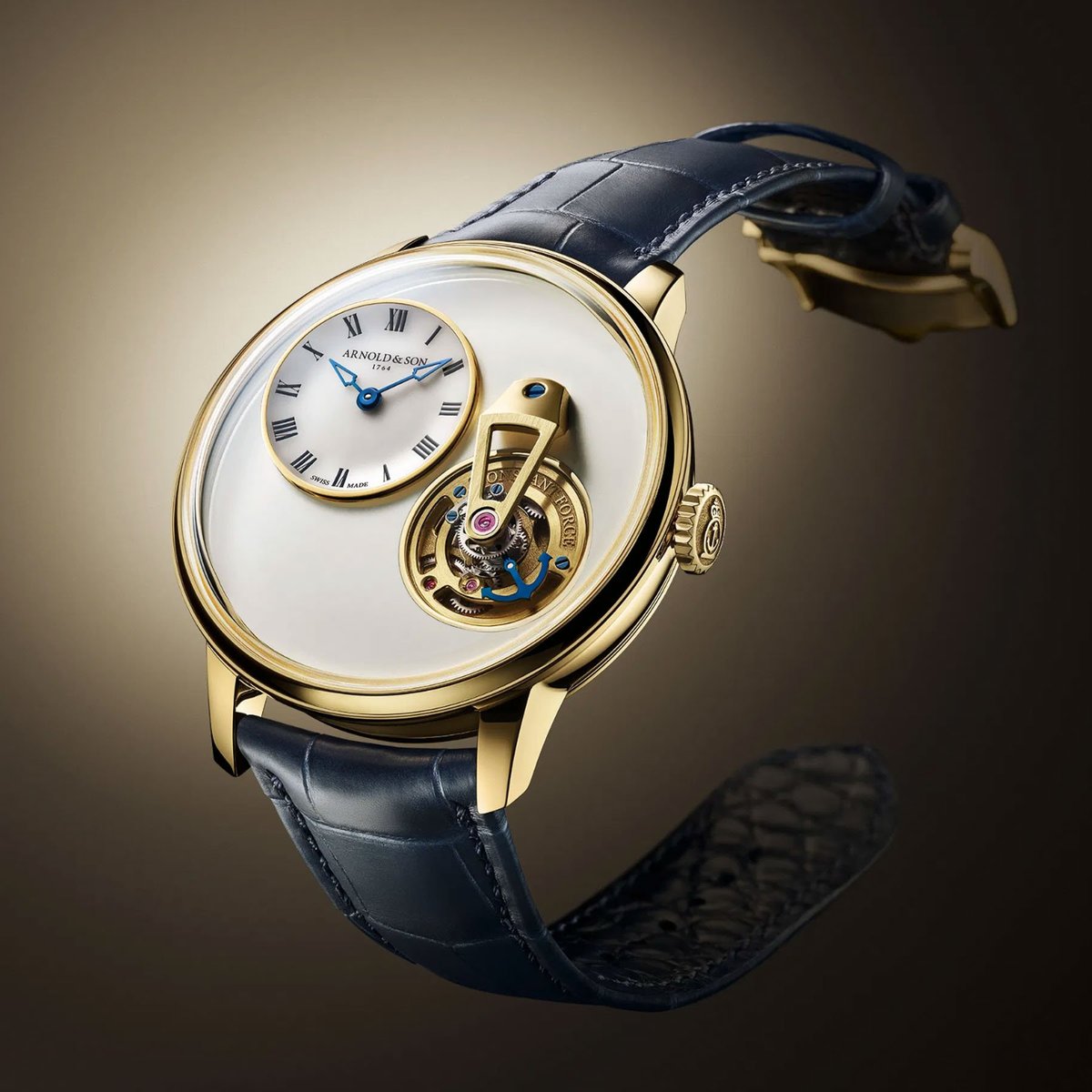
In the world of high horology, symmetry is often the bridge between engineering and art. The Arnold & Son Constant Force Tourbillon (ref. 1FCAR.B01A.C112C) is a structural marvel that places its most vital organs on display with a clinical yet beautiful precision. The dial is dominated by two large openings. At 12 o'clock, we find the constant-force mechanism, and at 6 o'clock, the one-minute tourbillon. This vertical orientation is not merely for show; it is a direct nod to the layout of 18th-century marine chronometers, where legibility and stability were the primary concerns of the navigator.
Living with this watch for a week reveals a fascinating quirk: the dead-beat seconds. Unlike most mechanical watches where the seconds hand sweeps smoothly, the Constant Force Tourbillon ticks once per second. This is the 'True Beat' complication, a hallmark of Arnold & Son. It allows the wearer to read the exact second with the same precision as a quartz watch, but powered by a complex mechanical heart. For the sophisticated collector, this is the ultimate 'if you know, you know' feature.
A Week on the Wrist: The Reality of 46mm
The most common question regarding this reference is the size. At 46mm, it sits firmly in the 'oversized' category for modern dress watches. On my first day of testing, the weight of the 18k red gold was apparent. It is a substantial object, a piece of sculpture that reminds you of its presence every time you move your arm. However, by day three, the ergonomics began to shine. The lugs are short and curved, which prevents the watch from overhanging on a 7-inch wrist. The strap, a matte brown alligator, is thick enough to support the case's weight, preventing the watch from sliding around.
Legibility is surprisingly good for a skeletonized dial. The time is read from a small, lacquered sub-dial at 12 o'clock. While the hands are small, the contrast of the white lacquer against the golden movement plates makes it easy to read at a glance. However, the lack of lume means this is strictly a daylight or well-lit evening companion. On a Thursday evening gala, the watch was in its element, catching the light from every angle as the tourbillon cage rotated—a hypnotic dance that never fails to draw the eye.
The Caliber A&S5119: Under the Hood
The heart of this watch is the Caliber A&S5119. To understand why this movement is special, one must understand the concept of 'isochronism.' In a standard watch, as the mainspring winds down, the force it sends to the escapement decreases, causing the watch to slow down. The constant-force mechanism in the 1FCAR.B01A.C112C acts as a buffer. It stores a small amount of energy in a secondary hairspring and releases it in consistent one-second bursts. This ensures that the tourbillon receives the exact same amount of energy whether the watch is fully wound or has only one hour of power left.
The finishing is exemplary. The bridges are NAC-treated for a dark, contemporary look, providing a stunning contrast to the red gold wheels and the mirror-polished tourbillon cage. Every angle is hand-beveled, and the 'Côtes de Genève' are applied with a depth that suggests many hours of artisan labor. This is a movement that rewards the use of a loupe, revealing a level of detail that justifies the six-figure price tag.
Investment and Collectibility
From an investment standpoint, Arnold & Son occupies a specific niche. Unlike the 'blue chip' brands like Patek Philippe or Rolex, Arnold & Son watches do not typically appreciate in value immediately after purchase. The reference 1FCAR.B01A.C112C is a limited production piece, which helps maintain a floor for its secondary market value. For the young collector, the advice is clear: buy this watch because you love the mechanics, not because you expect a 20% return in two years. It is a piece that marks a milestone in a collection, representing a move into 'independent' horology where the focus is on innovation rather than mass-market appeal.
Final Thoughts
The Arnold & Son Constant Force Tourbillon is not a daily wearer for the faint of heart. It is large, it is expensive, and it is mechanically delicate with its 30m water resistance. Yet, after seven days, I found it difficult to return to my simpler timepieces. There is a profound satisfaction in wearing a watch that solves a 250-year-old engineering problem so elegantly. It is a reminder that in our digital age, there is still room for the purely mechanical pursuit of perfection. For the collector who has the wrist size to pull it off and the eye for technical detail, the 1FCAR.B01A.C112C is a masterpiece that deserves its place in the sun.