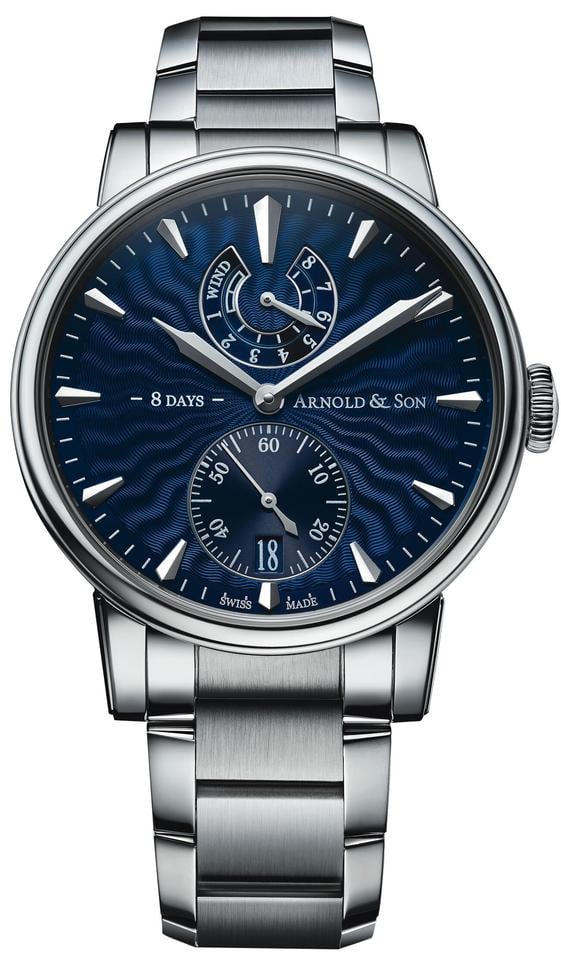
At a time when many luxury watches are chasing thinner cases and louder collaborations, the Royal Navy is refreshingly stubborn. It has a large steel case, a legible dial, a long-power-reserve movement, and no interest in being a smartwatch. It is the kind of watch you buy because you want to wind something every eight days and feel connected to a mechanical object. That is a small audience, but it is a passionate one. It is also the kind of watch that looks better in person than in a press image, because the case finishing and the dial depth need to be seen in motion.
British sea legs, Swiss execution
John Arnold founded his business in 1764 and became famous for precision timepieces, especially marine chronometers. His work was instrumental in making accurate longitude calculation possible at sea. The Arnold & Son name was revived in the modern era and is now part of the Citizen Watch Group, with production based in La Chaux-de-Fonds, Switzerland. That combination of British heritage and Swiss watchmaking is exactly what you get in the Eight-Day Royal Navy: a very English idea of a marine chronometer, executed with Swiss finishing and industrial precision.
The Royal Navy name is not an accident. The dial layout, the power-reserve indicator, and the manual-wind movement all point back to the era when a ship's chronometer was a critical instrument, not a luxury accessory. The watch does not try to be a dive watch or a pilot's watch. It is a marine chronometer in dress-watch clothing, which makes it unusual in a market full of luxury sports watches. It is also a reminder that Arnold & Son is one of the few brands that can legitimately claim a connection to the golden age of maritime timekeeping without sounding like it is borrowing someone else's history.
The dial: a marine chronometer you can read across the room
The first thing you notice is the dial's sense of order. The power-reserve display sits at 12 o'clock, and the small seconds counter sits at 6 o'clock. That symmetry gives the watch a calm, instrument-like face. The hands are sharp and legible, and the markers are applied with enough depth to catch the light without turning into a disco ball. The dial is black on the reviewed reference, which gives it a serious, almost naval feel. It is not a watch that shouts for attention, but it is one that rewards a closer look.
There is no date, no lume, and no unnecessary text. That is a good thing. A marine chronometer should be about legibility, precision, and power reserve, not about cramming in features. The power-reserve indicator is especially useful on an eight-day watch because it tells you when to wind. Without it, you would either wind too often or risk letting the watch stop. With it, the winding ritual becomes part of the ownership experience. You can see the reserve dropping and decide when to top it up. It is a small piece of theater, but it is also genuinely practical.
The case is stainless steel and measures 44.5mm across. That is a big watch by dress-watch standards, but the design keeps it from feeling bloated. The bezel is broad enough to frame the dial, and the lugs are shaped to let the strap sit close to the wrist. It is not a subtle watch, but it is not a novelty-sized statement piece either. It has the kind of presence that makes sense for a marine chronometer: confident, purposeful, and a little old-fashioned. The sapphire crystal is clear and gives the dial a crisp, high-contrast look.
A&S1016: the eight-day engine
Inside the Eight-Day Royal Navy is the Arnold & Son caliber A&S1016. It is a manual-wind movement with an eight-day power reserve, which means 192 hours of running time when fully wound. The movement beats at 21,600 vibrations per hour and uses 21 jewels. It is an in-house caliber, which matters at this price point. Arnold & Son is not a brand that simply drops a generic movement into a fancy case. The A&S1016 is designed to deliver a long, stable power reserve, and the finishing is visible through the sapphire caseback.
The finishing includes Côtes de Genève, blued screws, and circular graining. It is not the most elaborate finishing in the independent world, but it is appropriate for the price and the genre. The movement is built to be looked at, but it is also built to be wound. Manual-wind movements have a tactility that automatics often lack. You feel the crown engage, you feel the mainspring load, and you feel the watch come alive. On an eight-day movement, that ritual is less frequent but more deliberate. You are not winding every morning. You are winding every week or so, and the power-reserve indicator makes that relationship visible.
The watch is not COSC-certified. That is worth knowing if you are a collector who cares about chronometer certification. Arnold & Son does not market this watch as a certified chronometer, even though the marine chronometer heritage would make that an obvious marketing angle. Instead, the focus is on the long power reserve and the instrument-like design. In practice, a well-regulated A&S1016 should run within a few seconds per day when fully wound. As the power reserve drops, the rate can drift, which is normal for a long-power-reserve manual movement. The power-reserve indicator helps you keep the watch in its sweet spot.
The eight-day reserve is not just a spec on a page. It changes how you live with the watch. A 40-hour watch demands daily attention. An eight-day watch gives you some slack. You can take it off on Friday, put it back on Monday, and it will still be running. You can travel with it without worrying about a winder. You can rotate it with other watches and not feel guilty about leaving it in the box for a few days. That flexibility is a big part of the appeal.
On the wrist
The Eight-Day Royal Navy wears like a proper marine chronometer. The 44.5mm stainless steel case has real heft, and the leather strap gives it a dressy but not precious feel. On a medium-to-large wrist, it sits comfortably and feels balanced. On a smaller wrist, the case will dominate, and that is the main risk with this watch. It is not a watch for someone who wants a discreet 38mm dress piece. It is a watch for someone who wants a mechanical instrument with a bit of physical presence.
The leather strap is the right choice for this design. A steel bracelet would make it feel too sporty, and a rubber strap would be wrong for a marine chronometer with this level of finishing. The pin buckle keeps the vintage feel intact. The watch sits well under a cuff, but it is not a slim watch. You will notice it on your wrist, and that is part of the appeal. It feels like a piece of equipment, not a piece of jewelry. The crown is easy to grip, which matters on a manual-wind watch because you will be interacting with it regularly.
Accuracy and winding ritual
This is not a watch you wear for a week and forget about. The eight-day power reserve is long enough to make winding a weekly ritual rather than a daily chore. That is a meaningful difference. A watch with a 40-hour reserve demands attention. An eight-day watch gives you some slack. You can take it off on Friday, put it back on Monday, and it will still be running. You can travel with it without worrying about a winder. The power-reserve indicator makes the whole thing feel more intentional.
As for accuracy, do not expect quartz precision. A manual-wind mechanical watch with a long power reserve is a living mechanism. A few seconds per day is normal. If you are the kind of collector who checks their watch against a time server every morning, you will want to regulate it and keep it fully wound. If you are the kind of collector who enjoys the ritual, you will be happy. The watch is not advertised as a certified chronometer, and that is honest. It is a precision instrument in spirit, not a laboratory instrument in certification.
Who it is for
The Eight-Day Royal Navy is for collectors who already have a sports watch and want something with a different personality. It works with a suit, but it also works with a sweater and chinos. It is a formal watch, a dress watch, and a daily watch for people who do not need a date or a bezel. It is not a travel watch in the GMT sense, but it is a good travel companion because of the long power reserve. You can pack it for a long weekend and not worry about it stopping.
It is also a good watch for people who are bored of the usual luxury suspects. Arnold & Son is not Rolex, Patek Philippe, or Audemars Piguet. It does not have the same resale liquidity or brand recognition. But it has something else: a distinctive design language, an in-house movement, and a story that connects to the origins of precision timekeeping. For a certain kind of collector, that is more interesting than another steel sports watch. It is the kind of watch that starts conversations with people who know what they are looking at, and quietly ignores everyone else.
Market position, service, and value
Arnold & Son is a niche brand, and the Eight-Day Royal Navy is a niche watch within that niche. It is not a watch that shows up at major auctions with headline-grabbing prices. There is no major auction history to speak of. That is not necessarily a bad thing. It means the watch is bought by people who actually wear it, not by people who are trying to flip it. The secondary market for Arnold & Son is softer than the market for the big maisons, so buyers should expect depreciation. If you want a watch that holds value like a steel Daytona, this is not it. If you want a watch that offers a lot of mechanical character for the money, it is worth a look.
Service should be handled by an authorized Arnold & Son service center. Long-power-reserve manual movements need proper lubrication and regulation, and a watchmaker who does not know the caliber can do more harm than good. Service intervals will depend on how often you wear the watch, but most modern mechanical watches should be serviced every five to seven years. The cost will vary by service center and required work. Do not treat this as a cheap watch to maintain. It is a precision instrument, and it deserves proper care.
Alternatives and homages
If you like the idea of an eight-day manual-wind dress watch, the IWC Portugieser Hand-Wound Eight Days is the obvious alternative. It has a similar winding ritual and a cleaner, more modern dial. The Ulysse Nardin Marine Chronometer offers a more nautical look and a sportier feel. The A. Lange & Söhne 1815 Up/Down is a step up in finishing and price, with a power-reserve display and a more traditional dress-watch silhouette. Each of these watches has its own personality, but they all share the same basic idea: a mechanical watch that asks you to participate in its running.
There are no direct homages to the Arnold & Son Eight-Day Royal Navy. It is too niche and too specific. The closest budget alternative is a dress watch with a vintage marine feel, such as a Seiko Presage Cocktail Time. That watch will not give you an eight-day power reserve or an in-house manual caliber, but it will give you a taste of the aesthetic. If you want the real thing, you have to pay for the real thing.
Final verdict
The Arnold & Son Eight-Day Royal Navy is a watch for collectors who value character over consensus. It has a distinctive marine-chronometer design, an in-house eight-day manual movement, and a power-reserve display that makes the winding ritual part of the experience. It is not perfect. The 44.5mm case is large, the watch is not chronometer-certified, and the secondary market is soft. But it is honest. It does not pretend to be a sports watch or a smartwatch. It is a mechanical instrument with a story, and it rewards the person who wears it for the right reasons.
If you want a watch that will get you likes on social media, buy something else. If you want a watch that makes you think about marine chronometers, long power reserves, and the pleasure of winding a mechanical movement, the Eight-Day Royal Navy is a compelling choice. It is not for everyone, and that is exactly the point.