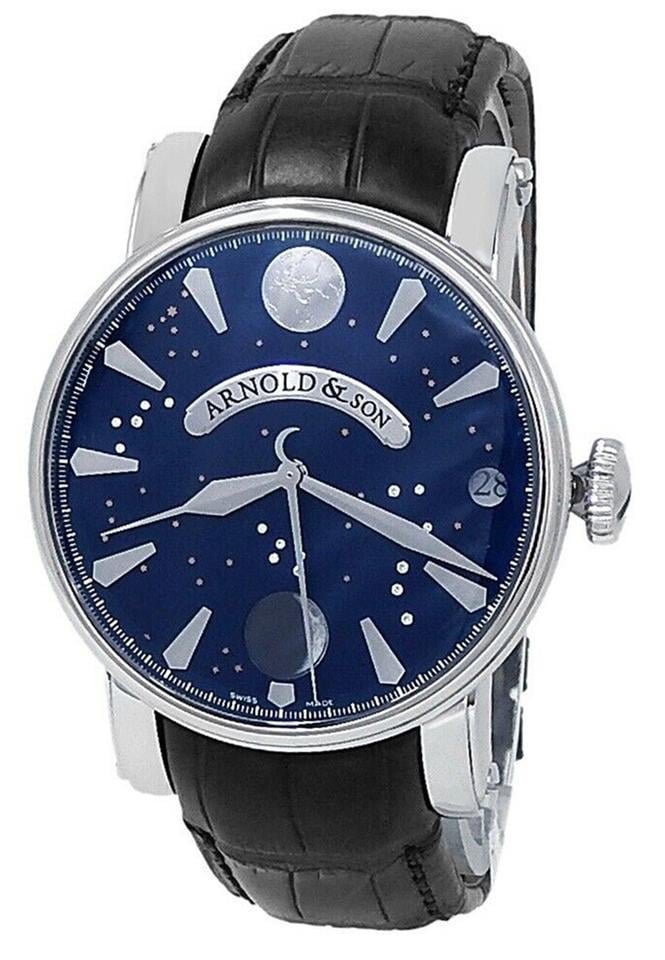
There are two kinds of moon-phase buyers. The first falls for the poetry: a small window onto a night sky, a complication with no practical purpose and therefore no compromise. The second wants to know what it costs to get out. The Arnold & Son True Moon, reference 1TMAS.U02A.C40B, is unusually good at satisfying the first and unusually honest about disappointing the second.
Arnold & Son occupies a strange, appealing corner of the market. It has a genuine 18th-century name, a modern manufacture behind it, and a design language that leans harder into astronomical spectacle than almost anything at its price. The True Moon is the purest expression of that: a watch built around a single, oversized, photorealistic moon rather than around a case shape or a bracelet.
This review is written for the collector who is close to buying one — probably pre-owned — and wants a straight answer on what it is, how it wears, and whether the money comes back.
John Arnold, and the brand that borrowed his name
John Arnold was born in 1736 and set up in London in 1764, at the height of the British chronometer race. His pocket chronometers were among the most accurate portable timekeepers of the 18th century, and his spring detent escapement — patented in the 1770s — became a foundation stone of precision horology. His son, John Roger Arnold, later worked alongside Abraham-Louis Breguet in Paris, and the Arnold name became shorthand for marine precision.
The modern Arnold & Son has almost nothing to do with that workshop in operational terms, and everything to do with it in spirit. The brand was relaunched in 2010 under La Joux-Perret, the Swiss movement specialist that Citizen Watch Co. acquired in 2012. That ownership matters when you are writing a cheque: Arnold & Son is not a two-man atelier improvising in a converted barn. It has industrial backing, its own movement production, and a service network that runs through the Citizen infrastructure.
What it does not have is the resale gravity of the established houses. That is the trade-off, and it runs through this entire review.
The True Moon: an astronomical moon, not a decorative one
Most moon phases are an afterthought. A 59-tooth disc, a 29.5-day cycle, a tiny aperture at six o'clock, and a correction every two and a half years. They are charming and they are cheap to make.
The True Moon is not that. The moon is the dial's organising principle: a large aperture dominated by a disc printed with a photographic rendering of the lunar surface, complete with craters, maria and the terminator line. It reads less like a complication and more like a window. In photographs it looks slightly unreal; in person it is the first thing anyone notices, and the reason the watch exists.
The gearing behind it is also more serious than the norm. Arnold & Son gears the disc to a long-cycle ratio, so the display tracks the synodic month closely enough that the correction interval is measured in decades rather than years — the brand's own literature talks in terms of roughly one day's deviation per century of running. In practice you will never correct it. That is the point: the True Moon is an astronomical moon phase dressed as a dress watch.
It is also, crucially, legible. The hours and minutes are not sacrificed to the spectacle, and the dial is not so busy that you lose the time. That sounds like a low bar. Plenty of independent moon phases fail it.
There is a subtler point here about why this watch exists at all. A moon phase is the least rational complication in horology — it tells you nothing you could not learn by walking outside. The True Moon leans into that irrationality rather than apologising for it. It is a piece designed to be looked at, and the fact that the moon is rendered photographically rather than as a stylised crescent is the whole argument.
Calibre A&S1021: hand-wound, twin-barrel, and finished for the loupe
Inside is the calibre A&S1021, a hand-wound in-house movement built around twin barrels and rated at roughly 90 hours of power reserve. The frequency is a traditional 21,600 vibrations per hour — three hertz — which is the right choice for a watch like this: it suits the architecture, it looks good through the back, and it does not pretend to be a sports movement.
Hand-winding is the correct decision here, and it is worth dwelling on. An automatic moon phase is a convenience; a hand-wound one is a ritual. Because the reserve runs to several days, you can wind it on a Sunday and forget it until midweek. The winding action on Arnold & Son calibres is generally crisp rather than buttery, with a positive feel at the crown and a clear stop.
The finishing is where the brand earns its keep. Bridges carry Côtes de Genève, the mainplate is circular-grained, the edges are hand-chamfered, and the screws are blued. It is not Lange-level — nothing at this price is — but it is a genuine manufacture finish rather than a decorated ébauche, and the display back is worth the money on its own. The moon mechanism is visible, which is more than you can say for most of the competition.
It is not chronometer-certified, and Arnold & Son does not submit these pieces for COSC testing. That is normal for the segment, but it does mean the movement's accuracy is a matter of regulation rather than certification.
Case, dial and strap
The reference reviewed here is the stainless-steel version, which is the one most collectors will actually encounter. The case is classically proportioned for a dress watch — round, with a thin bezel and lugs that curve down rather than out — and it is paired with a sapphire crystal and an alligator leather strap on a pin buckle. There is no lume, which is either a dealbreaker or entirely irrelevant depending on how you plan to wear it.
The dial is the deep blue variant, and it is the right choice for this watch. Blue gives the moon disc contrast without the self-conscious drama of black, and it keeps the piece wearable with a suit. The hour markers are slim and applied, the hands are fine and polished, and the overall effect is restrained everywhere except the aperture — which is exactly the balance a watch like this needs.
The strap is a standard alligator with a matching tone, and it is the one area where owners commonly upgrade. A hand-wound dress watch benefits from a strap with a bit of taper and a softer lining; the OEM strap is perfectly good but not the reason you buy the watch.
On the wrist
The True Moon wears like a dress watch should: it sits flat, it disappears under a cuff, and it does not announce itself across a room. The case is thin enough to clear a shirt sleeve without a fight, and the weight is balanced — the sapphire display back and the movement are not so heavy that the watch rotates on the wrist.
The one thing to think about is the strap. Because the case is polished and the lugs are relatively slender, the watch looks best on a leather strap with some structure. A flimsy strap makes it look smaller than it is; a well-made one gives it presence. If you buy pre-owned, budget for a strap.
On a smaller wrist it reads as a proper dress piece. On a larger wrist it reads as slightly understated — which, for a watch with a moon this large on the dial, is a strange and rather charming contradiction.
Living with it: accuracy, winding and service
Real-world accuracy from the A&S1021 is typically within a handful of seconds per day, though individual examples vary and there is no chronometer certificate to fall back on. If you are the sort of collector who times a watch against a radio signal every morning, this is not the piece for you; if you wear a watch in rotation and set it when you pick it up, it will be entirely satisfactory.
The winding routine is the pleasure. Because the reserve is long, the True Moon is forgiving of a rotation — you can leave it in the box for a few days and it will still be running. The moon display, once set, stays set.
Service is the less romantic part. Arnold & Son's movements are in-house, and the moon module is proprietary, so servicing really should go through the brand's authorised network rather than a local watchmaker. Expect a four-figure bill when the time comes, and expect the watch to be away for a while. That is the cost of owning a niche manufacture, and it should be part of your maths before you buy.
The competitive set
At this price, the True Moon is competing with some very established names.
The Jaeger-LeCoultre Master Ultra Thin Moon is the default answer for anyone who wants a moon phase and a blue-chip name. It is thinner, it is more versatile, and it holds value better. What it does not have is a moon that looks like the actual moon.
The Glashütte Original PanoMaticLunar offers German finishing, an off-centre layout and a big date, and it is arguably the best value in the segment. It is also a very different watch: more technical, less romantic.
The A. Lange & Söhne Saxonia Moon Phase is the aspirational comparison — better finished, better residuals, and roughly twice the money. If you can afford it, it is the better watch. If you cannot, the True Moon gives you a comparable emotional hit for less.
And then there is the Frederique Constant Slimline Moonphase, which costs a fraction of the Arnold & Son and proves that a moon phase is not inherently expensive. It is not in the same league in finishing or in the moon itself, but it is a useful reminder that you are paying for execution, not for the complication.
There is also the question of the brand's own sibling. The Luna Magna is Arnold & Son's current large-moon flagship, and it pushes the same idea further with a three-dimensional moon. If the True Moon's flat disc leaves you cold, the Luna Magna is the upgrade path — at a considerably higher entry point.
The market: what it costs and what it returns
Retail on the steel True Moon sat in the mid-teens of thousands of dollars, and the model has largely moved to the secondary market as Arnold & Son's collection has shifted toward the Luna Magna and other large-moon pieces. Pre-owned examples typically trade well below retail — expect a meaningful haircut, and expect to wait for a buyer if you ever sell.
This is not a criticism of the watch; it is a description of the brand's position. Arnold & Son is a niche manufacture with a small collector base, and niche manufactures depreciate. The True Moon is not an investment. It is a piece you buy because you want the moon on your wrist and you are willing to pay for the execution.
There is no meaningful auction history to point to. The model rarely appears at the major houses, and when it does it trades near the lower end of the secondary range. If you are buying for liquidity, buy something else.
The sensible play is to buy pre-owned, buy the steel version, and buy it because you intend to wear it. At that entry point, the True Moon is a lot of watch for the money — a manufacture movement, an astronomical moon and a dial that starts conversations. The collector who buys it as a keeper will do better than the collector who buys it as a trade.
Verdict
The Arnold & Son True Moon is one of the most characterful moon phases you can buy for the money, and one of the least sensible if you measure watches in resale percentages. The moon is genuinely beautiful, the A&S1021 is a proper hand-wound manufacture calibre with a long reserve, and the finishing rewards a loupe. The trade-offs — no lume, no chronometer certification, a soft secondary market and authorised-only service — are real but predictable.
Buy it pre-owned, wear it often, and do not expect it to fund your next purchase. On those terms, it is a very good watch.