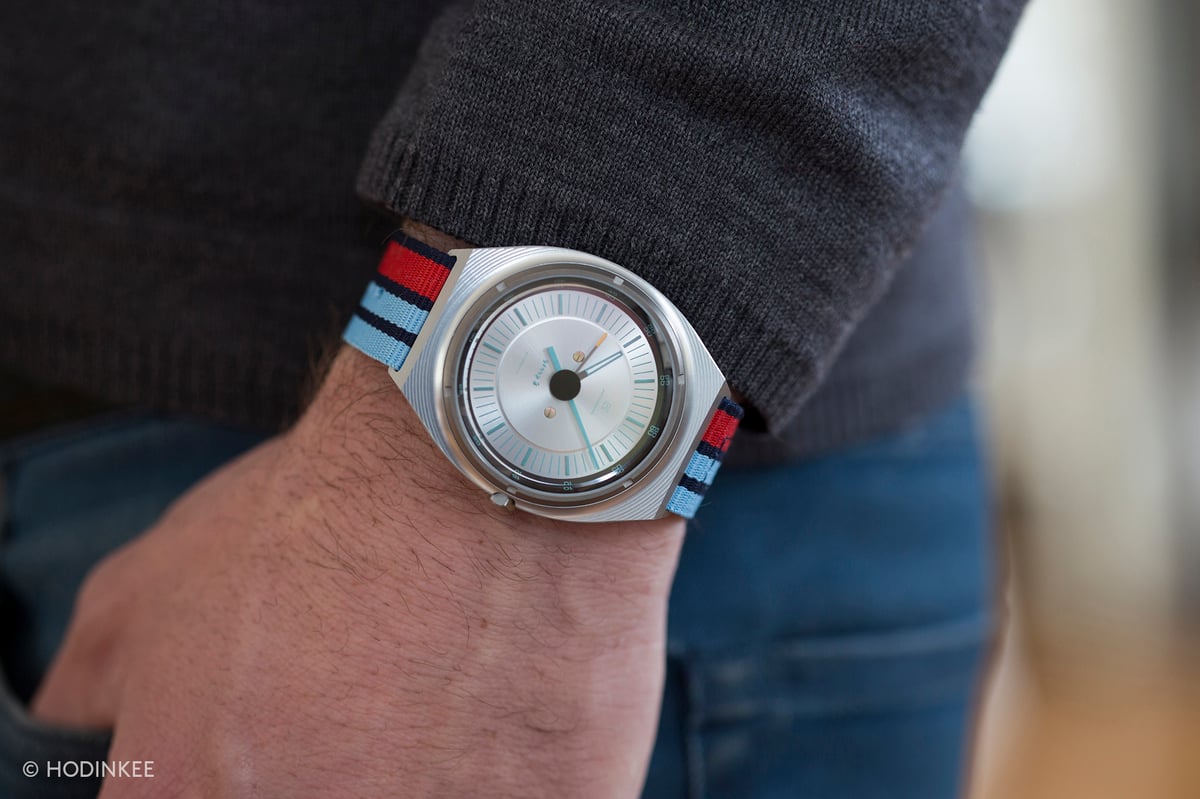
The Autodromo Group B Evoluzione is the kind of watch that makes an immediate argument. It does not rely on a familiar luxury formula, nor does it pretend to be a vintage Swiss chronometer. Instead, it takes the visual language of 1980s Group B rally cars — bold graphics, functional instrumentation, compact proportions, and a sense of mechanical purpose — and translates it into an integrated-bracelet sports watch. That is a specific idea, and the Evoluzione executes it with unusual coherence.
For young collectors, the appeal is obvious. The Evoluzione offers a mechanical watch with a strong identity at a price that is still grounded. It is not an entry-level quartz piece, but it is also not a five-figure object that requires a safe and an insurance rider. It is a watch to wear, to travel with, to knock against a desk, and to enjoy for its design rather than its scarcity.
That does not mean it is beyond criticism. The movement is industrial, the finishing is modest, and the brand does not carry the service infrastructure of a major Swiss house. But the Group B Evoluzione is not trying to win on those terms. It wins by being a coherent, wearable, and visually memorable watch with a clear point of view.
Autodromo and the Group B Myth
Autodromo was founded in 2011 by Bradley Price in New York. From the beginning, the brand looked to automotive and motorsport culture rather than traditional Swiss watchmaking folklore. That is an important distinction. Autodromo does not trade on Geneva hallmarks or centuries of watchmaking history; it trades on design literacy, mechanical accessibility, and a genuine enthusiasm for cars and the objects that surround them.
The Group B family is the clearest expression of that philosophy. It references the Group B rally era of the 1980s, a period defined by extreme homologation specials, graphic liveries, and a certain lawless energy. The watches translate that mood into wristwear through bold dials, instrumental typography, and cases that feel more architectural than dressy.
The Evoluzione takes the Group B idea one step further by integrating the bracelet into the case. That sounds like a small change, but it alters the entire character of the watch. An integrated bracelet makes the Evoluzione feel more like a single object and less like a case paired with a strap. It also places the watch in conversation with the current generation of integrated-bracelet sports watches, from the Tissot PRX to the Christopher Ward Twelve. The Autodromo holds its own in that company because it is not a generic me-too design; it has a specific rally-inspired flavor.
Case, Dial, and Integrated Bracelet
The Group B Evoluzione uses a 39mm stainless steel case, a sensible size for a modern sports watch. It is compact enough to wear comfortably on a wide range of wrists, but the case architecture gives it a visual density that keeps it from feeling small. The hooded lug design and integrated bracelet make the watch look like a continuous piece of hardware rather than a conventional round case with lugs attached.
The dial is where the Group B DNA is most obvious. It is graphic, legible, and slightly aggressive without becoming cluttered. The markers and hands are designed for quick reading, and the rally-inspired color accents give the watch a sense of motion even when it is sitting still. The date function is integrated into the dial in a way that does not disrupt the overall symmetry too badly, though purists will always debate the merits of a date aperture on a watch like this.
The sapphire crystal is a welcome choice for daily wear. It resists scratches and keeps the dial clear, which matters on a watch that is likely to see more than its share of desks, doorframes, and travel bags. The case is rated to 50 meters of water resistance. That is not dive-watch territory, but it is enough for daily life, hand washing, and accidental splashes. The Super-LumiNova on the dial and hands is a practical addition rather than a decorative flourish.
The integrated stainless steel bracelet is the centerpiece of the Evoluzione experience. It gives the watch a jewelry-like continuity and a more elevated feel than a standard strap. The folding clasp is secure and keeps the bracelet from feeling fragile. The overall effect is sporty but considered, with a level of finish that is appropriate for the price. It is not a haute-horlogerie bracelet with hand-bevelled links, but it is well executed and comfortable.
Movement: Miyota 9015
The Group B Evoluzione is powered by the Miyota 9015, a Japanese automatic movement that has become a staple of the affordable and microbrand watch world. It is a 24-jewel movement with a 42-hour power reserve and a frequency of 28,800 vibrations per hour. It is not COSC-certified, and it is not an in-house caliber. Those facts are important, but they are not disqualifying. The Miyota 9015 is a known quantity: reliable, serviceable, and reasonably thin for an automatic with a date.
In terms of architecture, the 9015 is a conventional modern automatic. It uses a rotor, a date mechanism, and a balance running at 4 Hz. The finishing is industrial rather than decorative. You will not find the hand-bevelled bridges or black-polished screws of a high-end Swiss caliber, but you will find a movement that is designed to work consistently and to be repaired without drama. That is exactly the right brief for a watch like the Evoluzione.
The movement also helps keep the watch accessible. A Swiss automatic with comparable reliability and a recognizable brand name would push the price significantly higher. The Miyota allows Autodromo to spend more of the budget on design, case construction, and bracelet integration, which are the areas that matter most to the Evoluzione’s character. For a collector who values design and wearability over movement prestige, that is a sensible allocation of resources.
On the Wrist
The Evoluzione wears like a compact sports watch with a strong visual signature. It sits close to the wrist, stays out of the way under a cuff, and feels balanced on the integrated bracelet. The case does not overwhelm the wrist, but the dial and bracelet give it enough presence to avoid looking undersized. It is the kind of watch that feels natural on the wrist from the first wear, rather than requiring a period of adjustment.
The bracelet is a major part of that comfort. Integrated bracelets can be tricky because they concentrate the visual weight of the watch at the case, but the Evoluzione manages that balance well. The folding clasp is secure, and the links articulate smoothly enough for daily wear. It is not a bracelet that you will forget you are wearing, but it is one that you will not resent after a long day.
The watch also has a strong tactile quality. The case edges, the bracelet links, and the dial details all feel deliberate. There is a sense of mechanical honesty to the Evoluzione that is often missing in watches at this price. It does not feel like a compromise object; it feels like a specific design executed with care.
Accuracy and Daily Ownership
The Miyota 9015 is not a chronometer, and Autodromo does not market the Evoluzione as one. In real-world use, expect stable running roughly in the range of minus ten to plus fifteen seconds per day, with individual examples varying. That is perfectly acceptable for a watch at this price, and it is consistent with the movement’s reputation for dependability rather than laboratory precision.
Daily ownership is straightforward. The date function is useful, the sapphire crystal is durable, and the 50-meter water resistance is enough for normal life. The watch is not designed for serious diving or rough industrial work, but it is more than capable of handling a commute, a weekend trip, or a casual dinner. The Super-LumiNova is a practical touch for low-light situations, though it is not the primary reason to buy the watch.
Service is another consideration. The Miyota 9015 is widely known to independent watchmakers, and Autodromo can service the watch through its own network. That means ownership should not be a logistical nightmare, even if the brand does not have the global service footprint of a major Swiss manufacturer. For a young collector, that accessibility is a meaningful advantage.
Occasions and Presence
The Group B Evoluzione is best suited to sport, daily wear, and travel. It is not a formal watch in the traditional sense, though it can work with smart casual clothing. The integrated bracelet gives it a slightly more polished feel than a strap-mounted rally watch, but the dial is still graphic and energetic. It is the kind of watch that looks right with a T-shirt, a field jacket, or a casual suit.
Its wrist presence is stronger than its size might suggest. The integrated bracelet and the rally-inspired dial draw the eye, and the watch has a distinctive silhouette that separates it from the usual round-case crowd. On a scale of one to five, it earns a four for presence: compact but visually assertive, with enough character to hold its own in a collection.
Value, Service, and Investment
The Group B Evoluzione has an MSRP of around $1,250. At that price, it competes with a wide range of integrated-bracelet sports watches, including the Tissot PRX Powermatic 80 and the Christopher Ward Twelve. The Autodromo is not the cheapest option in that group, nor is it the most technically advanced. What it offers is a specific design language and a level of automotive-inspired character that the alternatives do not match.
On the secondary market, pre-owned examples typically trade in the $850 to $1,150 range, depending on condition and dial color. The trend is stable rather than appreciating. This is not a watch to buy as an investment. It is a watch to buy because you want to wear it. The brand has a dedicated following, but the market for Autodromo is still niche. That is not a criticism; it is simply the reality of a small independent brand.
Service expectations are reasonable. The Miyota 9015 is a known quantity, and independent watchmakers can work on it. Autodromo can also service the watch through its network. There is no major auction history for the Group B Evoluzione, and it is unlikely to become a speculative object. That is fine. The value proposition is about design, wearability, and the pleasure of owning a mechanical object with a clear point of view.
Alternatives and Homages
The most obvious alternative is the Tissot PRX Powermatic 80. It offers an integrated bracelet, an automatic movement, and a retro-modern design at a lower price. The Tissot is more mainstream and more widely available, but it lacks the rally-inspired specificity of the Autodromo. The Christopher Ward Twelve is another strong option, with a more angular case and a Swiss movement. It feels more luxurious, but it also costs more and has a different design ethos.
The Nivada Grenchen F77 is a compelling choice for collectors who want a stronger vintage accent. It has a similar integrated-bracelet formula but a different historical reference point. The Brew Metric is a smaller, more playful option that appeals to collectors who value graphic design and compact proportions. None of these watches is a direct substitute for the Group B Evoluzione, which is a good thing. The Autodromo has its own identity.
As for homages, there are low-cost integrated-bracelet watches that capture the general look of the genre, but they do not replicate the specific Group B design language. A generic Pagani Design integrated-bracelet automatic can provide a similar silhouette for a fraction of the price, but it will not deliver the same case detailing, dial execution, or brand character. For collectors who care about the original design, the Autodromo is worth the premium.
Final Verdict
The Autodromo Group B Evoluzione is a successful evolution of the Group B idea. It takes the rally-inspired design language that made the original notable and gives it a more integrated, more wearable form. The 39mm stainless steel case, sapphire crystal, Super-LumiNova, and integrated bracelet make it a practical daily watch, while the Miyota 9015 provides reliable mechanical power at a reasonable price.
It is not a perfect watch. The movement is industrial, the finishing is modest, and the brand lacks the service network of a major manufacturer. But those criticisms miss the point. The Evoluzione is a design-led enthusiast watch with a clear identity, and it delivers exactly what it promises. For young collectors who want something distinctive, wearable, and mechanically honest, it is a compelling choice.
Buy it because you want the design and the integrated-bracelet experience. Do not buy it because you expect it to appreciate. The Group B Evoluzione is a watch for driving, traveling, and living. That is the right way to enjoy it, and it is the reason it deserves a place in a considered collection.