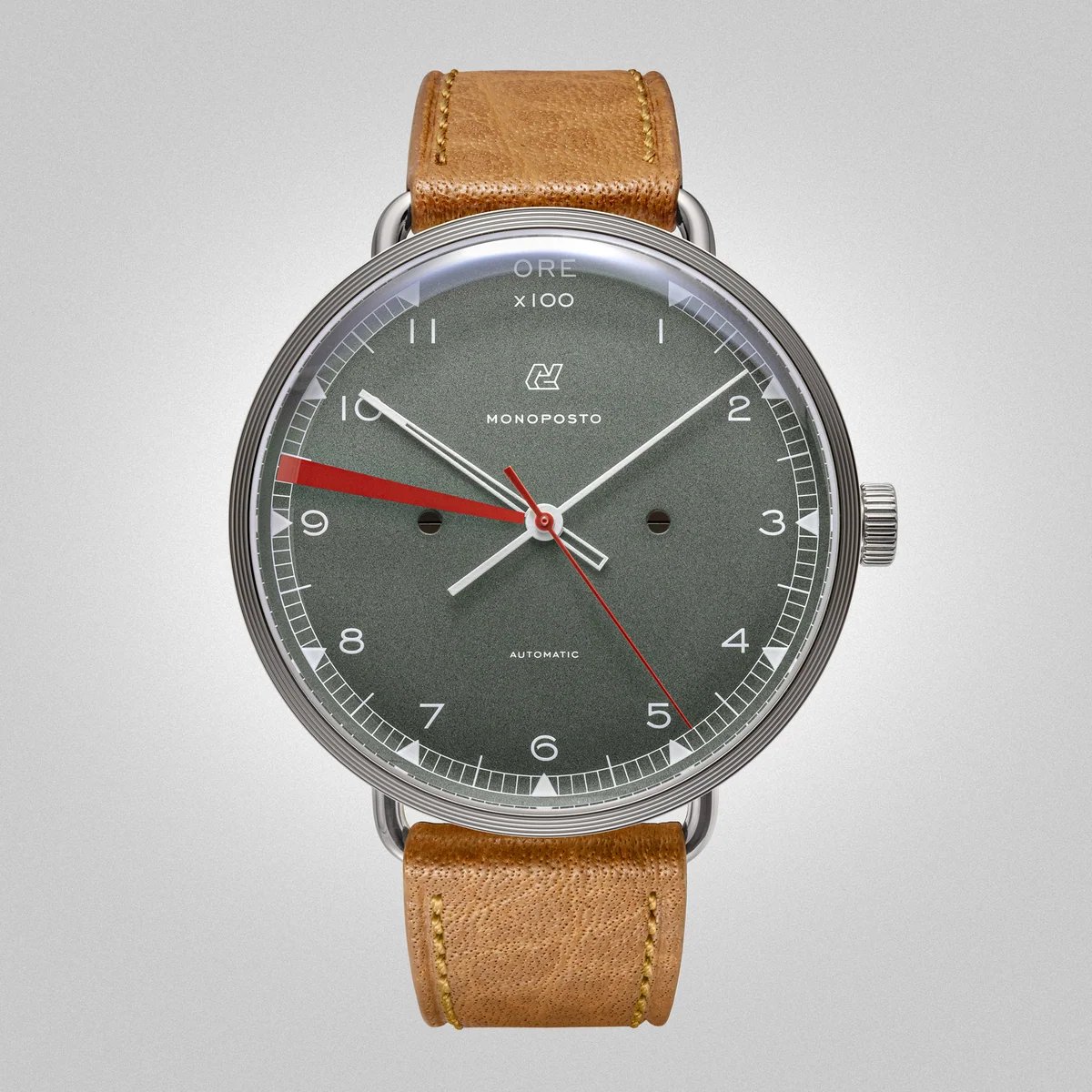
Most watches named after cars are named after the wrong thing. They borrow a badge, a colourway, a decade of advertising, and then go back to being an ordinary three-hander with a sticker on it. The Autodromo Monoposto does something rarer: it borrows an instrument.
The instrument, not the car
Monoposto is Italian for single-seat, and in the 1930s it meant the purest and most dangerous thing in motorsport — a Grand Prix car with one place in it, no passenger, no ballast, no compromise. What those cars carried on their scuttles was a tachometer: a large, legible dial with a marked red zone at the top of its sweep that told the driver, in the bluntest possible terms, when to stop asking for more.
Autodromo's founder, Bradley Price, built his watch around that dial rather than around the car. The Monoposto's face is not a decorative evocation of a dashboard; it is laid out the way a rev counter is laid out, with a clear sweep, a printed scale, and a red sector occupying the upper arc where the needle would live if there were one. It is a small distinction that turns out to be the whole argument.
This review covers the automatic version. The original Monoposto was a hand-wound piece with a limited, cultish following; the automatic broadened the brief, swapped in a Miyota 9015, and made the watch genuinely viable as an everyday object rather than a weekend costume.
A New York workshop with an Italian accent
Autodromo was founded in 2011 and is based in New York. Price came to watches from industrial design, and it shows in the way the brand reasons about its references — not as liveries to be reproduced but as objects to be understood. The catalogue runs from the Group B, a 1980s rally-derived piece, to the Prototipo chronograph and the Intereuropa, each anchored to a specific car or a specific era rather than to a general mood of nostalgia.
The Monoposto sits at the purest end of that spectrum. There is no chronograph, no date, no lume, no bracelet. Every element that could be removed has been, and what is left is a case, a dial, two hands and a sweep seconds. That kind of subtraction is harder to pull off than it looks, because there is nowhere to hide: any weakness in proportion or printing is immediately visible.
Reading a tachometer at a standstill
The dial is the reason to own the watch, and it rewards close looking. The ground is a soft silver-white with a fine matte grain, closer to a printed instrument face than to a sunburst. Printing is black and crisp, with the minute track running around the perimeter in a fine, evenly spaced scale — the sort of detail that separates a considered design from a pastiche.
The red sector occupies the upper portion of the dial, exactly where a tachometer's redline would sit. It is the only colour on the face, and it does an enormous amount of work: it fixes the eye at twelve, gives the composition an axis, and provides the one moment of visual tension in an otherwise calm layout. On the dark-dial variant the same sector is present but reads less assertively, subsumed into the black ground.
The hands are simple and legible, and there is no luminous compound on any of them. That is a deliberate decision rather than an oversight — lume would have meant a different dial treatment, a different case, and a different watch. The Monoposto is a fair-weather object, and it is honest about it. If you need a watch that reads at 3am in a hotel room, this is not it.
Case and crystal
The case is stainless steel, 43mm across, and entirely brushed. There is no polished flank, no chamfer catching the light, no brightwork to speak of beyond the hands. That uniformity gives the watch a tool-like flatness that suits the instrument concept and, incidentally, makes it very easy to live with — brushed steel hides the small abrasions that accumulate on a daily-worn watch in a way that polished surfaces never do.
The crystal is acrylic, domed, and this will be the deciding factor for a portion of buyers. Acrylic scratches. It also warms the dial in a way sapphire cannot, giving the printing a slight softness at the edges that reads as period-correct rather than imprecise. A tube of Polywatch and thirty seconds of work restores it. Those who cannot tolerate the idea should look elsewhere, because the acrylic is not an economy measure here — it is part of the design argument.
Water resistance is rated to 50 metres, which is enough for rain, washing hands, and the occasional accidental submersion, and not enough for swimming. The leather strap would object long before the case did.
The movement
Inside is a Miyota 9015, a Japanese automatic with 24 jewels running at 28,800 vibrations per hour and delivering roughly 42 hours of power reserve. It is not in-house, it is not certified, and it does not pretend to be either. What it is, is thin, reliable, and remarkably well understood by watchmakers the world over.
Look through a display back — where fitted — and you will find industrial finishing: perlage across the bridges, straight graining, a rotor with minimal decoration. There is no hand-bevelling, no black polish, no Geneva stripes. At this price that is the correct answer rather than a compromise, because decorative finishing of that order would have added several hundred dollars to the retail price and changed nothing about how the watch tells time.
The practical benefit of the 9015 is not aesthetic. It is that the watch can be serviced by any competent independent watchmaker for a modest sum, with parts availability that is effectively guaranteed by the movement's ubiquity. In a category where servicing can quietly become the largest cost of ownership, that matters more than a decorated bridge.
On the wrist
At 43mm the Monoposto is a deliberately generous watch, and the reasoning is sound: tachometers are meant to be read at a glance, and shrinking the design to 38mm would have turned an instrument into a trinket. What keeps it wearable is the restraint elsewhere. The bezel is narrow, the dial is uncluttered, the case is uniformly brushed, and the whole thing reads as a broad, flat disc rather than a lump.
The tapered lugs let the leather strap break downward cleanly instead of sitting proud of the case, which is the single most common failure of large watches on smaller wrists. Weight is modest — there is no bracelet and no chronograph module to carry — and the strap is supple from the first wear. It sits comfortably under a loose shirt cuff and never snags on a jacket lining.
Owners with wrists below roughly 6.5 inches should try before buying. The case is honest about its dimensions and does not visually retreat; that is not a flaw, but it is a fact worth knowing in advance.
Timekeeping
Miyota publishes a tolerance of roughly -10 to +30 seconds per day for the 9015, which sounds loose until you weigh it against the price. In practice most examples settle tighter than the specification, and a well-regulated sample running within ten seconds a day in either direction is entirely normal. Expect a little positional variation — these movements tend to gain slightly dial-up and lose a touch crown-down — and expect the rate to settle after a few weeks of regular wear.
There is no chronometer certification and no claim to one. If absolute precision is the priority, the Monoposto is the wrong purchase; if a watch that keeps time well enough to set twice a month is acceptable, it will never bother you.
Where it fits
This is a daily wearer that leans casual. It works with a knit, a field jacket, denim, a plain oxford. It works less well with a formal suit, not because a 43mm steel watch is inherently informal but because the dial's redline sector and the acrylic dome are both conversational elements, and a black-tie or boardroom context asks for less conversation.
As a travel watch it is competent — legible, robust, unbothered by airports — though the lack of lume and the modest water resistance mean it is not the piece you take if the itinerary involves swimming. Treat it as a companion to a weekend, not to an expedition.
The competition
The most direct rival is Oris's Chronoris Date, which occupies similar territory: a reissued 1970s motorsport design, an in-house-adjacent movement, and a price that sits just above the Autodromo. The Oris is the more conventionally finished watch; the Autodromo is the more specific design. Buyers who want a recognised badge should take the Oris.
Above that, TAG Heuer's three-hand Carrera and Chopard's Mille Miglia Classic both trade on racing heritage at two to five times the money, with the finishing and the brand gravity to justify it. Neither has a dial as single-minded as the Monoposto's. Hamilton's Intra-Matic sits below on price and captures a similar vintage register, though its automotive logic is looser. And within Autodromo's own catalogue, the Group B is the natural alternative for anyone who wants the same design intelligence in a smaller, rally-flavoured package.
Buying and owning
The Monoposto Automatic launched at roughly $1,250 and has crept upward with subsequent production; current retail sits nearer $1,450. Pre-owned examples trade in the $650 to $950 band, which tells you most of what you need to know about the value proposition. This is not a watch that rewards the original purchaser financially.
What it does reward is patience. Buying used puts a genuinely original piece of independent design on your wrist for less than the price of a mid-range Swiss quartz, and the Miyota inside means ownership costs stay low. Servicing should be planned on a five-year cycle at around $200, and there is no need to insist on an authorised channel — any watchmaker who knows the 9015 can handle it.
There is no meaningful auction record to speak of. Autodromo is a small brand with a devoted following rather than a speculative one, and the Monoposto should be bought as an object to be worn, not as a position to be held.
Verdict
The Monoposto Automatic succeeds because it resists the temptation to be a car watch and insists instead on being an instrument. The case is honest about its size, the dial does one job extremely well, and the movement inside means ownership never becomes a logistical problem.
It is not an heirloom. It will not make you money. But as a daily-worn piece of genuinely original industrial design, made by a small studio that understands its references rather than merely citing them, it earns its place — and it earns it on the wrist, where it belongs.