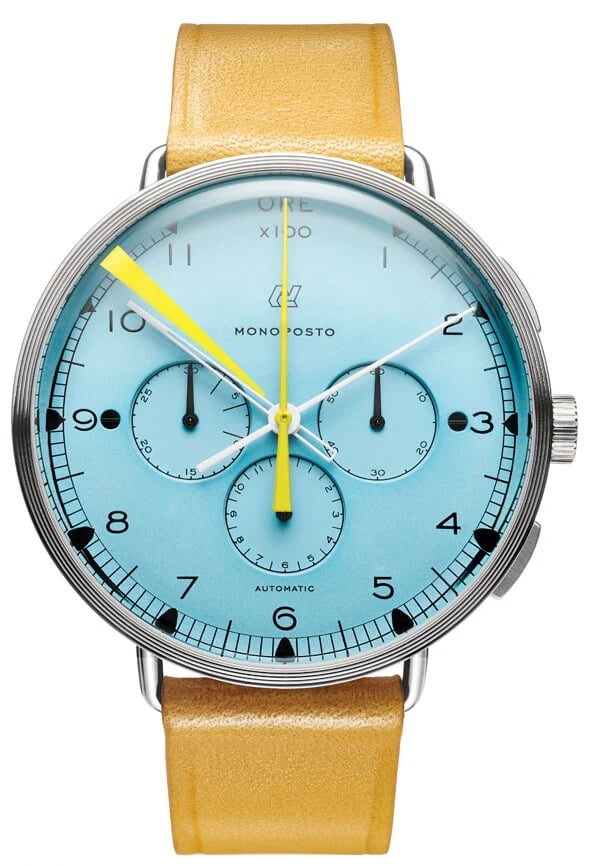
Autodromo Monoposto Chronograph BP-002K: A Week on the Wrist
Some chronographs are built to look expensive. The Autodromo Monoposto Chronograph BP-002K is built to look quick. That distinction matters on the wrist. It is not a watch that tries to overwhelm a cuff with polished mass; it is a compact automotive idea, a single-pusher chronograph with a vintage racing face and a strap-first personality. The Monoposto asks you to notice the dial before the badge, and that is a rare thing in the current market.
I wore this reference for a full week: desk days, school runs, a long drive, a dinner, and a rainy Saturday morning. The goal was not to treat it like a safe queen. The goal was to find out whether the Monoposto makes sense as a daily watch for someone who likes mechanical objects but does not want to be babied by them. The short answer is yes, with caveats that have less to do with performance than with expectation. This is a quartz chronograph with a designer's eye, not a mechanical heirloom with a boutique service story.
That is not a criticism. It is the brief. The BP-002K is best understood as an accessible piece of industrial design that happens to tell time. If you want a hand-wound column-wheel chronograph, keep walking. If you want a watch that captures the romance of Italian single-seater racing without demanding a collector's budget, the Monoposto is far more convincing than most retro chronographs at its price.
The Monoposto idea
Autodromo was founded in 2011 in the United States by Bradley Price, a designer with a clear interest in the graphic language of mid-century Italian motoring. The brand's early reputation was built on the Monoposto, a watch that translated the dashboard instruments and minimalist dials of 1950s racing cars into something wearable. That origin story matters because the Monoposto is not a generic motorsport chronograph with a checkered flag slapped on the dial. Its whole reason for being is the relationship between a clean instrument face and a lightweight, open car.
The reference BP-002K belongs to that lineage. It is a chronograph with a single pusher, a detail that gives the watch a cleaner flank and a more deliberate interaction than the usual two-button layout. The case is stainless steel, the strap is leather, and the crystal is sapphire. The design is confident without being loud. It reads as a piece of period-correct gear rather than a modern watch pretending to be vintage. Autodromo has always been at its best when it treats the watch as a small piece of automotive graphics, and this reference is a clear example of that philosophy.
Case, crystal and wrist feel
The first thing I noticed was not the size but the attitude. The Monoposto sits like a watch designed to be worn with a jacket sleeve rolled up, not buttoned down. The case has a rounded, slightly domed presence, and the crystal catches light without turning the dial into a mirror. Because Autodromo has not made a fetish of sharp edges, the watch feels friendly on the wrist. It does not dig into the back of the hand, and it does not feel like a brick when you type.
I judge wear by where the spring bars sit and how the strap falls. Here the leather strap does most of the work. The case is light enough that the watch disappears during the day, and the single pusher is easy to find without looking. The crown is not buried, and the chronograph action has a clean, positive feel. If you have ever owned a vintage-inspired watch that looked right but wore like a cufflink, the Monoposto is the opposite. It is a watch you forget you are wearing until someone asks about it.
The crystal deserves a mention because it shapes the whole experience. It adds a little warmth to the dial and keeps the case from looking like a flat disc. It also means you see the dial from an angle rather than through a window. That is a small thing, but it is the kind of small thing that separates a watch with character from a watch with specifications. The caseback and mid-case transition are tidy rather than overworked, which suits the price and the purpose. This is not a watch that tries to win a finishing contest under a loupe. It is a watch that wants to look right at arm's length and feel right on a long day.
Dial and legibility
The dial is the reason to buy the Monoposto. It is clean, graphic, and easy to read at a glance. The hour markers are simple, the hands are thin enough to feel period-correct but broad enough to find quickly, and the chronograph layout does not crowd the face. This is not a watch with five lines of text and three overlapping scales. It trusts the driver to know what time it is. The result is a dial that feels calm even when the chronograph is running.
Legibility in daylight is excellent. The contrast between the dial and the markers is strong, and the hands do not disappear against the background. At night, the Monoposto is not a lume-first tool watch. It is a watch for restaurants, garages, and evening drives, not for reading in a dark tent. That is consistent with the concept. A racing chronograph from this era of inspiration was an instrument, but it was an instrument used in daylight and under floodlights, not on a night hike.
The single pusher changes the way you use the chronograph. With a two-button chronograph, the ritual is start-stop-reset with a thumb and forefinger. With the Monoposto, the whole action lives in one place. It feels more mechanical and more deliberate, even though the movement is quartz. I found myself timing mundane things just to use it: coffee brewing, a walk to the station, the time between traffic lights. That is a good sign. A chronograph should invite use, not just sit there as a decorative subdial. The typography and layout also do their part. Nothing on the dial feels added for the sake of filling space, and the result is a face that stays interesting without becoming busy.
Movement and chronograph operation
The BP-002K is powered by a Swiss quartz monopusher chronograph movement, understood to be Ronda-based. Autodromo has not made the caliber the centerpiece of the watch, and that is the right call. This is not a watch you buy to discuss column wheels and vertical clutches over dinner. You buy it because the single-pusher layout makes the chronograph feel like a tool with a purpose, and because quartz ownership removes the winding anxiety from daily life.
The trade-off is obvious. A quartz chronograph does not have the same emotional pull as a mechanical one. There is no rotor to watch, no subtle ticking of an escapement, no service ritual that makes you feel like a custodian of a small machine. What you get instead is accuracy, low maintenance, and a watch that is ready whenever you are. For a young collector building a first serious watch wardrobe, that is not a small advantage. The Monoposto is a design object first and a mechanical object second, and it is honest about that.
The single pusher also makes the chronograph easier to use in motion. You can start, stop, and reset with one thumb without looking down for a second button. That sounds like a minor detail until you actually use it in a car, on a walk, or while holding a coffee. The action is crisp enough to feel intentional, and the reset is clean. It is not a high-horology experience, but it is a satisfying one. That is the right target for this watch.
Accuracy and daily ownership
Quartz accuracy is not a daily anxiety. A healthy example should keep time within seconds per month rather than seconds per day, and mine showed no drama over the week. I set it once, wore it through a normal mix of activity, and never thought about it again. That is exactly what you want from a watch in this role. If you are comparing it with a mechanical chronograph, the Monoposto wins on convenience and loses on ritual. If you are comparing it with a smartwatch, it wins on character and loses on features. That is the correct trade.
The bigger question is whether the watch feels special enough to justify wrist time. It does. The dial does the heavy lifting, and the single pusher gives your thumb something to do. The leather strap softens with wear, and the case develops the kind of small marks that make a daily watch feel lived-in. I would not baby this one. I would wear it, wipe it down, and enjoy the fact that it does not demand a winder or a safe. Battery changes are the main ownership event, and they are easy to plan around. That makes the Monoposto a low-friction watch, which is a virtue in a collection that already has enough high-maintenance pieces.
Strap, clasp and real-world comfort
The leather strap is the right partner for the Monoposto. It keeps the watch in the casual-to-smart lane rather than pushing it toward pure sport. The pin buckle is simple and secure, and the strap has enough taper to look tidy without feeling flimsy. On the wrist, the watch balances well because the strap is not stiff and the case is not top-heavy. I wore it with a shirt cuff and with a T-shirt, and it looked at home in both. That versatility is the point of a daily-wear chronograph.
If you are between strap holes, this is a watch that rewards a proper fit. A loose fit makes the case flop, and a tight fit kills the vintage mood. Once the strap settles, the Monoposto becomes one of those watches that you reach for without thinking. It is not a bracelet watch, and it does not pretend to be. The leather is part of the identity. A rally-style strap would push it further toward the racing theme, while a plain black leather strap would make it more versatile for evening wear. Either way, the watch is easy to live with because the case does not fight the strap.
Occasions and presence
The Monoposto is a daily watch, a weekend car-meet watch, and a travel watch because it never needs winding. It can pass with a jacket if the strap is tidy, but it is not a black-tie piece. Its presence is modest. This is a watch that rewards close inspection rather than announcing itself across a room. I would rate wrist presence at 3/5: enough character to start a conversation, not enough to feel flashy. For some collectors, that is exactly the right balance. For others, it may feel too quiet. The dial is the star, and the case is there to support it.
On a plane, in a train, or at a desk, the watch is easy to live with because it does not demand attention. It is the kind of piece that works best when you stop thinking about it and just wear it. That is not a knock. Most watches in this price range are trying too hard to be noticed. The Monoposto knows what it is, and that confidence is part of its charm.
Value, alternatives and collectibility
The Monoposto makes the most sense as a pre-owned buy. The original price bought a distinctive design, a Swiss quartz chronograph, and a leather strap. Today, the value case is about condition and completeness. A clean example with its strap and paperwork is easier to justify than a loose watch with a tired strap. This is not an auction-market watch, and it is not likely to become one. It is a stable, affordable piece with a specific charm. Buy it because you want to wear it, not because you want to flip it.
If you are shopping alternatives, the TAG Heuer Carrera is the obvious reference point for a racing chronograph, but it operates at a different price and a different level of mechanical ceremony. The Tissot PRS 516 offers a more mainstream motorsport look with broader service support. The Seiko Speedtimer is a stronger choice for someone who wants solar quartz convenience and a more tool-watch feel. The Dan Henry 1964 is the closest thing to a budget homage in spirit, though it lacks the Monoposto's specific single-pusher layout. Each of those watches makes sense. The Monoposto makes sense if the design speaks to you. That is a different kind of value, and it is the kind that lasts longer than a spec sheet.
Service and long-term care
Quartz service is straightforward. A competent watchmaker can handle battery replacement and gasket checks, and there is no complex mechanical overhaul to budget for. Case restoration and crystal replacement are the areas where you should use Autodromo or a specialist who understands the watch. The leather strap is a consumable, so factor in a replacement if you plan to wear it hard. The Monoposto is not a fragile watch, but it is not a diver either. Treat it like a vintage-inspired daily and it will reward you.
Final verdict
The Autodromo Monoposto Chronograph BP-002K is a convincing piece of accessible design. It has the right dial, the right single-pusher interaction, and a wearability that makes it easy to justify as a daily watch. It is not the choice for a collector who needs mechanical exclusivity or auction potential. It is the choice for someone who wants a racing chronograph with a clear point of view and a low-maintenance ownership experience. On the wrist, that combination works.