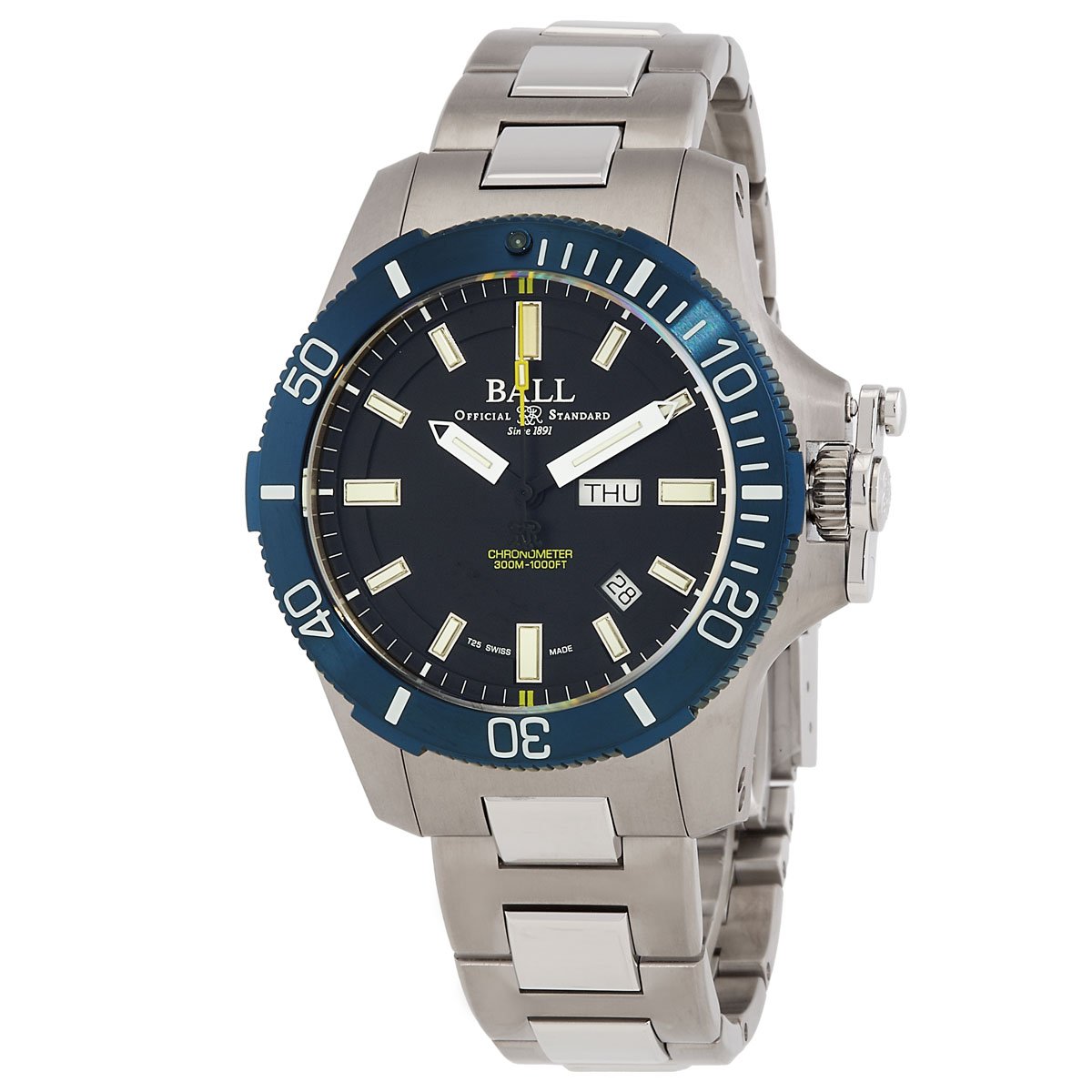
The Industrialist’s Choice: A Deep Dive into the Ball Engineer Hydrocarbon Original
In the hierarchy of Swiss watchmaking, Ball Watch Co. occupies a space that is curiously detached from the hype-cycle of the 'Big Three' or the mainstream luxury giants. While the rest of the industry spent the last decade chasing integrated bracelets and vintage reissues, Ball has been quietly fortifying its position as the king of the 'overbuilt' tool watch. The Engineer Hydrocarbon Original, specifically the reference DM2218B-P1CJ-BE with its striking blue dial and rubber strap, is the culmination of that philosophy. It is a watch that doesn't just meet standards; it creates them.
The Legacy of the Official Rail Road Standard
To understand the Hydrocarbon, you have to understand Webb C. Ball. Following the Kipton train wreck of 1891—a tragedy caused by a four-minute discrepancy in a conductor's watch—Ball was appointed to establish strict standards for chronometric precision on the American railroads. This legacy of 'safety first' is baked into the DNA of the DM2218B-P1CJ-BE. Every design choice, from the micro gas tubes to the Amortiser® anti-shock system, is a modern interpretation of that 19th-century obsession with reliability.
Visual Architecture: Brutalism on the Wrist
The first thing that hits you about the Hydrocarbon Original is the crown protection system. It’s a massive, hinged steel arm that locks the crown into place. It’s not just for show; it ensures the crown is fully screwed in before the watch can be put into service, and it provides a level of lateral impact protection that would leave a Submariner's crown stem in pieces. This is brutalist design at its finest—form following function with a heavy, industrial hand.
The dial is a deep, saturated blue that shifts from a midnight navy to a vibrant cobalt depending on the light. This isn't the sunburst blue you see on dressy divers; it’s a matte, high-contrast finish designed for legibility. The day-date window at 3 o'clock is framed with the same precision as the rest of the dial, maintaining the balance of a watch that is clearly meant to be used as a daily instrument.
The Tritium Factor: A Permanent Glow
While most luxury watches rely on Super-LumiNova—which requires a light source to 'charge' and fades over time—Ball uses self-powered micro gas tubes (H3). These tubes are filled with tritium gas, which reacts with a phosphor coating on the inside of the glass to produce a constant, steady glow. On the Hydrocarbon Original, these tubes are mounted both on the hands and under the dial, and even on the sapphire bezel insert. The result is a watch that is arguably more legible at 3:00 AM than it is at 3:00 PM. For the collector who spends time in low-light environments, or simply appreciates the 'nuclear' aesthetic of tritium, this is the gold standard.
Engineering the Movement: Beyond the ETA Base
Inside the DM2218B-P1CJ-BE beats the Ball Caliber RR1102-CSL. While its architecture is based on the workhorse ETA 2836-2, calling it a stock movement would be a disservice. Ball has integrated several patented technologies that elevate it to a different class of durability:
- SpringLOCK®: A patented anti-shock system that covers the balance spring with a cage to limit its movement during impacts, reducing the risk of deformation or breakage by up to 66%.
- SpringSEAL®: This protects the regulator assembly, ensuring that the watch's timing remains consistent even after significant physical shocks.
- Amortiser®: An anti-magnetic protection ring that surrounds the movement, shielding it from the magnetic fields of modern life—from MRI machines to the magnets in your MacBook.
This movement is COSC-certified, meaning it has passed the rigorous 15-day testing of the Contrôle Officiel Suisse des Chronomètres. In an era where many 'tool' watches are becoming delicate jewelry pieces, Ball is doubling down on mechanical resilience.
The Blue Dial and Rubber Aesthetic
The specific reference DM2218B-P1CJ-BE comes on a high-quality rubber strap that integrates perfectly with the case. The strap is thick, scented with a hint of vanilla (a classic Swiss rubber strap trait), and features a sturdy pin buckle. This configuration is the ultimate 'Gorpcore' flex. It pairs as well with an Arc'teryx hardshell as it does with a black t-shirt and raw denim. The blue dial provides just enough color to prevent the watch from looking like a piece of military surplus, giving it a sophisticated edge that works in an urban setting.
On the Wrist: A Presence That Can't Be Ignored
At 40mm, the case diameter is the 'Goldilocks' size for most men, but the 14.5mm thickness means this watch sits tall. It has a 'wrist presence' that punches far above its dimensions. When you wear the Hydrocarbon, you feel it. It’s a heavy, reassuring weight that reminds you of its 200m water resistance and its ability to withstand 7,500Gs of shock. The lugs are short and curved, which prevents the watch from overhanging on smaller wrists, but there is no denying that this is a 'chunky' timepiece.
Cultural Context: Why Ball is Trending
We are seeing a shift in the watch community away from the 'hype' pieces that defined the 2020-2022 era. Collectors are looking for authenticity and technical merit. Ball, with its genuine American-Swiss railroad history and its refusal to compromise on specs, is perfectly positioned for this new wave of interest. It’s the brand for the person who has already owned a Rolex or an Omega and is now looking for something more niche, more rugged, and more technically interesting.
Vivir Verdict
The Ball Engineer Hydrocarbon Original Ref. DM2218B-P1CJ-BE is a triumph of industrial design. It’s not a watch for everyone—those seeking a slim, elegant timepiece should look elsewhere. But for the enthusiast who wants a watch that can handle anything from a weekend of rock climbing to a Monday morning board meeting, it is one of the best values in the $3,000 price bracket. It is a watch with a soul, a history, and enough patented technology to satisfy the most demanding horological nerd.