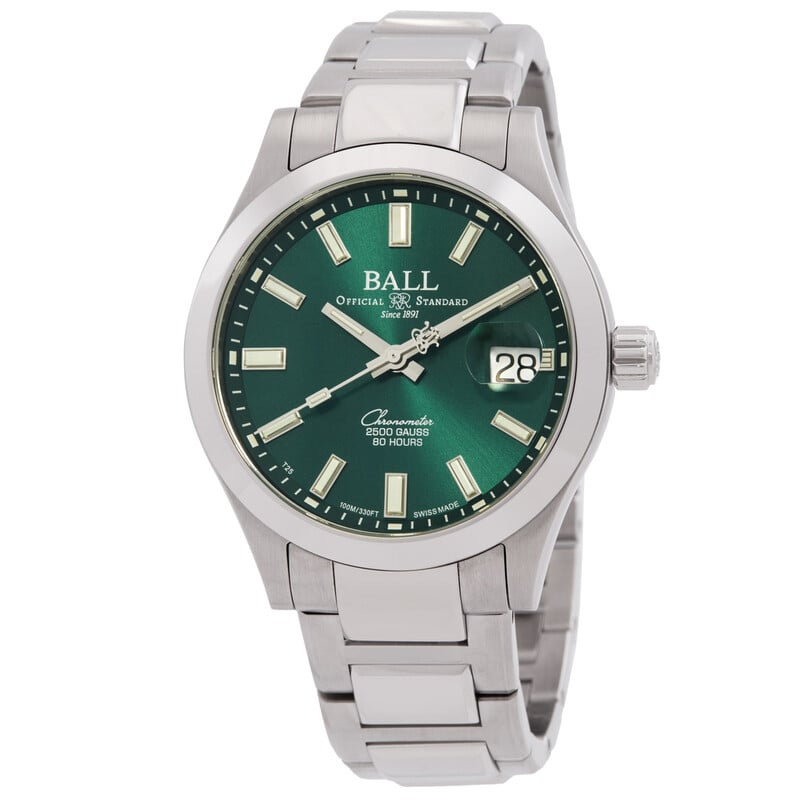
The Evolution of the Railroad Standard
For over a century, the Ball Watch Company has been defined by its adherence to the 'Official Railroad Standard.' It is a legacy built on the tragic Kipton train wreck of 1891, an event that necessitated a universal, fail-safe timekeeping system for the American rail network. However, in the modern era, a brand cannot survive on history alone. The contemporary collector demands more than just a story; they demand vertical integration, material innovation, and a design language that translates from the boardroom to the weekend. The Ball Engineer M Ascension (ref. NM9032C-S8C-BKJ) is the brand’s most articulate answer to these demands.
At first glance, the Ascension appears to be a classic, understated tool watch. But beneath its polished exterior lies a significant shift in Ball’s manufacturing philosophy. By moving toward in-house calibers and adopting 904L stainless steel, Ball is positioning itself against the heavyweights of the industry. This review explores how those high-level specs translate into the daily reality of a week on the wrist.
The Case for 904L: Metallurgy Meets Ergonomics
The most immediate talking point of the Ascension is its construction from 904L stainless steel. While the industry standard 316L is more than sufficient for most applications, 904L contains higher amounts of chromium, molybdenum, nickel, and copper. This results in superior resistance to acids and corrosion—a feature originally intended for the chemical industry but co-opted by luxury horology for its unique aesthetic properties. On the wrist, the 904L steel of the Ascension has a perceptibly 'whiter' and more brilliant luster than the slightly greyer 316L. It polishes to a mirror finish that feels exceptionally smooth against the skin.
From a wearability standpoint, the case dimensions are masterfully executed. A 40mm diameter is the 'Goldilocks' zone for modern collectors, but it is the 46.6mm lug-to-lug distance that truly defines the experience. Many tool watches in this category suffer from long, straight lugs that create an unsightly gap between the strap and the wrist. Ball has opted for a compact, downward-sloping lug architecture that allows the watch to wrap around the wrist. During my week of testing, which included long hours of typing and several commutes, the watch remained centered and stable, never feeling top-heavy despite its 13.4mm thickness.
The Dial: Legibility in the Dead of Night
Legibility is where Ball truly separates itself from its peers. While most brands rely on Super-LumiNova, which requires an external light source to charge and fades over several hours, Ball utilizes micro gas tubes (tritium). These tubes are filled with tritium gas, which naturally emits light for up to 25 years without any 'charging' required. In the Ascension, these tubes are integrated into the hour markers and hands with surgical precision.
Transitioning from a brightly lit office to a dark cinema or a late-night flight, the dial remains perfectly readable. There is no 'fade-out' at 3:00 AM; the glow is constant and reliable. The black dial of the NM9032C-S8C-BKJ provides a high-contrast backdrop for these tubes, and the inclusion of a date window with a magnifying cyclops at 3 o'clock adds a layer of practical utility that daily wearers will appreciate. While the cyclops is a point of contention for some purists who prefer a clean crystal, its magnification is sharp and aids in quick-glance legibility.
The In-House Revolution: Caliber RRM7309-C
The heart of the Ascension is the Ball Manufacture Caliber RRM7309-C. This is not a modified ETA or Sellita movement; it is a movement designed and produced to Ball's exacting specifications. The most significant benefit to the user is the 80-hour power reserve. In a world where many luxury watches still offer a standard 38 to 42 hours, the Ascension can be taken off on a Friday evening and will still be ticking accurately on Monday morning. This 'weekend-proof' capability is a hallmark of modern movement design.
Furthermore, the movement is COSC-certified, meaning it has undergone 15 days of rigorous testing by the Contrôle Officiel Suisse des Chronomètres. In my real-world testing, the accuracy was superlative. It gained less than two seconds a day, regardless of whether it was stored dial-up or on its side overnight. The movement is visible through a sapphire caseback, revealing a level of finishing—perlage and circular graining—that is commendable at this price point. It lacks the hand-finishing of a Patek, but it feels appropriately industrial and high-tech, matching the 'Engineer' moniker.
On the Wrist: A Seven-Day Journal
Monday-Tuesday: The Corporate Grind
Paired with a navy suit and a crisp white shirt, the Ascension feels at home. The 904L steel provides enough 'pop' to look expensive without looking gaudy. The 13.4mm thickness is the only minor drawback here; it occasionally catches on a tight cuff, but the rounded bezel helps it slide through most of the time. The weight is balanced, and the bracelet's lack of sharp edges makes it comfortable for 12-hour stretches.
Wednesday-Thursday: The Active Mid-Week
I took the Ascension on a 5km run and wore it through a gym session. While not a dedicated 'fitness' watch, its shock resistance (5,000Gs) and 100m water resistance mean it doesn't need to be babied. The screw-down crown provides peace of mind. The tritium tubes are particularly useful during pre-dawn workouts where traditional lume would have long since faded.
Friday-Sunday: Casual Versatility
The watch shines in a casual setting. Paired with a grey cashmere sweater or a simple leather jacket, the black dial and steel construction are incredibly versatile. The bracelet is the star here; it feels substantial and high-quality. My only critique is the butterfly clasp. While it creates a seamless look on the underside of the wrist, the lack of micro-adjustment holes means you rely on half-links for the perfect fit. On a hot day when the wrist swells, a tool-less micro-adjust system would have been the icing on the cake.
The Verdict: A New Standard for Ball
The Ball Engineer M Ascension is a watch for the collector who values 'over-engineering.' It is a piece that prioritizes durability, legibility, and mechanical autonomy over heritage-inspired fluff. By utilizing 904L steel, Ball has provided a material experience that was once the exclusive domain of much more expensive brands. When you combine that with a COSC-certified in-house movement and the unrivaled utility of tritium gas tubes, the value proposition becomes undeniable.
For the young collector looking for a daily wearer that can survive a decade of abuse while maintaining chronometric precision, the Ascension is a formidable contender. It is a watch that doesn't just tell time; it protects it. In the crowded $3,000 to $4,000 price bracket, the Ascension stands out not by shouting, but by performing with a quiet, metallurgical superiority.