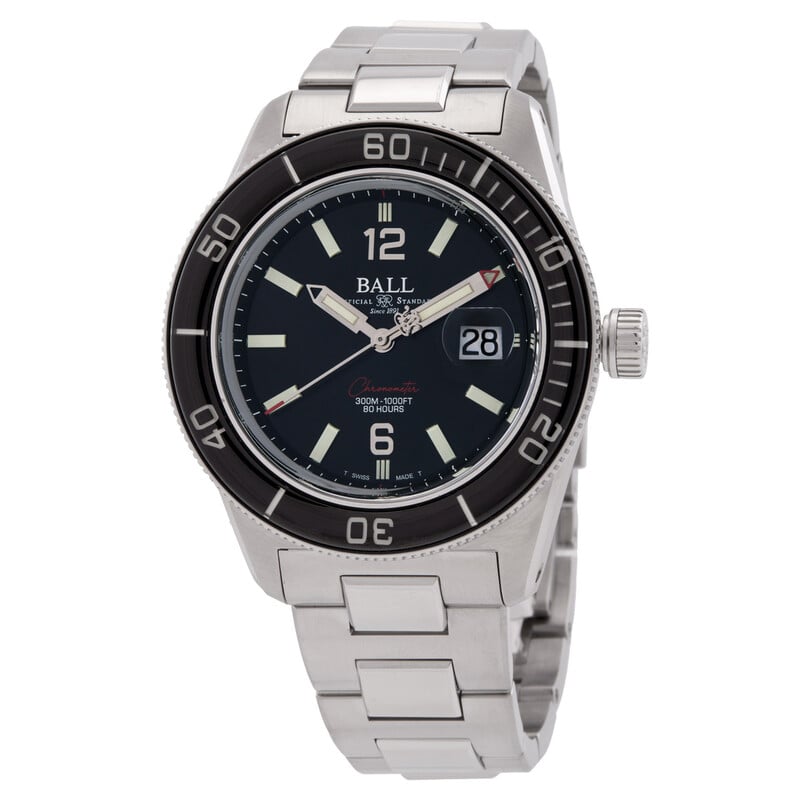
Ball Engineer M Skindiver III Review: Tool Watch Value in a Tudor World
There is a version of the modern watch market where every collector is chasing the same three references and every diver under $5,000 is measured against the Tudor Black Bay 58. That is not the whole market. The Ball Engineer M Skindiver III is aimed at the buyer who wants a capable, technical dive watch without paying the Tudor tax — or waiting on a boutique list. It is a watch that wins on specification, not on hype.
That distinction matters for anyone reading this as an investment question. Ball is a legitimate Swiss-made brand with a long railroad history and a clear tool-watch identity. But the resale market is thin, and the Engineer M Skindiver III is not a watch you buy to flip. It is a watch you buy because the combination of COSC certification, 300m water resistance, 80-hour power reserve and tritium gas tubes is genuinely useful. The value case is strong at pre-owned prices. At retail, it is more complicated.
Brand History: Railroad Standards and Swiss Tool Watches
Ball Watch Company was founded in 1891 by Webb C. Ball in Cleveland, Ohio. The brand’s origin story is not about luxury salons; it is about railroad timekeeping standards. Ball became the name associated with accurate, reliable pocket watches for American railroads, and that industrial-precision identity still informs the modern catalog. Today Ball is based in Switzerland and produces sports watches with a strong emphasis on legibility, shock resistance and anti-magnetic protection.
The Engineer M Skindiver III fits that brief neatly. It is a modern dive watch with a vintage skin-diver silhouette, but the engineering story is contemporary: COSC certification, a long-power-reserve movement and tritium gas tubes. Ball is not a fashion brand trading on heritage. It is a specialist tool-watch maker with a slightly niche following. That is exactly why the secondary market is softer than the product deserves.
Case, Design and Build
The Engineer M Skindiver III uses a 40mm stainless steel case, a 13.8mm thickness and a 46.6mm lug-to-lug span. Those numbers put it in the sweet spot for a modern daily diver. It is compact enough for smaller wrists, but substantial enough to feel like a real tool watch. The case has a mix of brushed and polished surfaces, with a clearly defined bezel and a crown protected by integrated guards. The sapphire crystal is a welcome detail at this price, as is the 300m water resistance rating.
The design language is restrained. This is not a showy diver with oversized plots or a ceramic bezel designed for Instagram. The Skindiver III reads as a purposeful skin-diver with a rotating bezel, a clean dial and a bracelet that looks ready for real wear. The proportions are balanced, and the case finishing is respectable for the segment. It does not have the liquid-metal precision of an Omega, but it also does not cost like one.
The bracelet is stainless steel with a folding clasp. It is comfortable and secure, though the clasp assembly is the least elegant part of the package. The case thickness of 13.8mm is noticeable under a cuff, and the watch sits a little taller than a Black Bay 58. That is the trade-off for the movement and the 300m rating. On a 7-inch wrist it feels planted and stable. On a 6.5-inch wrist it still works, but the thickness is the main thing to try on before buying.
Dial, Lume and Legibility
Ball’s signature technology is the tritium gas tube. Unlike Super-LumiNova, which needs exposure to light to glow, tritium tubes provide constant low-level illumination for years. The Engineer M Skindiver III uses these tubes on the hour markers and hands, and the effect is immediately obvious in a dark room. It is not blindingly bright, but it is always on. For a dive watch, that is a meaningful practical advantage.
The dial itself is clean and functional. The date window at 3 o’clock is useful without dominating the layout. The bezel is easy to read, and the hands are distinct enough for quick legibility. The black dial variant is the classic choice, while the blue dial adds a little more character without becoming loud. Neither version is trying to be a dress watch. This is a tool dial with enough refinement to wear every day.
Legibility is one of the watch’s strongest arguments. The combination of high-contrast markers, a clear bezel and tritium illumination makes it easy to read in low light, on a dive boat or in a dark apartment. If you value functional lume over decorative finishing, the Skindiver III delivers.
Movement: BALL RRM7309-C
The Engineer M Skindiver III runs the BALL RRM7309-C automatic caliber. It offers an 80-hour power reserve and a 28,800 vph frequency, and it is COSC-certified. Ball describes it as a manufacture movement, and it is a significant step up from the brand’s older ETA-based calibers in terms of power reserve. The date complication is simple and useful, and the movement winds smoothly.
In practical terms, the 80-hour reserve is one of the best features of the watch. You can take it off on Friday and pick it up on Monday without resetting the time. That is a real lifestyle benefit, not a spec-sheet novelty. The COSC certification also means you can expect chronometer-level accuracy, typically within -4/+6 seconds per day, with many examples running closer to +2/+5 seconds per day in real use.
The movement is not a collector-grade micro-rotor with hand-finished anglaged bridges. It is a modern, robust engine designed for daily reliability. That is the right choice for this watch. Ball’s claim of manufacture status is worth understanding, but it should not be confused with haute-horlogerie independence. The value is in the performance, not the decoration.
On-Wrist Comfort and Daily Wear
The Skindiver III is a comfortable daily wearer, provided you are comfortable with a slightly thick case. The 40mm diameter and 46.6mm lug-to-lug span keep the watch from overhanging the wrist, and the bracelet distributes weight well. The crown guards are unobtrusive, and the bezel is easy to turn without being loose. It feels like a watch that can handle a desk, a gym session and a weekend trip without drama.
The main comfort caveat is the clasp. It is secure and functional, but it adds bulk under the wrist. If you are sensitive to clasp size, try the watch on before committing. The bracelet itself is well made for the price, with solid links and a decent taper. It is not a bracelet you would describe as luxurious, but it is clearly built for use.
On a smaller wrist, the thickness is the limiting factor. On a larger wrist, the watch feels balanced and planted. The 300m water resistance and sapphire crystal give it a robust feel that suits daily wear. It is not a dress watch, and it should not be treated as one. It is a sports watch with a clean enough design to pass in casual settings.
Accuracy and Real-World Performance
COSC certification is a meaningful benchmark at this price. The Engineer M Skindiver III is tested to the standard -4/+6 seconds per day tolerance, and real-world examples generally behave accordingly. You should expect a slight positional variation, as with any mechanical watch, but the movement is regulated to a high standard. The 80-hour power reserve also means the watch is less likely to stop between wears, which reduces the need to reset it constantly.
For a daily wearer, that combination is more valuable than a fancy finish. The Skindiver III is accurate enough for serious use and robust enough for travel. If you are the kind of collector who checks timing every morning, you will be satisfied. If you are looking for a movement with visual drama, you will need to spend more.
Occasions: Where It Works
The Engineer M Skindiver III is at its best as a daily sports watch. It works with a T-shirt, a casual jacket and a weekend bag. The 300m water resistance and tritium lume make it a natural travel companion, especially if you are going somewhere near water. It is also a credible office watch in a casual environment, though it will not pass for a dress watch.
It is not a formal piece. The case thickness, bracelet and tool-watch dial are all wrong for black tie or a conservative suit. If you need one watch for everything, this can be it — but only if your definition of everything is casual. For a serious collector, it slots in as the grab-and-go diver rather than the centerpiece of a collection.
Variants and Reference Points
The standard black-dial reference is DM2036A-SCA-BK, paired with a stainless steel bracelet. The blue-dial version is DM2036A-SCA-BE, which uses the same case and movement but adds a little more color. Both are straightforward tool watches without limited-edition games. That is a positive for buyers who want a watch, not a lottery ticket.
In the broader Ball family, the Engineer Master II Skindiver II is the obvious predecessor, while the Engineer M Marvelight andEngineer M Pioneer sit alongside it as more urban or field-oriented options. The Engineer Hydrocarbon DeepQUEST is the more hardcore diver, and the Fireman Night Train is the more affordable tritium-focused option. The Skindiver III sits in the middle of the Ball range: more refined than the entry models, less extreme than the Hydrocarbon series.
Competition: Tudor, Omega, Longines, Oris and Sinn
The obvious rival is the Tudor Black Bay 58. Tudor has stronger brand equity, better resale and a more cohesive vintage design. The Black Bay 58 also wears thinner, which matters for daily comfort. But the Ball wins on water resistance, power reserve and tritium lume. If you care about specifications and do not care about brand status, the Ball makes a strong case. If you care about resale, Tudor wins without much debate.
The Omega Seamaster Diver 300M is a step up in brand cachet and movement technology, but it is also significantly more expensive. The Longines Legend Diver offers vintage skin-diver style, but it has lower water resistance and no tritium illumination. The Oris Divers Sixty-Five is a comparable value proposition with a retro feel, but it does not match the Ball’s technical lume or 300m rating. The Sinn U50 is the closest philosophical rival: a German tool watch with a no-nonsense attitude and strong engineering credibility. Sinn has a more dedicated cult following; Ball has the tritium advantage.
None of these watches is a direct substitute. The Ball’s niche is the combination of COSC certification, 80-hour power reserve, 300m water resistance and tritium gas tubes at a sub-$3,000 retail price. That is a genuinely differentiated package.
Investment Value and Resale
The retail price is around $2,999, and the pre-owned market typically trades between $1,600 and $2,200 depending on condition, dial color and completeness. That is a meaningful depreciation from retail, which is normal for Ball. The brand does not have the auction history or collector base of Tudor, Omega or Rolex. There is no major auction history for this reference, and liquidity is limited.
The trend is depreciating. That does not mean the watch is bad; it means the market does not treat it as a store of value. If you buy at retail, you should expect to lose money if you sell. If you buy pre-owned, you are letting someone else take the depreciation hit, which is the smarter entry point. The hold recommendation is simple: buy pre-owned if you want the specification and the tritium lume. Do not buy it as an investment. Do not buy it to flip. Buy it to wear.
For serious collectors, the Skindiver III is a useful reminder that value and investment are not the same thing. It is a lot of watch for the money, but the money is better spent on the secondary market. The price range of $1,600 to $3,000 captures the spread between a good pre-owned example and a new retail piece. The verdict is that the pre-owned buyer gets the better deal.
Service and Ownership
Ball recommends service through its authorized network, and that is the safest route for tritium tube and parts support. Independent watchmakers can service the base movement, but Ball-specific components may be harder to source. Service costs are not dramatically higher than other Swiss brands in this segment, but you should budget for routine maintenance. The watch is not a disposable object, and the movement deserves proper care.
Ownership is straightforward. The bracelet is easy to adjust, the clasp is secure and the sapphire crystal is scratch-resistant. The main long-term consideration is the tritium tubes, which have a finite life and will eventually dim. Ball can replace them, but that is a service consideration rather than a daily concern. For most owners, the tubes will remain useful for many years.
Final Verdict
The Ball Engineer M Skindiver III is one of the better spec-per-dollar divers in the sub-$3,000 bracket. It offers COSC certification, an 80-hour power reserve, 300m water resistance and tritium gas tubes in a compact steel case. It is not a status symbol, and it is not an investment. It is a well-engineered tool watch with a clear purpose.
Buy it pre-owned if you want a daily diver that stands out on technical merit rather than brand hype. Buy it at retail only if you plan to keep it and you value the warranty and dealer experience. Either way, do not expect it to appreciate. The Engineer M Skindiver III is a watch for collectors who care about what a watch does, not just what it says on the dial.