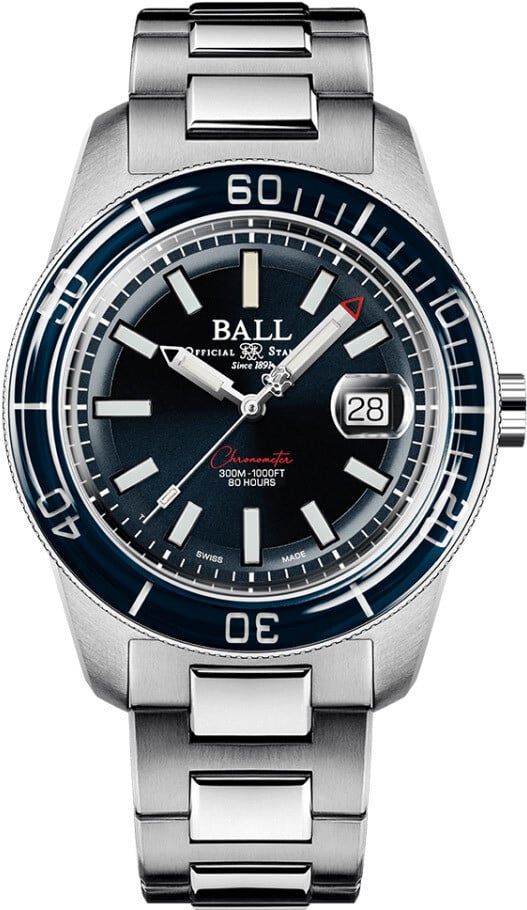
BALL Watch: The Brand Serious Collectors Find Late
There is a particular kind of watch enthusiast who arrives at BALL after a decade of Tudors and Omegas. They have usually been tipped off by someone with an engineering background, they have read the spec sheet twice to make sure they are not being sold a gimmick, and they come away slightly annoyed that nobody mentioned it sooner. The Engineer M Skindiver III Beyond is the watch that converts them.
BALL's history is not a marketing invention. Webster Clay Ball founded the company in Cleveland in 1891 in the aftermath of the Kipton train collision, and as Chief Time Inspector he effectively wrote the standards that governed American railroad timekeeping for the following half-century. The modern company was re-established in Switzerland in 2001, and it has carried that railroad obsession forward: accuracy standards, shock resistance, anti-magnetic protection and, most distinctively, the H3 micro gas tube — a tritium-filled borosilicate capsule that glows on its own for years without ever being charged by light.
The Skindiver III sits in the middle of the catalog. Above the Fireman and Roadmaster value lines, below the Engineer Hydrocarbon's over-engineered tanks. The 'Beyond' designation marks the current evolution of that platform, and it is the version that finally makes a coherent argument for BALL as a movement maker rather than merely a case maker with a clever lighting trick.
Case, Bezel and the Skin-Diver Philosophy
The skin diver is a specific and slightly misunderstood genre. It is not a saturation diver, not a 1,000-metre pressure vessel, not a watch designed to survive being run over by a Land Rover in a manufacturer's press video. It is a dive watch built to be worn constantly — thin enough for a cuff, light enough for a full day, legible enough to actually use, and durable enough that you stop thinking about it.
That is exactly the brief BALL set for the Skindiver III, and the execution is disciplined. The stainless steel case is compact and the profile is low, which puts it in a category most modern 'heritage' divers have abandoned in favour of ever-larger footprints. There is no superfluous polishing, no crown guards designed for photographs rather than fingers, and no attempt to make a tool watch look like jewellery.
The bezel is the tell. It has clean, positive detents with no discernible back-play, and the grip is generous enough that you can turn it with wet hands — a test an embarrassing number of four-figure dive watches fail. The crown is screw-down, well-shouldered and easy to engage. The sapphire crystal is the correct choice for a watch intended to be used rather than admired under a loupe.
Is it beautifully finished? No. It is honestly finished. The brushing is even, the case lines are crisp, and the transitions are competent rather than artful. BALL does not pretend to compete with Grand Seiko's Zaratsu polishing, and at this price it should not. What matters is that the case reads as a single, coherent object rather than a collection of parts assembled to hit a price point.
Dial, Legibility and the Tritium Advantage
Here is where the Skindiver III Beyond separates itself from virtually everything else in its price bracket. BALL's H3 micro gas tubes are not paint and they are not photovoltaic. Each tube contains tritium gas that excites a phosphor coating continuously, independent of ambient light. The practical consequence is straightforward: at 3am, in a tent, on a boat, in a hotel room with blackout curtains, the watch is still glowing at the same intensity it had when you took it out of the box.
Super-LumiNova is excellent, but it is a charge-and-fade technology. It is at its brightest for twenty minutes, still useful at four hours, and effectively gone by morning. Tritium tubes do not have a peak — they have a plateau that lasts for years, gently declining as the tritium's half-life does its work. BALL rates the tubes for well over a decade of useful output, and in practice owners report good visibility long after that.
The trade-off is aesthetic. Tritium tubes are physical capsules set into the dial and hands, which gives the Skindiver III a slightly clinical, instrument-like look rather than the warm, creamy glow of aged radium-style lume that vintage-styled divers chase. Some collectors love it; some find it cold. There is no middle ground, and if you are in the second camp this watch will never convince you regardless of its other merits.
Legibility is otherwise excellent. The handset is bold and unambiguous, the minute track is clearly indexed, and the dial furniture does not compete with the bezel triangle. BALL has resisted the temptation to add text or texture that would muddy the read at a glance — a discipline many brands half this watch's price have failed to learn.
The RRM7309-C: BALL's In-House Argument
The 'M' in Engineer M stands for Manufacture, and it matters. The Caliber RRM7309-C is BALL's own automatic movement rather than a rebadged ETA or Sellita, and it is chronometer-certified by COSC. On paper it delivers an 80-hour power reserve at 28,800 vibrations per hour — figures that, a decade ago, were the exclusive property of watches costing several times as much.
The 80-hour reserve is not a spec-sheet curiosity. It means the watch survives a weekend in a drawer without stopping, which means you never reset the date and time on Monday morning, which means you actually wear it instead of treating it as a special-occasion object. Combined with a screw-down crown and a robust gasket architecture, it makes the Skindiver III a genuine one-watch candidate.
What the movement does not offer is decorative finishing. This is an industrial caliber — clean, serviceable, built for reliability rather than exhibition. That is the correct decision for a tool diver, but buyers who have been trained by exhibition casebacks and Geneva stripes may find it austere. BALL has generally kept the caseback solid on this line, and that is the honest choice.
One genuine consideration: the tritium tubes will need factory replacement eventually, and the movement will need servicing like any mechanical caliber. Neither is a reason not to buy, but both belong in your cost of ownership calculation, particularly if you are buying used at a discount.
On the Wrist
The Skindiver III wears like a watch designed by someone who actually dives, which is to say it disappears rather than announces itself. The case is compact and the profile is low enough that a shirt cuff clears it without a fight — a combination far rarer in this category than marketing departments would have you believe. On the steel bracelet the package feels balanced rather than top-heavy, and the caseback sits flat instead of digging into the wrist bone.
Swap to a rubber strap or a NATO and the character changes entirely. It becomes a beater, and a very good one. The moderate weight works in its favour here: this is not a titanium featherweight, but it never feels like a hockey puck either. Owners with smaller wrists in particular tend to find that the Skindiver III is one of the few Swiss dive watches that does not require them to compromise.
The bracelet itself is competent rather than exceptional — solid links, a folding clasp, decent articulation — but the strap-change route is where this watch really lives. If you are buying one, budget for a rubber strap immediately. It is the configuration in which the design makes the most sense.
Real-World Accuracy
COSC certification guarantees -4/+6 seconds per day, and the RRM7309-C tends to run tighter than that once broken in. Expect real-world wear of roughly +2 to +4 seconds per day in mixed use, with positional variation that rewards you for resting it dial-up overnight. That is chronometer performance by any honest measure, and it is the sort of thing you stop noticing after a month because you no longer need to correct it.
The more meaningful long-term question is stability rather than raw rate. BALL's movements have a reputation for holding their regulation well between services, which is consistent with the railroad-accuracy heritage the brand trades on. If you buy used, ask for a timing report or have the watch checked on a timegrapher — an aging example that has never been serviced will show it immediately.
The Market Case: Buy Used, Hold Long
Now the part BALL's marketing department would rather I did not write. The Engineer M Skindiver III Beyond is not a good investment in the financial sense. New examples trade at full retail and then lose a substantial portion of that value on the secondary market, in line with the broader BALL catalog. Liquidity is thin, dealer networks are limited, and there is effectively no auction record to speak of. If you need to sell one quickly, you will take a haircut.
But that is precisely why the pre-owned market is where the value sits. At secondary prices, this watch competes against a very different set of alternatives — and it wins on specification. An in-house, chronometer-certified movement with an 80-hour reserve; proprietary tritium illumination; a compact, genuinely wearable case; and honest tool-watch construction. You are getting movement architecture that Swiss rivals at the same secondary price point simply do not offer.
The hold-versus-sell judgment is therefore easy: buy it to keep. Five years of wear, one service, and the depreciation maths becomes irrelevant because the cost per year is lower than almost anything comparable. The collector who buys this watch and checks its value monthly is doing it wrong. The one who buys it used, straps it to rubber and wears it in salt water is getting exactly what BALL built it for.
What Else to Consider
The obvious comparison is the Tudor Black Bay Fifty-Eight, which offers stronger brand equity, better resale and a genuinely excellent in-house movement — but no tritium, and a less distinctive engineering story. The Seiko Prospex SPB143 is the value benchmark for a compact vintage-styled diver and gets you most of the way there for considerably less. The Longines Legend Diver brings heritage credibility and better value retention. The Oris Divers Sixty-Five is slimmer and dressier. The Sinn U50 is the closest philosophical cousin: engineering-first, low-hype, and equally dependent on a buyer who knows what they are looking at.
None of them offer the specific combination BALL does. That is the entire argument for the Skindiver III Beyond — not that it beats any single rival on any single metric, but that the package as a whole is not replicated elsewhere at the price.
Verdict
The Engineer M Skindiver III Beyond is the watch BALL should be famous for: a compact, chronometer-certified dive watch with a manufacture caliber and a lighting technology no competitor can match, sold at a price that undercuts its Swiss peers. Buy it used, wear it as your daily diver, and ignore the resale chart — because the chart is the only part of this watch that disappoints. For collectors who value engineering over logos, it is one of the smartest quiet purchases in the category.