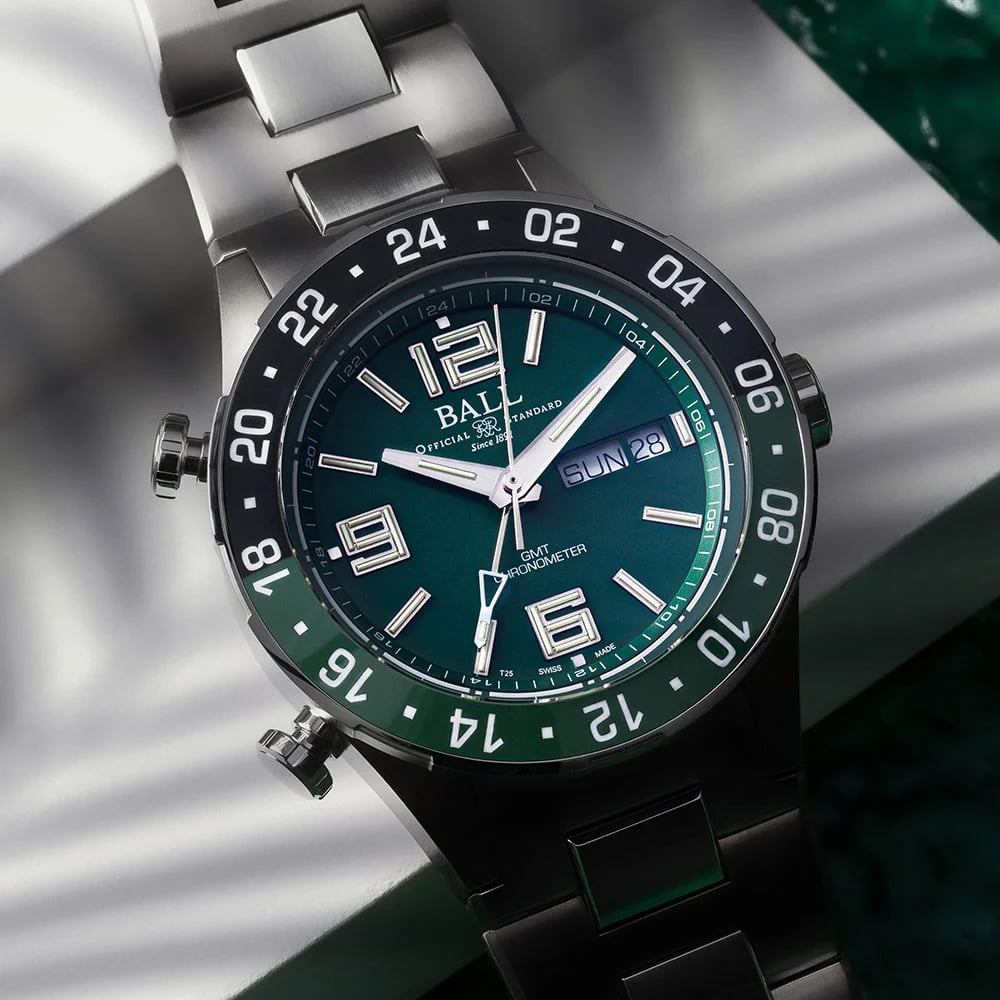
A Celestial Approach to Chronometry
In the world of luxury horology, the term 'tool watch' is often used as a marketing shorthand for any timepiece that isn't a dress watch. However, for the Ball Watch Company, the term carries the weight of history. The Roadmaster Marine GMT Meteorite (Ref. DG3222A-S2C) is the latest evolution of this ethos, blending the rugged requirements of maritime navigation with the exotic rarity of the Muonionalusta meteorite. As an editor, I have seen many brands attempt to integrate meteorite into their dials, often with mixed results that obscure legibility. Ball, however, has managed to maintain the utilitarian focus of the Roadmaster line while elevating the aesthetic to something truly special.
The Muonionalusta meteorite, which crashed into northern Scandinavia roughly one million years ago, is famous for its Widmanstätten pattern—a unique crystalline structure formed over millions of years of slow cooling in space. In the DG3222A-S2C, this pattern provides a high-contrast, metallic backdrop that complements the technical nature of the GMT complication. It is a reminder that while we track time on Earth, the materials we use often have origins that predate our very concept of hours and minutes.
Movement Architecture: The BALL RR1203-C
At the heart of the Roadmaster Marine GMT is the caliber RR1203-C. To the uninitiated, this might appear to be a standard GMT movement, but a closer inspection of the case reveals its true complexity. Unlike traditional GMT watches where the local hour hand is adjusted via the crown, Ball has implemented a patented pusher system. Located at 8 and 10 o'clock, these pushers allow the wearer to jump the GMT hand forward or backward in one-hour increments. This system is not only more intuitive for the frequent traveler but also reduces wear on the crown stem and seals.
The movement is COSC-certified, ensuring that it meets the rigorous standards of the Contrôle Officiel Suisse des Chronomètres. While the base architecture is derived from the reliable ETA 2893-2, Ball's modifications are significant. The addition of a day and date display at 3 o'clock—uncommon for a GMT—adds a layer of daily practicality that many of its competitors lack. The finishing is clean and industrial, befitting a watch designed for the 'Marine' environment. While the 38-hour power reserve is admittedly on the lower end for modern luxury watches, the efficiency of the winding system ensures that it remains topped up with even minimal wrist movement.
Case Engineering and Ergonomics
The case of the Ref. DG3222A-S2C is a masterclass in material selection. Measuring 40mm in diameter, it strikes a balance that is increasingly rare in the tool watch category. The use of Grade 5 titanium for the mid-case and components of the bracelet is a strategic choice. Titanium offers superior corrosion resistance to seawater and a significantly higher strength-to-weight ratio than stainless steel. On the wrist, the watch feels substantial without being cumbersome, a critical factor for a piece that measures 14mm in height.
The bezel is another highlight. Crafted from ceramic, it is virtually scratch-proof and features a bi-directional rotation. The 'Pepsi' color scheme—blue for day hours and red for night—is a nod to horological tradition, but the execution is modern. The numerals are etched and filled with luminous material, ensuring that the second time zone is readable in all lighting conditions. The transition between the red and blue sections of the ceramic is seamless, a testament to the manufacturing prowess required to produce bi-color ceramic components.
The Brilliance of Tritium
One cannot discuss a Ball watch without mentioning their signature use of micro gas tubes (H3). While Super-LumiNova is the industry standard, it requires an external light source to charge and fades over time. Ball's tritium tubes, however, glow consistently for up to 25 years without any need for 'charging.' In the Roadmaster Marine GMT, these tubes are integrated into the hands, the hour markers, and even the GMT pushers. The result is a watch that is arguably the most legible GMT on the market in total darkness. For the maritime professional or the overnight traveler, this constant, reliable illumination is a functional advantage that cannot be overstated.
Wrist Feel and Daily Wear
Wearing the Roadmaster Marine GMT is a tactile experience. The bracelet features a unique H-link design with a combination of brushed and polished surfaces. The inclusion of stainless steel links within the titanium bracelet is a clever move by Ball; it provides the necessary weight to prevent the watch from feeling like a 'toy,' which is a common complaint with full-titanium timepieces. The butterfly clasp is secure, though I would have liked to see a micro-adjustment system given the watch's positioning as a travel and sport piece.
The 47.8mm lug-to-lug distance ensures that the watch sits comfortably on a variety of wrist sizes. During my time with the piece, I found it to be exceptionally well-balanced. Whether worn with a casual linen shirt or more technical gear, the meteorite dial adds a level of sophistication that allows the watch to transcend its tool-watch origins. It is a piece that invites closer inspection; the way the light dances off the Widmanstätten patterns ensures that the wearer never tires of looking at the time.
The Vivir Verdict
The Ball Roadmaster Marine GMT Meteorite (Ref. DG3222A-S2C) is a watch for the connoisseur who appreciates the 'how' as much as the 'what.' It is a technically dense timepiece that offers features—such as the pusher-actuated GMT and T100 tritium tubes—that are simply not available from the more mainstream luxury houses. While the brand may not carry the same 'flex' factor as a crown or a Greek letter, the substance offered here is undeniable.
For the sophisticated young collector, this watch represents a high 'value-per-feature' proposition. You are receiving a COSC-certified chronometer, a unique extraterrestrial dial, a patented complication, and superior material science for under $4,000. In an era where stainless steel sport watches are often marked up to astronomical prices, Ball provides a grounded, technically superior alternative that literally reaches for the stars.