Ball Trainmaster MSF 55 Review: The 55-Piece In-House Railroad Dress Watch
The Ball Trainmaster MSF 55 is not a watch you trip over at every dealer. It is the 55-piece limited edition better known as the Trainmaster Manufacture 55, and it sits at the intersection of two Ball ideas: the railroad-grade legibility of the Trainmaster family and the brand's push into its own manufacture movement. That makes it more interesting than the average dress watch, and more complicated to value than the average Ball.
For collectors, the appeal is not a hype cycle. It is a low-production, chronometer-certified automatic with an in-house caliber, a classic Trainmaster silhouette, and the kind of nighttime legibility Ball does better than almost anyone at this price. The weakness is equally clear: Ball is a specialist brand, not a liquidity machine. If you need to exit quickly, the MSF 55 will not behave like a steel sports Rolex.
This review looks at the MSF 55 as a wearable object first and a secondary-market asset second. I will not invent case dimensions or service costs where published data is inconsistent. I will tell you what the watch is, how it wears, what to expect from accuracy, and whether the limited-edition number is enough to justify holding it.
What the MSF 55 Is
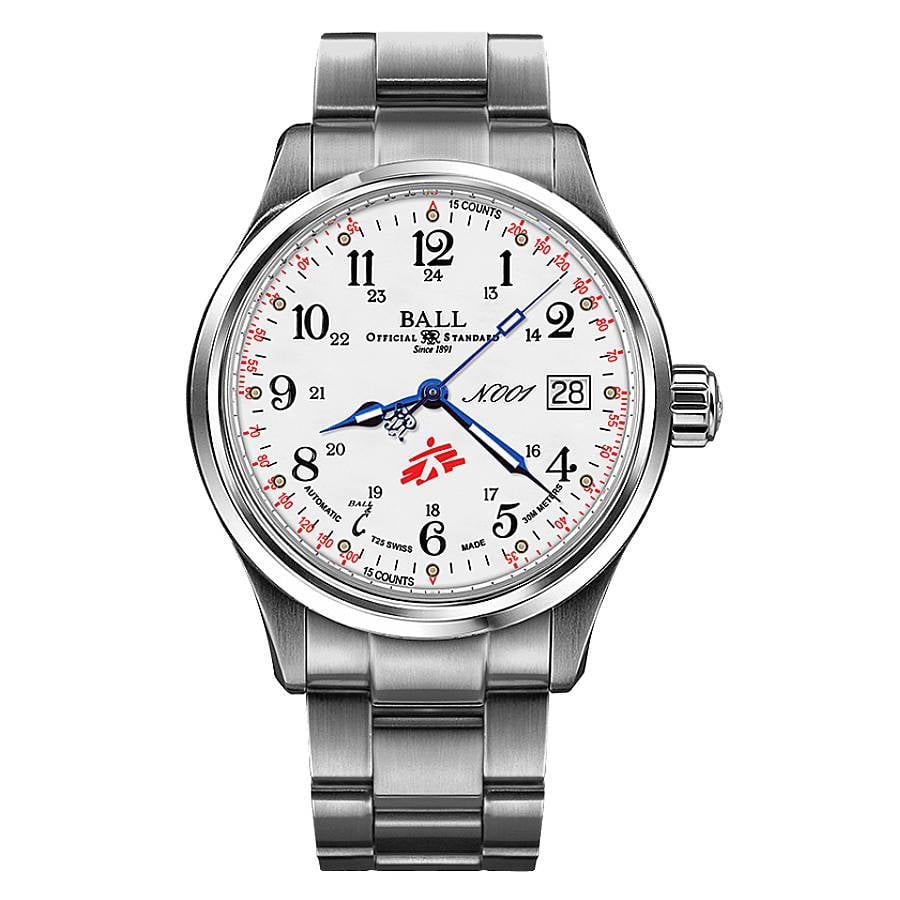
The MSF 55 is Ball's Trainmaster Manufacture 55, a limited run of 55 pieces built around the BALL RRM7309-C automatic caliber. It is a dress-leaning Trainmaster with a stainless steel case, sapphire crystal, leather strap, and Ball's H3 micro gas tubes for lume. The dial is restrained by Ball standards, which is exactly the point. This is not an Engineer Hydrocarbon with a tank-like bezel and a bracelet that could tow a car. It is a Trainmaster that wants to live under a shirt cuff.
The name matters less than the specification. A 55-piece run gives it scarcity, and the in-house movement gives it technical credibility. But Ball has made many Trainmasters over the years, and not every limited edition is a collector landmark. The MSF 55 earns attention because the movement is the story, not because the case is wildly exotic.
The dial is where the Trainmaster formula pays off. Ball keeps the layout clean and readable, with gas tubes doing the work at night rather than a busy set of applied markers. It is a watch that looks better in person than in a compressed product photo, because the case and strap proportions create the classic dress-watch stance. This is not a watch for collectors who need a loud dial or a complicated layout. It is for the buyer who wants a Trainmaster that feels considered.
Brand Context: Why Ball Matters Here
Ball Watch traces its origin to Webb C. Ball and the American railroad timekeeping standards of the late 19th century. The brand's founding date is 1891, and its early reputation was built on precision, legibility, and accountability: a watch that failed on the railroad was not a style problem, it was a safety problem. The Trainmaster name carries that DNA. Even today, when Ball is Swiss-made and positioned as a value-driven enthusiast brand, the Trainmaster line still reads as a railroad watch dressed for civilian life.
That history is relevant because the MSF 55 is not trying to be a generic luxury dress watch. It has gas tubes, a clean dial, and a movement story. It is a Ball first and a dress watch second. If you like the brand's railroad-adjacent identity, the MSF 55 makes more sense than a plain three-hander from a fashion-adjacent label. If you want a pure formal watch with no technical garnish, it may feel over-specified.
Movement and Accuracy
The MSF 55 uses the BALL RRM7309-C, an automatic manufacture caliber with an 80-hour power reserve and a 28,800 vph frequency. It is COSC-certified, which means Ball is selling chronometer performance rather than just a decorated caseback. The 80-hour reserve is genuinely useful: put it down on Friday and it should still be running on Monday, which is more than many dress watches at this price can claim.
In real-world use, a COSC-certified Ball should land inside the -4/+6 seconds per day window, and many examples will do better. Expect variation with position and wearing habits, as with any automatic. The movement is not haute horlogerie in finishing; it is industrial-clean and built for daily reliability. That is the right trade-off for this watch. You are paying for an in-house chronometer with a long reserve, not for hand-finished bridges that belong in a safe.
The date complication is useful but not transformative. The dial remains legible, and the gas tubes do the heavy lifting at night. If you are the kind of collector who resets a watch every time you wear it, the 80-hour reserve removes some of the ritual. If you rotate heavily, it is a real convenience.
Why does in-house matter here? It does not automatically make a watch better, but it does give the MSF 55 a stronger collector narrative than a modified outsourced caliber. Ball has built its reputation on robust daily watches, and the RRM7309-C fits that story. The movement is the reason this limited edition exists, and it is the reason a Ball collector will pay attention.
Case, Dial, and Wearing Experience
The case is stainless steel, the crystal is sapphire, and the strap is leather with a pin buckle. I am deliberately not quoting case diameter, thickness, lug-to-lug, or water resistance here because those figures are not consistently confirmed for every MSF 55 catalog entry. What matters is the wearing philosophy: this is a mid-sized Trainmaster that prioritizes balance over wrist presence. It does not wear like a chunky sports watch, and it does not try to.
On the wrist, the MSF 55 feels like a classic railroad dress watch with modern legibility. The stainless case and leather strap keep the weight reasonable, and the short-lug geometry should suit most wrists without overhang. It tucks under a cuff, but the gas-tube markers give it a nighttime signature that most dress watches lack. That combination is the Ball party trick: formal enough for a suit, readable enough for a dark restaurant or a late train.
The strap is the main variable. On a flat leather strap it reads formal; on a textured or rally-style strap it becomes a weekend piece. The pin buckle is lighter and less fussy than a deployant, though it will show creasing faster. Overall, it is comfortable for a full office day and not so precious that you fear wearing it. That matters more than a spec sheet for a watch like this.
Wrist Presence and Occasions
I would rate wrist presence at 3.5 out of 5. The MSF 55 is refined, not loud. It has enough dial interest and gas-tube glow to satisfy an enthusiast, but it will not announce itself across a room. That is a feature if you want a dress watch that works in conservative settings. It is a limitation if you want a limited edition that feels like an event on the wrist.
Occasions are straightforward: formal, daily, dress, and travel. It is not a sport watch, and I would not treat it as a beach or gym companion. But it is versatile enough for office wear, dinners, and travel where you want one watch that reads clean with a jacket and still glows at night. The leather strap makes it seasonal; in heavy summer humidity, you may want a spare strap or a more casual alternative.
Market and Investment Case
The MSF 55 launched as a limited edition, and public pricing has clustered around the $4,999 mark at introduction. It is discontinued, so current retail is effectively zero. Pre-owned examples should trade in the $2,900 to $4,300 range depending on condition, completeness, and whether the limited-edition papers are present. That is a stable but niche market, not an appreciating asset.
The limited run of 55 pieces helps scarcity, but scarcity alone does not create liquidity. Ball collectors are passionate and knowledgeable, but the brand does not have the auction depth of Rolex, Patek Philippe, or even Omega. There is no major auction history for the MSF 55 to point to, and most transactions will happen privately or through specialist secondary marketplaces. That means you should buy the watch, not the story.
My hold-versus-sell take is simple: if you already own one and enjoy wearing it, hold. The limited number and in-house movement give it a reason to stay in a collection, and the financial downside is manageable at current pre-owned levels. If you are buying purely for appreciation, pass. The MSF 55 is a collector's watch, not an investment vehicle. Buy a complete example with box and papers, have it checked by a watchmaker, and assume normal service costs down the line.
Service should go through Ball's authorized network. I am not quoting a service interval or cost because those figures vary by region and by the work required. Budget for routine maintenance as you would for any Swiss automatic, and avoid unknown repair shops unless they specialize in Ball movements.
What to Check When Buying
Condition matters more than the limited-edition number. Check the case for polishing, because a heavily polished stainless case can soften the Trainmaster's clean lines. Verify that the gas tubes are intact and glowing; tritium gas tubes have a long service life, but they are a signature feature and should be assessed in person. Confirm the limited-edition number on the caseback and make sure it matches the paperwork.
Ask about service history and whether the watch has been opened by an unauthorized shop. The in-house movement is not impossible to service, but it is not a generic ETA that every local watchmaker should practice on. A complete set with box and papers is worth a premium at resale because Ball collectors are detail-oriented. A loose watch may be a bargain, but it will be harder to sell later.
Alternatives and Homages
If the MSF 55 is on your shortlist, compare it with an Omega De Ville Prestige for stronger brand liquidity and a more traditional dress-watch finish. The Longines Master Collection is a lower-cost classical automatic with broad dealer support. The Grand Seiko Heritage line offers superior finishing and a different kind of collector credibility, though at a higher price. The Tudor 1926 is a mid-price dress-sport alternative with stronger resale than Ball.
On the homage side, the Orient Bambino delivers a classical dress-watch look at a fraction of the price, the Seiko Presage Cocktail Time offers a more expressive dial for a few hundred dollars, and the Tissot Le Locle Powermatic 80 gives you a Swiss automatic dress watch with easy service access. None of them have the MSF 55's gas tubes or in-house movement, but they scratch the same formal-watch itch.
Collector Context
The MSF 55 is best understood as a niche collector piece within the Ball universe. It is not a first watch for someone who wants one do-everything mechanical object. It is a second or third watch for a collector who already has a sports watch and wants a dressier Ball with a movement story. That buyer will appreciate the 55-piece run, the COSC certification, and the gas-tube legibility more than the average luxury shopper.
Compared with mainstream Trainmaster models, the MSF 55 has a clearer reason to exist. The in-house caliber and limited production separate it from the standard lineup. But it still carries Ball's general market profile: good value on the secondary market, strong enthusiast support, and limited mainstream liquidity. That is not a criticism. It is simply the reality of buying a specialist brand.
Pros and Cons
Pros: in-house COSC-certified automatic, 80-hour power reserve, 55-piece limited edition, excellent nighttime legibility from H3 gas tubes, classic Trainmaster silhouette, comfortable leather-strap package, and a stable pre-owned market at the right price.
Cons: niche resale versus mainstream luxury brands, no major auction record, limited public specification consistency, leather strap is not a summer-friendly solution, and the watch is not sporty enough for one-watch duties if you need water resistance and durability.
Final Verdict
The Ball Trainmaster MSF 55 is a smart enthusiast purchase, not a status purchase. It gives you a limited-edition, in-house, chronometer-certified Trainmaster with real nighttime utility and a classic dress-watch profile. At pre-owned prices, it is a lot of watch for the money if you value the movement and the brand's railroad DNA.
Buy it because you want a low-production Ball that wears well and does not look like everything else. Do not buy it because you think 55 pieces equals a guaranteed return. The MSF 55 is a hold if you own it, a selective buy if you find a complete example, and a pass if you need liquid resale above all else.