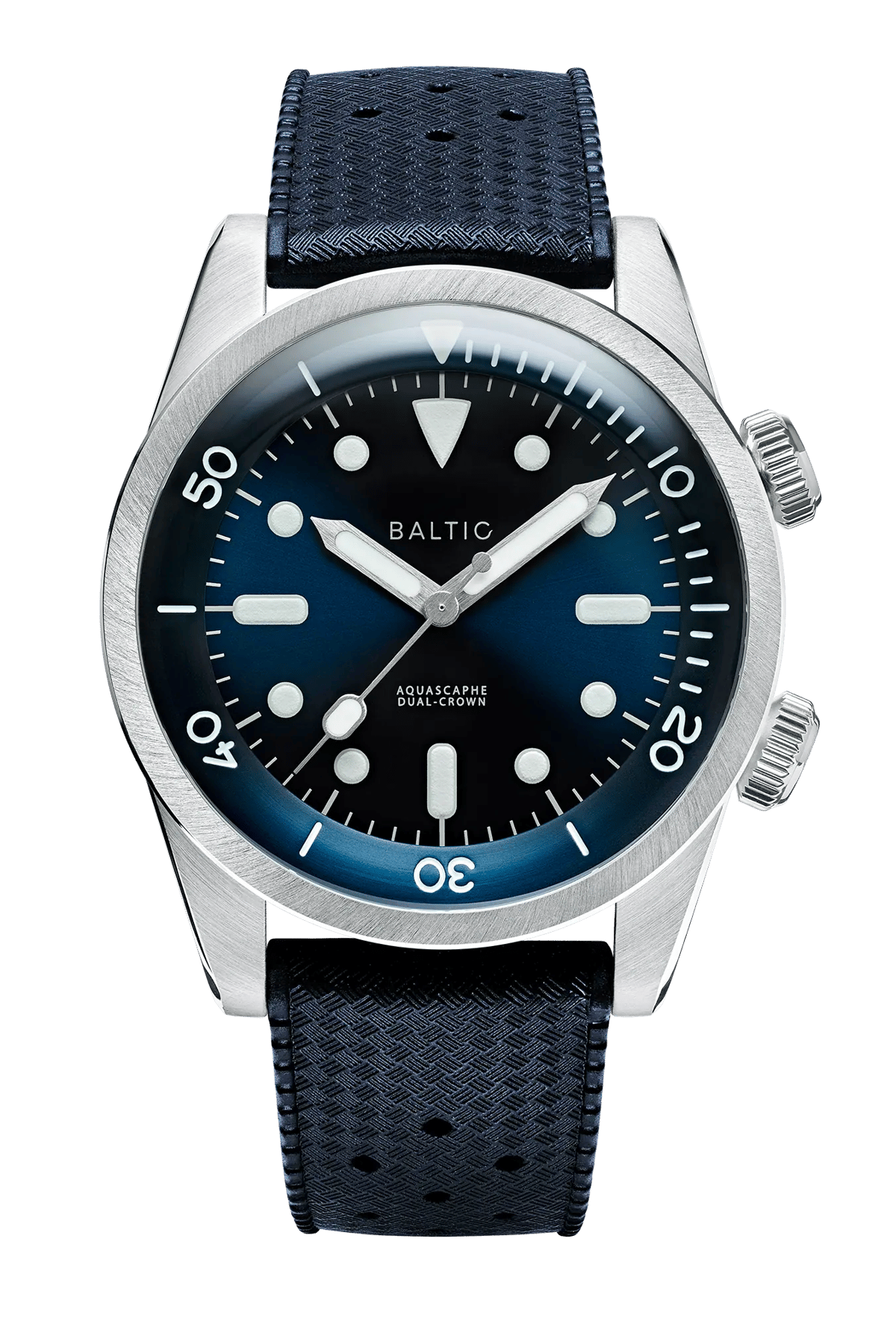
The French Disruptor: Baltic's Rise
Baltic was founded in 2017 by Etienne Malec, a French watch enthusiast who turned a passion for vintage watches into a direct-to-consumer brand. The company is based in France and has built its reputation on affordable, well-designed watches that capture the spirit of mid-century horology without the mid-century price tag. Baltic's early models, like the HMS and Bicompax, won over collectors with their clean dials and honest pricing. The Aquascaphe line, launched in 2018, brought the brand into the dive-watch conversation.
The Dual-Crown arrived later, as a more specialized take on the compressor-style diver. Compressor cases were originally developed by brands like EPSA in the 1950s and 1960s. They used a spring-loaded caseback that tightened under water pressure, and many featured two crowns: one for winding and setting, one for an internal rotating bezel. The Dual-Crown revives that concept with modern materials. Baltic did not invent the compressor; it made it accessible again. That is the brand's superpower.
Baltic's rise is also a story about the modern collector. The brand built its audience through online forums, Reddit, and Instagram, where enthusiasts share wrist shots and debate value. Limited editions and collaborations sell out quickly, creating a drop culture around what is still a small French company. The Dual-Crown is not a limited edition, but it carries that same energy: a design-forward watch that feels like a discovery.
Movement: Miyota 9039 Automatic
The Aquascaphe Dual-Crown ref. DUA11BLAS21 is powered by the Miyota 9039, a Japanese automatic movement. It is not in-house, and it is not COSC-certified. What it is: a known quantity. The 9039 is a no-date movement, which suits the Dual-Crown's clean, symmetrical dial. It runs at 28,800 vph, has 24 jewels, and delivers a 42-hour power reserve. That is a solid, modern specification for a watch at this price point.
The 9039 is essentially a date-free version of the ubiquitous Miyota 9015. It is thin, reliable, and easy to service. You will not find the decorative finishing of a Swiss manufacture, but you will find a movement that starts easily, hacks, and hand-winds. For a tool watch, that is exactly what matters. The no-date layout also means no cyclops, no date window interrupting the dial, and no fuss when you pick it up after a weekend. Set it and go.
Some collectors turn their noses up at Miyota, but that is a mistake. The 9039 is used by dozens of microbrands because it works. It is accurate enough for daily wear, robust enough for travel, and inexpensive enough to service without a second mortgage. In a watch like the Dual-Crown, the movement is not the star. The design is. The 9039 stays out of the way and lets the dial do the talking.
Specs and Case: The Compressor Formula
The Dual-Crown's case is stainless steel, with a diameter of 39mm, a thickness of 12.5mm, and a lug-to-lug of 47mm. Those numbers are close to the goldilocks zone for modern dive watches. The 39mm diameter gives it vintage proportions, while the 47mm lug-to-lug keeps it wearable on a wide range of wrists. The 12.5mm thickness is reasonable for an automatic diver with an internal bezel, and it slides under a cuff more easily than many 200m-rated competitors.
Water resistance is 200 meters. The crystal is sapphire. The lume is Super-LumiNova C3, which glows a classic green. The bracelet is a stainless steel beads-of-rice design with a deployant clasp. The beads-of-rice bracelet is a period-correct touch; it is comfortable, flexible, and visually distinct from the oyster-style bracelets that dominate the category. The deployant clasp keeps the bracelet secure and reduces wear on the strap.
The dual crowns are positioned at 2 o'clock and 4 o'clock. The upper crown operates the internal rotating bezel; the lower crown winds and sets the movement. The internal bezel is a key part of the compressor aesthetic. It keeps the case profile clean and avoids the external bezel that can snag on gear. The bezel action is firm and precise, with enough grip to turn even with wet fingers. The crown at 4 o'clock is slightly recessed, which prevents accidental knocks. This is a thoughtful layout.
The case finishing is a mix of brushed and polished surfaces. The lugs are brushed, which hides scratches well. The bezel edge and crown guards have a subtle polish that catches light. The sapphire crystal has an anti-reflective coating, making the dial easy to read in bright sun. The caseback is solid, with engraving that includes the reference and water resistance. It is not a display back, but that is fine. The movement is not the point.
On the Wrist: Comfort and Balance
On the wrist, the Aquascaphe Dual-Crown feels smaller than its 39mm diameter might suggest. The short lug-to-lug and the curved lugs help it hug the wrist. The beads-of-rice bracelet drapes nicely and distributes weight evenly. At around 12.5mm thick, it has enough presence to feel substantial without being top-heavy. The caseback is flat enough to sit comfortably, and the dual crowns do not dig into the back of the hand. I wore it for a full day of desk work and errands, and it never became a distraction.
The blue gilt dial is the star. The blue has a sunburst-like depth, and the gilt printing and hands add warmth. The internal bezel ring is legible, and the lume plots are generous. The hands are broad enough for quick reads. The no-date layout keeps the dial balanced. The beads-of-rice bracelet matches the vintage vibe perfectly. It is the kind of watch that looks good with a t-shirt and jeans, but also works with a casual button-down. It is not a dress watch, but it is not purely a beater either. It occupies a sweet spot: rugged enough for the beach, refined enough for the office.
The bracelet is easy to adjust, and the deployant clasp is secure. If you prefer a rubber strap, the Dual-Crown looks great on one, and the 20mm lug width makes strap changes simple. A NATO or sailcloth strap also works, giving the watch a more casual, military feel. The dual crowns do not interfere with strap changes, which is a small but appreciated detail.
Accuracy: What to Expect Day to Day
The Miyota 9039 is rated by the manufacturer to run within -10 to +30 seconds per day. In real-world use, most examples perform better than that broad range. Expect something in the neighborhood of -5 to +15 seconds per day, depending on position and temperature. That is not chronometer-grade, but it is perfectly acceptable for a watch at this price. If you are the type who syncs to an atomic clock every morning, you will notice the drift. If you are the type who sets your watch once a week, you will be fine.
The movement hacks, so you can set it precisely. The winding action is smooth, and the crown is easy to grip. The 42-hour power reserve means it will keep running if you take it off Friday night and put it back on Monday morning. That is a practical benefit for a daily wearer. If you need COSC-certified accuracy, you will need to look elsewhere, but you will also need to spend significantly more.
If accuracy is a concern, any watchmaker can regulate a Miyota 9039. It is not a complicated movement, and a good regulation can bring it closer to +5 seconds per day. That is one of the advantages of a common caliber: you are not locked into an expensive service center. You can have it tuned to your liking without shipping it across the world.
Occasions: Where It Fits
The Dual-Crown is a sport watch at heart, but its vintage styling makes it more versatile than a modern tactical diver. It works for sport, daily wear, travel, and casual settings. It is not a formal dress watch, though the blue gilt dial and steel bracelet can pass with a blazer in a pinch. It is not a dedicated tool watch for saturation diving, but 200m water resistance is more than enough for swimming, snorkeling, and recreational diving. It is a travel-friendly watch because it is robust, legible, and not so expensive that you will panic if it gets scratched.
For the office, it pairs well with business casual. For the weekend, it looks at home with a t-shirt and shorts. For travel, the internal bezel can be used to track a second time zone in a pinch, though it is not a true GMT. The no-date layout means you do not have to reset a date when you cross time zones. That is a small but real convenience. The Dual-Crown is the kind of watch you can wear for almost anything short of black tie.
Wrist Presence: 4/5
I give the Aquascaphe Dual-Crown a 4 out of 5 for wrist presence. It has a distinctive look thanks to the dual crowns and internal bezel, and the blue gilt dial catches light in a way that draws attention without shouting. It is not a massive watch, so it will not dominate a room. But among watch people, it will start conversations. The beads-of-rice bracelet adds a vintage flair that sets it apart from the sea of Submariner homages. It is a watch that rewards a closer look.
The only reason it is not a 5 is size. If you are used to 42mm divers, the 39mm case may feel modest at first. But that is also its strength. It is a watch that disappears on the wrist in the best way, leaving you free to go about your day. It is not a status symbol in the traditional sense. It is a taste signal. Those who know, know.
Reference Variants
The Dual-Crown family includes a few dial and strap options. The reviewed reference DUA11BLAS21 is the blue gilt dial on the stainless steel beads-of-rice bracelet. The black dial variant, DUA11BKAS21, offers a more subdued, classic look on the same steel bracelet. Other combinations exist, including rubber strap options, but the blue gilt on steel is the one that best captures the compressor spirit.
If you are choosing between the blue and the black, think about your wardrobe. The blue gilt is more playful and vintage. The black is more versatile and stealthy. Both share the same case, movement, and bracelet. The blue is the one that gets the most attention online, and it is the reference that put the Dual-Crown on the map. The black is the sleeper pick for someone who wants the same design without the flash.
Family References
The Dual-Crown sits within the Aquascaphe family, alongside the Aquascaphe Classic, the Aquascaphe GMT, and the Aquascaphe Titanium. The Classic is the simpler, no-frills diver. The GMT adds a fourth hand for travelers. The Titanium offers a lighter case. Each shares the same vintage-inspired design language, but the Dual-Crown is the most specialized and arguably the most characterful.
The Aquascaphe Classic is the entry point, with a similar 39mm case and Miyota movement. The GMT is for those who need a true travel complication. The Titanium is for weight-conscious collectors. The Dual-Crown is for those who want the compressor look and the internal bezel. It is the enthusiast's choice within the family.
Other Notable Baltic Models
Baltic has built a diverse catalog beyond the Aquascaphe. The MR01 is a dress watch with a micro-rotor movement and a vintage Art Deco feel. The HMS 002 is a clean, sector-dial everyday watch. The Bicompax 002 is a manual-wind chronograph with a classic layout. The Prismic is a more recent release with a contemporary design. Baltic has also experimented with collaborations and limited editions, which often sell out quickly. The brand has become a favorite among collectors who want design-forward watches without the luxury markup.
If you like the Dual-Crown, it is worth exploring Baltic's other lines. The MR01, in particular, shows the brand's ability to do dress watches with the same value proposition. The Bicompax 002 is a great option for someone who wants a mechanical chronograph without spending thousands. Baltic has proven it is not a one-hit wonder.
Similar Watches
If you are considering the Dual-Crown, you might also look at the Oris Divers Sixty-Five, the Longines Legend Diver, the Christopher Ward C65 Super Compressor, and the Vulcain Nautical Heritage. The Oris offers Swiss movement and a similar vintage dive aesthetic. The Longines Legend Diver has a true dual-crown internal bezel design and more heritage, but it costs significantly more. The Christopher Ward C65 Super Compressor is a direct competitor with a compressor-style case and modern specs. The Vulcain Nautical Heritage is a tribute to the original super-compressor, but it is in a different price bracket entirely.
Each of these watches has its own strengths. The Oris has a more refined bracelet and a Swiss Sellita movement. The Longines has brand prestige and a rich history. The Christopher Ward has a light-catcher case and a display back. The Vulcain has the original DNA. But none of them match the Baltic on price. The Dual-Crown gives you 90 percent of the experience for 30 percent of the cost.
Homages and Alternatives
For buyers on a tighter budget, there are homage-style alternatives. The Seiko 5 Sports SRPD line offers a sporty diver look for around $250, though it lacks the dual-crown compressor layout. The Vostok Amphibia is a quirky, affordable dive watch with a compressor-style case on some models, priced around $100. The San Martin SN008-G is a modern homage with sapphire crystal and solid bracelet for around $250. These are not the same watch, but they capture parts of the vibe. If you want the real dual-crown experience, the Baltic is still the value leader.
It is worth noting that none of these alternatives have the same combination of design, finishing, and brand cachet. The Seiko is a great beater, but it does not feel special. The Vostok is a cult classic, but it is crude. The San Martin is impressive for the money, but it lacks the Baltic's refined dial and bracelet. If you can stretch to the Baltic, it is the better long-term purchase.
Investment Value
The Baltic Aquascaphe Dual-Crown ref. DUA11BLAS21 had an original MSRP of around $725. Current retail is also around $725. On the pre-owned market, expect to pay between $500 and $650, depending on condition and whether the original box and papers are included. The trend is stable. This is not a watch that will appreciate like a Rolex or a limited-edition Speedmaster. It is a watch that you buy to wear. The hold recommendation is simple: if you love the design, buy it and enjoy it. Do not buy it as an investment. There is no major auction history for this reference, and that is unlikely to change. The value proposition is in the wearing, not the flipping.
That said, Baltic has a strong following, and certain limited editions have sold out quickly and traded above retail. The Dual-Crown is not limited, but it is popular. If you buy used, you can often find a good example for under $600, which is excellent value. If you buy new, you get the full warranty and the satisfaction of supporting a small brand. Either way, you are getting a lot of watch for the money.
Service and Maintenance
The Miyota 9039 is a common movement, and service is straightforward. You are not required to use Baltic's authorized service network; many independent watchmakers can handle a Miyota 9039. That said, using a trusted watchmaker is always recommended. Service costs are typically lower than for Swiss movements, and parts are readily available. The watch is built to be worn, so do not baby it. A routine service every several years will keep it running well. The sapphire crystal is scratch-resistant, and the 200m water resistance means you can swim with confidence as long as the gaskets are in good condition.
If you do send it to Baltic, turnaround times can vary, but the brand has a good reputation for customer service. The watch is not complicated, so most issues can be resolved quickly. The deployant clasp and bracelet are also easy to maintain. A quick rinse with fresh water after saltwater exposure will keep the case and bracelet looking new. This is a tool watch, and it is meant to be used.
Pros and Cons
Pros: Strong vintage compressor style; excellent value for the specs; comfortable 39mm case; sapphire crystal and 200m water resistance; reliable Miyota 9039 movement; distinctive dual-crown layout; beads-of-rice bracelet adds character.
Cons: Not an in-house movement; no date may bother some; microbrand resale can be soft; the clasp could be more refined; the internal bezel is not as easy to operate as an external bezel for some users.
Final Verdict
The Baltic Aquascaphe Dual-Crown ref. DUA11BLAS21 is one of the best value propositions in the vintage-inspired dive watch market. It delivers the romance of a 1960s super-compressor without the fragility or the five-figure price tag. The 39mm case, blue gilt dial, and beads-of-rice bracelet make it a joy to wear. The Miyota 9039 is not glamorous, but it is reliable and easy to live with. If you want a watch that looks like it has a story, but you do not want to mortgage your collection to get it, this is a compelling choice. It is not an investment. It is a tool, a style piece, and a conversation starter. For the sophisticated young collector, that is often the best combination.