Baltic Aquascaphe GMT MK-II: A Week on the Wrist
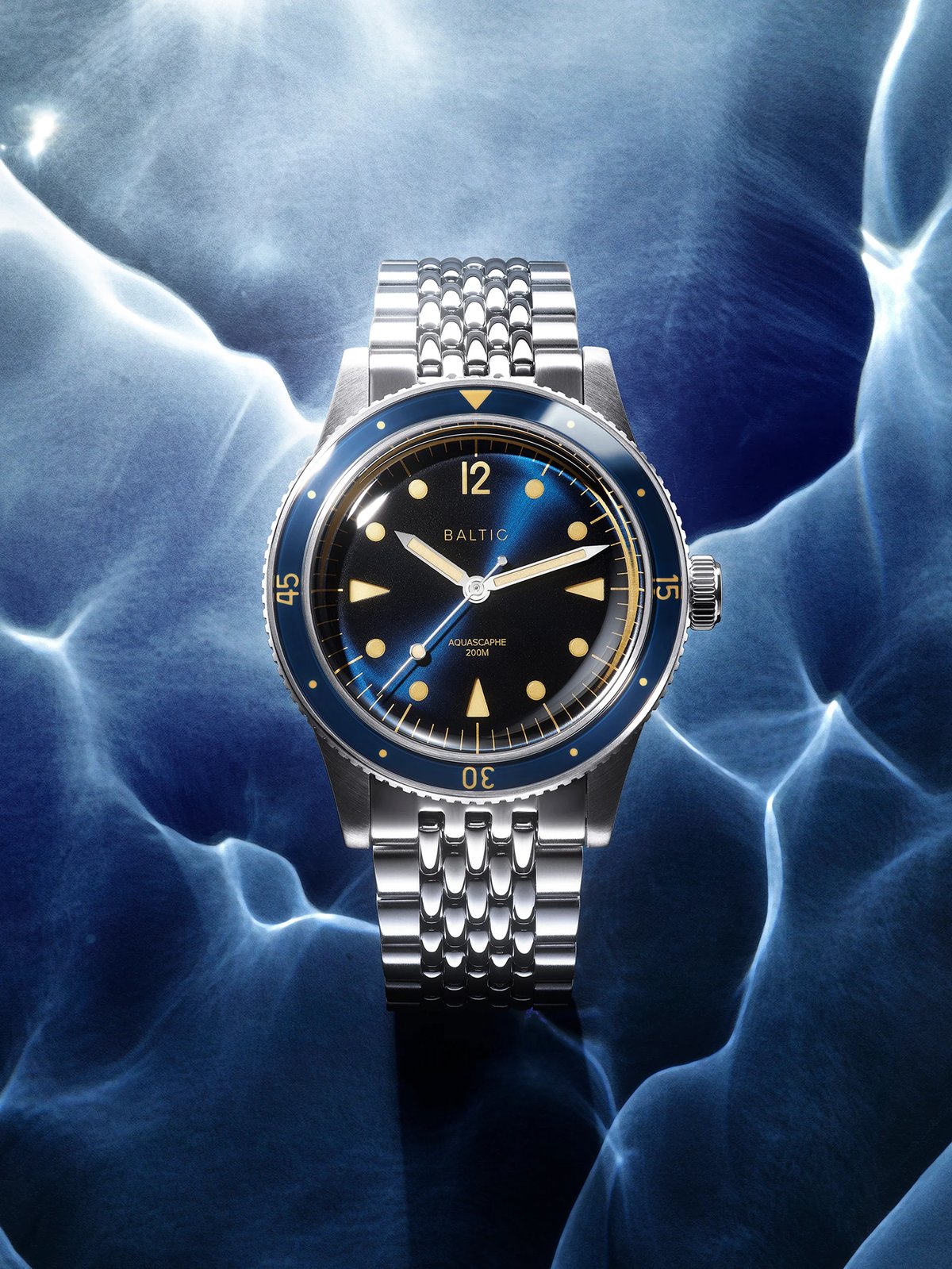
I wore the Baltic Aquascaphe GMT MK-II for seven straight days: desk, train, school run, a damp weekend by the coast, and one dinner where I probably should have worn something dressier. That is the right test for this watch. The Aquascaphe GMT MK-II is not a safe-queen travel GMT; it is a compact steel dive watch with a 24-hour hand, a date, and a bracelet that invites daily abuse. At around $1,150, it sits in the busy space between microbrand value and entry-level Swiss alternatives, and its case proportions are the reason it works.
What the MK-II is
Baltic is a French brand founded in 2016 by Etienne Malec. It built its reputation on vintage-informed designs sold direct, and the Aquascaphe is its anchor family. The GMT MK-II takes the Aquascaphe dive-watch formula and adds a traveller-style GMT complication: the local hour hand jumps independently, while the 24-hour hand and bezel track home time or a second time zone. That makes it more useful in an airport than a caller GMT, where you adjust the GMT hand instead.
The MK-II is a refinement rather than a reinvention. The case is stainless steel, the crystal is sapphire, the crown screws down, and the watch is rated to 200 metres. The dial is clean, the bezel is a 24-hour unit, and the bracelet is the version to order if you want one watch to do everything. It is a Baltic through and through: vintage proportions, modern specs, direct-to-consumer pricing.
Case, bracelet, and wrist feel
The numbers are 39mm across, 12.5mm thick, and 47mm lug-to-lug. On my 16.5cm wrist, that translates into a watch that sits inside the wrist bones rather than over them. The 47mm lug-to-lug is the figure that matters most. It keeps the lugs from overhanging, and the 12.5mm thickness keeps the case from feeling like a puck under a shirt cuff. The case has enough presence to read as a dive watch, but it does not dominate a small wrist.
The bracelet is the surprise. It articulates easily, the links are not sharp, and the folding clasp sits flat. I wore it slightly loose on warm days and snug in the morning, and it never pinched. The steel bracelet adds visual weight to the watch, but the case remains balanced on the wrist. On a rubber strap the Aquascaphe GMT MK-II becomes lighter and more casual; on the bracelet it is a proper daily wearer. The crown is easy to grip, the bezel has a firm action, and the whole package feels more considered than the price suggests.
Dial, bezel, and legibility
Legibility is where the MK-II earns its keep. The dial is matte enough to kill glare, the applied markers are large enough to read at a glance, and the hands are distinct without being cartoonish. The GMT hand is the critical detail: it is readable against the dial, but it does not shout over the local time. The date at 3 o'clock is small and unobtrusive. The 24-hour bezel is easy to set and useful for travel, though it is not a substitute for a world-time bezel if you cross multiple zones in a week.
Lume is Super-LumiNova BGW9, and it performs as you would hope. After a few minutes under a lamp, the dial and bezel remained readable through a dark hotel room. The lume is not a torch, but it is even and practical. The sapphire crystal has a subtle domed profile that catches light without washing out the dial. The overall effect is tool-watch clarity with a vintage accent, not a fussy dress watch pretending to be a diver.
Movement and accuracy
The movement is a Miyota 9075, an automatic traveller GMT with a jumping local hour hand, a date, 42 hours of power reserve, 28,800 vibrations per hour, and 24 jewels. It is not in-house, and it is not COSC-certified. That is the honest trade at this price. The 9075 is a proven, thin calibre that allows the case to stay at 12.5mm, and it is easy for a watchmaker to service. The winding is smooth enough, though the rotor is audible if you listen for it in a quiet room.
On the wrist, my sample ran within about +8 seconds per day over the week, with variation depending on how I left it overnight. I would expect most examples to settle somewhere in the -10 to +15 seconds per day range. That is not chronometer accuracy, but it is perfectly livable for a daily wearer. The GMT function is the real point: setting local time when you land is quick, and the date follows correctly when you use the jumping hour hand. The power reserve is adequate rather than generous; if you rotate watches, put it on a winder or expect to reset it.
Living with it for a week
The Aquascaphe GMT MK-II is one of those watches that disappears on the wrist in the best way. It is comfortable enough for a full day at a desk, sporty enough for a weekend, and restrained enough for a smart-casual dinner. The 39mm case and 47mm lug-to-lug make it a natural daily wearer for smaller wrists, while the 200m water resistance and screw-down crown mean you do not have to baby it. I wore it in the rain, washed it under a tap, and knocked it against a door frame; the case and crystal took it without drama.
The bracelet picks up scratches, as steel bracelets do, but the case finishing hides them well. The bezel action is firm and aligned, and the crown is easy to use. The only daily annoyance is the date window: it is small, but the aperture is clean and the font is legible. The watch does not try to be a dress watch, and that is why it works. It is a travel-capable dive watch with vintage proportions, not a luxury object that needs its own pillow.
Occasions and wrist presence
I would wear this watch for daily duty, sport, travel, and smart casual. It can pass with a jacket, but it is not a formal watch; the bezel and bracelet keep it firmly in the casual lane. Its wrist presence is about three and a half out of five: enough to be noticed by someone who knows watches, not enough to announce itself across a room. That is a compliment. The MK-II is confident without being loud.
It also makes a sensible one-watch travel companion. The 24-hour bezel and jumping local hour hand are easy to use on the move, and the 200m rating means you can swim without thinking about it. The rubber strap option makes it a better beach watch; the steel bracelet makes it a better city watch. Neither turns it into a dress watch, but that is not the brief.
Competition and value
The obvious alternatives are the Christopher Ward C65 Aquitaine GMT, the Lorier Hydra SIII, the Farer Lander GMT, and the Nodus Contrail GMT. The Christopher Ward brings Swiss movement and a slightly larger case; the Lorier is more vintage and more microbrand in feel; the Farer is more colourful and extroverted; the Nodus is more modern and robust. The Baltic sits in the middle with compact proportions and a true traveller GMT, which is still rare under $1,500.
Homages exist, as they always do. The Pagani Design PD-1662 GMT and the San Martin SN0055 GMT offer the look for a fraction of the price, but they do not offer the same case finishing, bracelet quality, or warranty. If you want the experience rather than the silhouette, the Baltic is the better buy. At around $1,150, the MK-II is not cheap for a Miyota-powered microbrand, but it is fair for a well-made true-GMT dive watch with a bracelet and 200m water resistance.
Ownership, service, and value
Baltic sells direct, so the buying experience is straightforward. The Miyota 9075 is widely serviceable, and independent watchmakers familiar with Miyota can handle it, though factory service through Baltic is the safest route. I would not treat service as a yearly ritual; wear it, check the accuracy, and service when it needs it. The pre-owned market for Baltic is stable but not strong: expect to lose a little if you flip it quickly. There is no major auction history, and there is unlikely to be one. This is a watch to buy and wear.
The price range is roughly $1,050 to $1,250 depending on strap choice and region. That buys a compact steel case, a sapphire crystal, 200m water resistance, a true GMT movement, and a bracelet that feels better than the price. It does not buy COSC accuracy, in-house watchmaking, or luxury brand cachet. For a discerning young collector, that is a fair trade: the MK-II spends its money on the parts you touch and use every day.
Verdict
The Baltic Aquascaphe GMT MK-II is a well-judged travel watch for people who actually wear their watches. It has the right case size, a useful true GMT, a comfortable bracelet, and enough water resistance for real life. It is not a status piece, and it does not pretend to be. It is a compact, legible, honest daily wearer with a sense of vintage proportion and modern practicality.
If you want a GMT that fits under a cuff, works on a small wrist, and does not cost five figures, this is one of the smartest options in its class. If you need COSC accuracy or luxury finishing, look elsewhere. For everyone else, the MK-II is a very easy watch to recommend.