There is a specific kind of collector who will never buy a Clifton Baumatic, and a specific kind who should. The first buys the story: the waitlist, the auction result, the wrist shot on a red carpet. The second buys the watch that makes the first look like they overpaid. Baume & Mercier built the Clifton Baumatic for the second kind, and it has spent every year since 2018 being politely ignored for it.
That is the paradox of this watch. On paper it was, and arguably still is, the most technically ambitious thing anyone has put on a jewellery counter for under four thousand dollars. In the culture, it barely registers. Which is exactly why it deserves a proper look rather than a passing mention in a buying guide.
What Baume & Mercier was actually doing in 2018
Context matters here. Baume & Mercier has spent most of the last thirty years as the dependable, slightly forgettable cousin in the Richemont portfolio: perfectly good dress watches, movements sourced from the group, prices that crept upward without much of a narrative behind them. The brand was shorthand for a watch your father bought at an authorised dealer and never thought about again.
The Baumatic changed the internal logic of the company even if it did not change public perception overnight. Baume & Mercier was given access to a movement developed inside the Richemont network and reserved primarily for itself: an automatic calibre with a silicon hairspring, a silicon escape wheel, a five-day power reserve and chronometer certification from COSC. The brand did not put it in a limited edition. It did not wrap it in a story about heritage. It put it in the most conservative case it makes, priced it under three thousand dollars, and let the spec sheet do the shouting.
The result is a watch that behaves like a movement showcase disguised as a dress watch. Whether that was brave or merely pragmatic does not really matter now. What matters is what it does on the wrist and what it costs to own.
The Baumatic movement: why silicon is the whole argument
Silicon gets thrown around in marketing copy until it loses meaning, so it is worth being precise. A silicon hairspring does not rust, is not affected by magnetic fields, and expands and contracts far less than a metal alloy under temperature swings. Those three properties address the biggest real-world accuracy killers in a mechanical watch, and the reason the industry spent the 2010s racing to industrialise silicon components is that they genuinely work.
What makes the Baumatic notable is not that Baume & Mercier did silicon. It is the price at which it did silicon. Omega and Rolex deployed the technology at several times this money. Tudor brought it down into the three-to-four thousand bracket with real success. Baume & Mercier landed it in a slim steel dress watch with a display back and a 120-hour reserve, which remains the harder trick: five days of autonomy is a lifestyle feature, not a specification.
The movement is a manufacture calibre in the way the modern industry understands the term: developed within the group's specialist movement network, built for this brand, not bought off a shelf. It beats at 28,800 vibrations per hour and is regulated to chronometer standard, minus four to plus six seconds a day. The finishing is industrial rather than artisanal. You will find clean, evenly executed surfaces and a signed rotor, not hand-bevelled bridges. Through the sapphire caseback it reads as modern and precise rather than romantic, which is honest, and at this price it is also the correct decision.
On the wrist: quiet by design
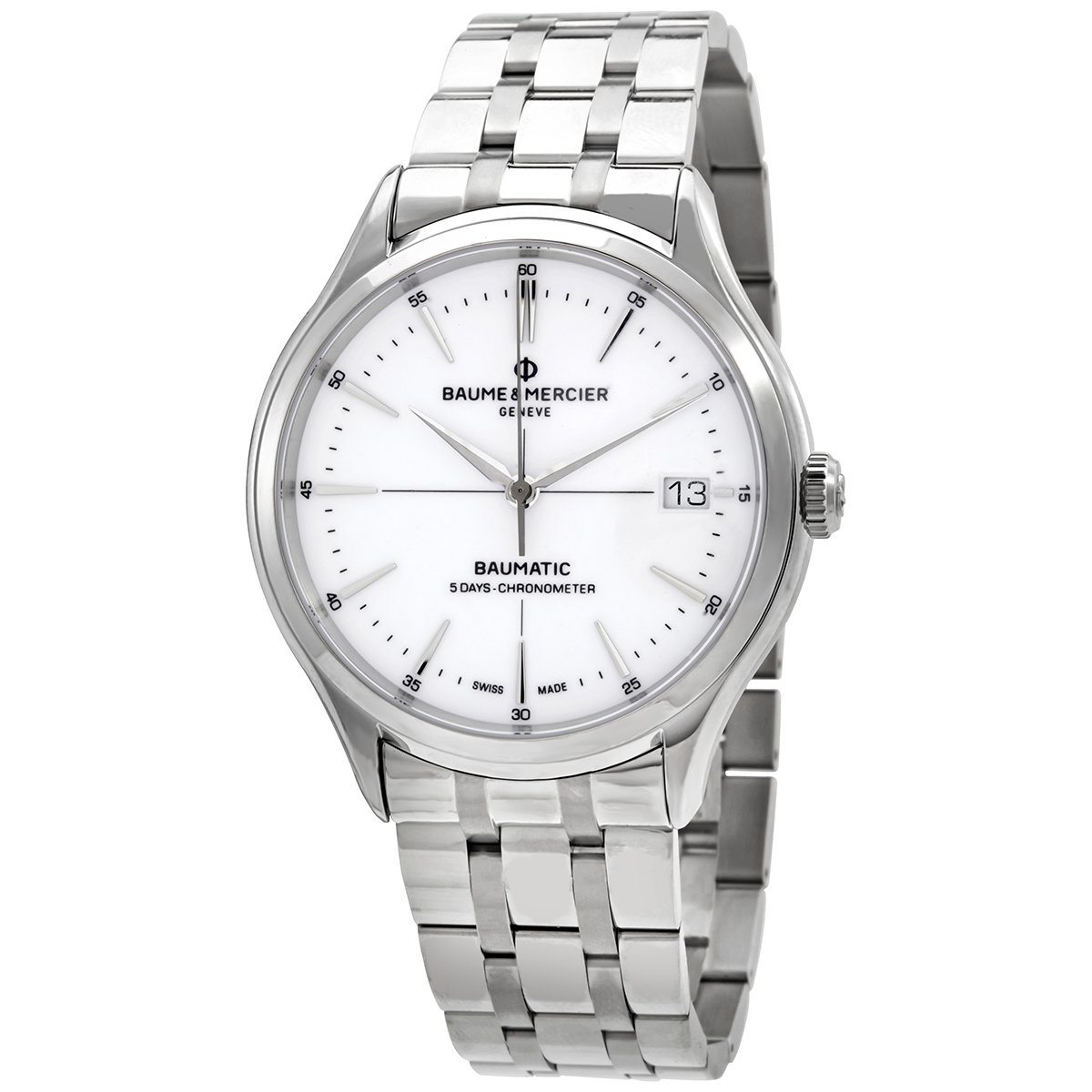
The Clifton Baumatic is a 40mm steel watch, and it wears like a full 40mm. There is almost no bezel, so the dial occupies the entire top surface, which makes it read larger than the number suggests. On a 6.75-inch wrist it takes up real estate. On a larger wrist it looks correctly proportioned in the way a proper dress watch should: wide through the face, restrained everywhere else.
The case has the alternating polished and brushed treatment that has become standard practice at this tier, and it is executed without drama. The watch carries itself close to the wrist and slips under a shirt cuff, which is the one job a dress watch cannot fail. It weighs little enough that you forget you are wearing it, and there is no crown dig, no lug overhang, no sense that the design was compromised to accommodate the movement.
Where the value engineering shows is the strap. The alligator is soft out of the box and looks correct with tailoring, but it is not the leather you get one tier up, and the pin buckle feels like a cost decision rather than a design one. This is the easiest thing to fix. Put a proper strap on it and the watch jumps a category.
Dial-wise, the design is deliberately conservative: a pale, slightly opaline surface with applied baton markers and faceted hands, a date window at three, nothing to distract. It is the kind of face that photographs beautifully in daylight and never demands a second look across a dinner table. Anyone who has spent time around auctions knows the pattern: the watches that get the loudest gasps are rarely the ones that survive the decade. This dial is built to survive the decade.
The five-day reserve is a behaviour change, not a spec
Most reviews treat power reserve as a number on a card. In practice it is the single feature that determines whether you actually wear a mechanical dress watch or just own one.
With 120 hours of autonomy, the Clifton Baumatic does not need a winder and does not need to be reset every time you put it on. Take it off after a Friday in the office, leave it through a weekend of swim meets and errands, pick it up Wednesday morning and it is still running and still close to time. That sounds like a small thing. It is the difference between a watch that lives in a drawer and one that becomes habitual. For anyone who rotates three or four pieces rather than wearing one watch every day, this is the argument that sells the Baumatic more effectively than any marketing line about silicon.
Accuracy in the real world tends to land inside the certified band, generally a couple of seconds to five seconds a day depending on position and how much you move. The silicon hairspring means that figure holds steady even if you spend your life next to a laptop speaker, a hotel keycard reader and an airport scanner, which is more than can be said for a conventional hairspring in the same environment.
What it does not do is sport. There is no luminous material anywhere on the dial, water resistance sits at 50 metres, and the alligator strap is not built for sweat. This is a dress watch, and Baume & Mercier did not pretend otherwise. If you want one watch for everything, this is not it. If you want a second watch that makes your rotation feel considered, it is.
The competition, honestly assessed
The obvious alternative is Grand Seiko, and the comparison is not flattering to Baume & Mercier on finishing. A Heritage reference in the same bracket will out-polish, out-dial and out-craft the Clifton without breaking a sweat. What it will not do is give you a five-day reserve at the same price, and it will not sit as quietly under a cuff. Grand Seiko is a watch for people who want to be seen knowing. The Baumatic is a watch for people who do not care whether they are seen knowing.
Omega's De Ville Prestige line is the establishment choice: stronger brand equity, better resale, METAS certification on current references, and a price that reflects all of it. If you want a single dress watch that holds value and never requires an explanation, buy the Omega. If you want the best movement per dollar, the arithmetic points elsewhere.
Tudor's 1926 is the closest thing to a direct rival in spirit, and it wins on brand heat and bracelet execution. NOMOS offers a different, more architectural kind of restraint with a genuinely in-house calibre, though its thin, flat case wears very differently. None of them combine a certified manufacture movement with a 120-hour reserve at this money. That is the Baumatic's entire case for itself, and it is a good one.
Buying guide: references, prices and the secondary question
The reference most people mean when they say Clifton Baumatic is the launch-era steel watch on leather, reference M0A10399, with a white dial, a date at three and a sapphire display back. Its bracelet twin, M0A10400, is the same watch on steel, which nudges it toward daily wear and adds a small premium at retail. If you are buying one, the strap version is the more flexible purchase because you can put it on leather, a suede or a fine-grained calf and change its register entirely.
At launch the leather-strapped watch sat under three thousand dollars, which was the entire point. Current retail has drifted up to roughly the mid three-thousands, in line with the rest of the market rather than any sudden surge in demand. The secondary market, meanwhile, has done what it does to watches without waitlists. Clean pre-owned examples trade in the region of fifteen hundred to twenty-four hundred dollars, occasionally less for pieces without box and papers.
That gap is the whole buying decision. At retail you are paying a fair price for interesting engineering. Pre-owned, you are paying roughly half of that for the same engineering and accepting that the brand on the dial will never open doors at a collector dinner. There is no auction history to speak of. This is not a watch that appreciates. It is a watch that delivers.
Ownership, service and the long game
Servicing goes through Baume & Mercier's authorised network, which is extensive but not the kind of infrastructure you can route around with an independent watchmaker. The silicon escapement's lubricant-free design means practical service intervals tend to stretch longer than a conventional Swiss automatic, and fewer lubrication points means fewer things to go wrong quietly. Confirm current pricing and turnaround directly with the brand before you buy, because service costs at this tier move as often as retail prices do.
The long game is straightforward. This is a watch you keep and wear rather than flip. It will not fund a holiday. It will, however, still be running accurately in five days' time, in five years' time, and probably in fifteen, and it will look appropriate at every one of those milestones without ever having announced itself.
Verdict
The Clifton Baumatic is the rare watch whose engineering outstrips its badge. It gives you a COSC-certified, silicon-equipped, five-day manufacture movement inside a genuinely elegant 40mm steel case, and it asks nothing of you socially: no waitlist, no posturing, no explanation at the dinner table. It is not the finishing benchmark in its class and it will not hold value. It is, instead, the most defensible technical argument in entry-luxury watchmaking, sitting quietly on a leather strap while louder watches get all the attention.
Buy it pre-owned. Wear it under a cuff. Enjoy the fact that the most interesting thing on your wrist cost less than the strap upgrade on someone else's status symbol.