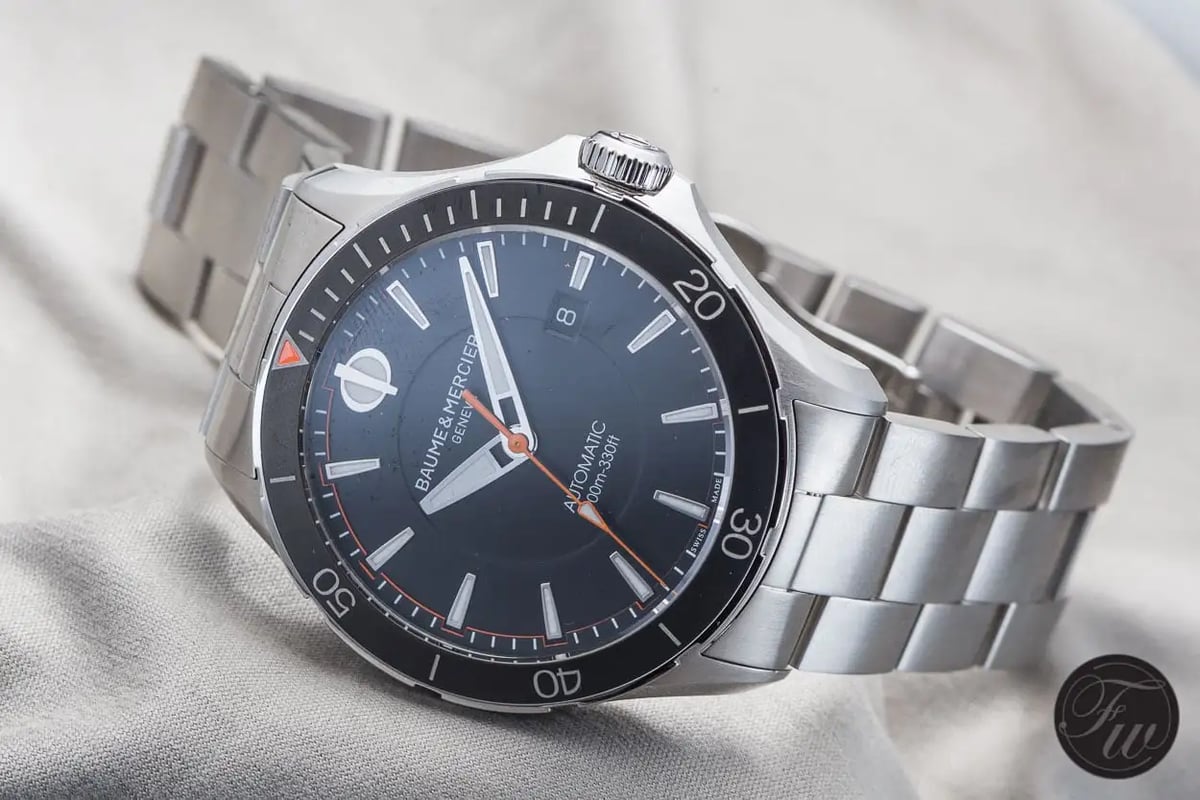
Why the Clifton Club 10337 matters
There is a specific kind of collector who does not want to talk about their watch. Not because they are embarrassed by it — because the conversation is boring. Nobody crowds around a steel three-hander at a dinner. Nobody slides into your DMs about it. And that, if you are paying attention, is the entire pitch of the Baume & Mercier Clifton Club.
Baume & Mercier has been making watches since 1830, which makes it one of the oldest continuously operating names in Swiss horology and one of the least discussed. The house has spent the last three decades inside Richemont as the group's entry point — the first real Swiss watch for people who are not yet ready to spend five figures, and the second watch for people who are. The Clifton Club, launched as a sportier branch of the Clifton family, is the purest expression of that brief: a steel automatic with a Swiss movement, a sapphire crystal and a design language borrowed from the tennis club rather than the regatta.
Reference 10337 is one of the three-hand automatics at the centre of that line. It is not a hype watch. It will not appear on a waitlist. It is, instead, the watch you buy when you have stopped trying to impress people with your wrist and started trying to enjoy it.
Baume & Mercier: the house behind the Clifton Club
Founded in 1830 by Louis-Victor and Célestin Baume in the Swiss Jura, Baume & Mercier built its reputation on slim, precise, quietly elegant watches — the kind of thing a Geneva banker wore to a meeting that actually mattered. The brand's historical trophy case is real: chronometer prizes, observatory trials, a genuine pedigree in precision. What it has never had is heat.
Since joining Richemont in 1988, Baume & Mercier has occupied a specific slot in the group's portfolio: the accessible Swiss watch. Above the entry Swiss names in finishing, below Cartier and IWC in price, and almost permanently out of fashion in the way that only a well-made, well-priced watch can be. That is not a knock. It is a description of a brand that has consistently delivered more watch than the logo suggests.
The Clifton collection arrived in the 2010s as a vintage-inflected round dress watch, all domed dials and applied numerals. The Clifton Club spun off from it as the casual sibling — same family DNA, looser collar. Where the Clifton wanted a suit, the Clifton Club wanted a polo shirt. The name was deliberate: not Sport, not Diver, not Racing. Club. Country club, tennis club, the members-only kind of club where the watch on your wrist is meant to be noticed by exactly the people who already know what it is.
What the Clifton Club actually is
Strip away the marketing and the Clifton Club is a straightforward proposition: a stainless steel case, a sapphire crystal, a Swiss automatic movement with a date, and a dial designed to be read rather than photographed. It is the watch equivalent of a navy blazer — the thing you reach for when you do not want to think about what you are wearing, because thinking about it would be a waste of a good morning.
That positioning puts it in direct competition with some of the most crowded territory in watchmaking. Tudor, Longines, TAG Heuer, Nomos and Omega all have something to say at or near this price. What the Clifton Club offers that most of them do not is a combination of thinness, restraint and secondary-market value. It is the least conspicuous option in the room, and for a certain kind of buyer, that is the whole appeal.
Design: the unremarkable done well
The Clifton Club's case is the part you will appreciate most after a month of ownership. It is a round steel body with a thin, unobtrusive bezel, a crown that sits close to the case, and lugs that curve down toward the wrist rather than sticking out from it. Nothing about it announces itself. Everything about it is deliberate.
The dial follows the same logic. Applied indices, faceted and polished at the edges so they catch light without flashing it. A date window at three — a real one, not an afterthought, with a matching dial-coloured disc on most variants. Baton hands with luminous fill. The whole composition is symmetrical, legible and completely free of the design tics that date a watch five years after launch.
This is the quiet skill of the Clifton Club. It does not have a signature. It has an absence of mistakes. In a market where every microbrand is chasing a gimmick — a fumé dial, a titanium case, a sandwich dial with a story attached — a watch that simply gets the fundamentals right is quietly radical.
On the wrist
The Clifton Club wears like a watch designed by someone who actually wears watches. The case sits flat and low against the wrist, the lugs follow the curve of the arm instead of hovering above it, and the weight is balanced — no top-heaviness, no sense that the watch is trying to slide toward your hand when you gesture. On a strap it is close to weightless in the way a good steel watch should be. On the bracelet it gains presence without gaining bulk.
What surprises people is how it reads on smaller wrists. The Clifton Club is not a small watch on paper, but the thin bezel and the way the dial opens out make it wear closer to a dress watch than a sports watch. It tucks under a shirt cuff without a fight. It does not catch on a jacket sleeve. It does not feel like equipment.
That is the point. The Clifton Club is a sports watch in the way a blazer is sportswear — a category that exists because real life is not a rotation of formal and athletic occasions. You wear it to a meeting, to dinner, to the airport, to a kid's football match. It never looks wrong. It rarely looks remarkable. That is a trade most people should be willing to make.
The movement: Sellita SW200-1
Inside the Clifton Club three-hand is a Sellita SW200-1 — the Swiss automatic that quietly powers a meaningful share of the watches in the $1,000-$3,000 bracket. Baume & Mercier does not dress this up as in-house, and it should not. What it is: a 4 Hz automatic with a date, roughly 38 hours of power reserve, and a design lineage that traces back to the ETA 2824, which is to say to the most serviced, most understood, most reliably fixable automatic architecture in modern watchmaking.
That last part matters more than the spec sheet suggests. The SW200-1 is not a romantic movement. It is a working one. Any competent watchmaker in any city on earth has the parts and the knowledge to service it. It does not require a trip to a brand service centre, a six-month wait, or a bill that exceeds the value of the watch. For a first serious Swiss automatic — or a fifth, worn hard — that is a feature, not a compromise.
Finishing is industrial rather than artisanal: the movement is built for function, and Baume & Mercier sensibly keeps it behind a solid caseback rather than pretending it is something to look at. What you get instead is a movement that starts reliably, keeps time respectably and does not ask for attention.
Accuracy: what to actually expect
Baume & Mercier does not certify the Clifton Club to COSC standards, and you should not expect chronometer performance. In practice, a healthy SW200-1 in a well-regulated Clifton Club will run within roughly -10 to +15 seconds a day, with many examples landing considerably closer once they have settled after a few weeks of wear. That is normal for the price bracket and entirely acceptable for daily use.
Two caveats. First, position matters: an automatic left crown-up overnight will gain or lose differently than one left dial-up, and you can use that to your advantage once you know your watch. Second, regulation is cheap. If your example drifts more than you would like, a watchmaker can regulate an SW200-1 in minutes for a modest fee. Do not send a watch in this bracket back to the factory for a rate issue.
If accuracy is the thing you care about most, this is the moment to mention the Clifton Baumatic — Baume & Mercier's in-house, silicon-equipped, five-day automatic, delivered to a -4/+6 seconds per day standard. It costs more. It is the better movement. It is also a different watch with a different brief. The Clifton Club is not trying to win a timing competition. It is trying to be the watch you do not think about.
Lume, legibility and daily life
Super-LumiNova on the hands and indices means the Clifton Club is readable in a dark cinema, on a night flight, and at 3 a.m. when you are checking whether the baby has gone back to sleep. It is not a dive-watch torch, and it is not meant to be. It is enough lume, applied well, on a dial that is otherwise designed for daylight legibility.
The sapphire crystal is the correct choice at this price and resists the kind of everyday abuse — door frames, seatbelt buckles, the corner of a laptop — that destroys acrylic and scratches mineral glass. Anti-reflective treatment keeps the dial readable at angles where a lesser crystal would turn into a mirror.
Straps, bracelets and the configuration question
Baume & Mercier has offered the Clifton Club across leather, rubber and steel, and the reference you buy matters less than the strap you end up wearing. The steel bracelet gives the watch its sportiest read and the most wrist presence; the leather strap pulls it toward the dressier end of its range; a rubber strap turns it into something you can wear to the beach without a second thought.
Our advice: buy the bracelet if you can, because bracelets are expensive to add later and straps are cheap to change. Then put it on a strap anyway, because the Clifton Club's real talent is how completely it changes character with a two-minute swap. A brown calf strap and a black rubber strap are two different watches. That flexibility is the most underrated thing about the whole package.
Occasions: where the 10337 works
Almost everywhere, which is the point. It works with a suit because it is thin, round and unadorned. It works with a t-shirt because it is steel and Swiss. It works on a plane because it is legible and does not need winding. It works at a wedding and it works at a barbecue, and it does not require you to own a second watch.
The one place it does not work is the place where watches are the point — the collector's dinner, the watch meet, the room where everyone is wearing something with a story. The Clifton Club has no story. It has a job, and it does the job.
Limited editions and the Clifton Club's cultural moment
The line's most interesting footnote is its collaborations. Baume & Mercier built numbered limited editions with Indian Motorcycle and with Shelby, which gave the Clifton Club a brief moment of cultural oxygen in a segment that rarely gets any. Those editions trade on the same restrained case with louder detailing, and they are worth a look if you want the Clifton Club's bones with a bit more conversation attached.
They are also a reminder of what the Clifton Club is not. It is not a motorsport watch, despite the partnerships. It is not a dive watch. It is not a racing chronograph. It is a steel Swiss automatic that happens to look good in a paddock and in a boardroom, which is a rarer combination than the marketing suggests.
What it costs and what it is worth
The Clifton Club launched at roughly the $2,000 mark, with strap versions at the bottom of that range and bracelet versions slightly above it. That pricing was, and remains, honest: you are buying a Swiss-made automatic with a sapphire crystal, a well-finished steel case and a movement that will outlive most of the phones you own.
The secondary market tells a different story. Baume & Mercier is one of the most heavily discounted brands in Swiss watchmaking, and pre-owned Clifton Clubs trade well below retail — commonly in the high three figures to low four figures depending on condition, box, papers and configuration. That is bad news if you bought new and expect to sell. It is excellent news if you are buying used, which is what a discerning buyer should do.
On the auction block, the Clifton Club does not exist. Baume & Mercier's auction record is built on vintage pieces — mid-century chronographs, dress watches from the golden age of Swiss precision — not on modern steel sport watches. There is no investment case here, and anyone who tells you otherwise is selling something.
The honest framing: this is a watch you buy to wear, not to hold. Buy it pre-owned, wear it for a decade, service it once, and the cost per year is lower than a streaming subscription. That is a better return than most watches in this bracket deliver.
Service and ownership
Ownership is the Clifton Club's strongest argument. The SW200-1 is a commodity movement in the best sense: serviceable by any competent independent watchmaker, with parts that are widely available and a routine service that costs a fraction of what a comparable service on an in-house movement would run. You are not locked into the brand's service network, and you are not waiting six months for a watch to come back from Geneva.
For a young collector building a first serious collection, that independence is worth more than a few seconds of accuracy or a fancier rotor. The Clifton Club is a watch you can actually own, rather than a watch you have to manage.
Alternatives worth considering
If you are shopping in this bracket, the Clifton Club sits in crowded water. The Tudor Black Bay 41 offers more brand heat and a stronger secondary market, but a thicker, more tool-watch presence. The Omega Seamaster Aqua Terra offers a better movement and a higher ceiling, at roughly twice the money. The Longines Conquest and the TAG Heuer Carrera Calibre 5 both compete directly on price and finish. The Nomos Club — different club, same idea — offers German design purity and in-house calibres for similar money.
What the Clifton Club offers that none of them quite match is a combination of thinness, restraint and value on the secondary market. It is the least conspicuous option in the room, and for a certain kind of buyer, that is the whole appeal.
Who should buy it
Buy the Clifton Club 10337 if you want one watch that does everything, you care more about how a watch wears than how it photographs, and you have no interest in explaining your wrist to strangers. Buy it if you are building a collection and want a baseline — a reference point for what good value and good proportions actually feel like before you start spending real money.
Do not buy it if you need your watch to appreciate, if you need a room to notice it, or if you need a mechanical story to tell. The Clifton Club has none of those things. What it has is a job, and it does the job every single day.
Verdict
The Baume & Mercier Clifton Club ref. 10337 is not a watch that will make you the most interesting person at the table. It is a watch that will never be the reason you are late, never be the reason you are uncomfortable, and never be the reason you are worried. It is a Swiss automatic with a sapphire crystal and a movement that any watchmaker can fix, wrapped in a case that does not try too hard.
Buy it pre-owned. Wear it daily. Change the strap when you get bored. That is the entire ownership experience, and it is a good one.