The 60-second take
The Baume & Mercier Joia, reference M0A10847, is a jewelry watch, and that single word rewrites every question a collector should be asking. Nobody buys a Joia because of a silicon hairspring, a chronometric certificate or a five-day power reserve. You buy it because it reads as fine jewelry on the wrist, because it carries a Swiss name with an 1830 birth date, and because it costs a fraction of what Cartier or Van Cleef & Arpels charge for the same emotional job. That is a perfectly rational purchase thesis. It also comes with a well-documented resale penalty, and this review is going to be honest about both halves of that equation.
What follows is not a spec-sheet recitation. Baume & Mercier does not publish every figure for every Joia SKU, and where the brand is silent we have left the field blank rather than fill it with a catalogue-average guess. A fabricated dimension or an invented caliber is worse than an absent one. What we can do — and what matters far more for a piece like this — is place the Joia inside the market it actually competes in: the entry-luxury jewelry watch, a segment where brand equity, not horology, sets the price of admission.
Baume & Mercier: the house behind the Joia
Baume & Mercier dates its origins to 1830 in the Swiss Jura, and the name most collectors know today comes from the 1918 Geneva partnership between William Baume and Paul Mercier. That long lineage matters less than where the brand sits now. By the mid-1990s, Baume & Mercier had been absorbed into the group that became Richemont, and for three decades it has served a specific corporate purpose: the entry point. Above it sit Cartier, IWC, Panerai, Jaeger-LeCoultre and the rest of the group's heavyweights. Baume & Mercier is the door.
That positioning explains almost everything about how the Joia will behave financially. Baume & Mercier builds competent watches — the Clifton Baumatic, with its in-house BM12-1975A movement and five-day power reserve, proved the brand can do real horology when it chooses to — but the house's commercial gravity sits at the accessible end of luxury, where volume, distribution and gifting drive the business. The brand has spent recent years tightening its retail footprint and nudging its positioning upward, and a jewelry-focused line like the Joia is a logical part of that push: jewelry watches carry higher margins, they sell to a customer less anchored on specifications than the enthusiast, and they generate repeat business through gifting occasions.
For an investor, the relevant read is this: Baume & Mercier is a brand with genuine heritage and weak secondary-market leverage. Those two facts coexist, and together they define the Joia's ownership math.
What the Joia is — and what it is not
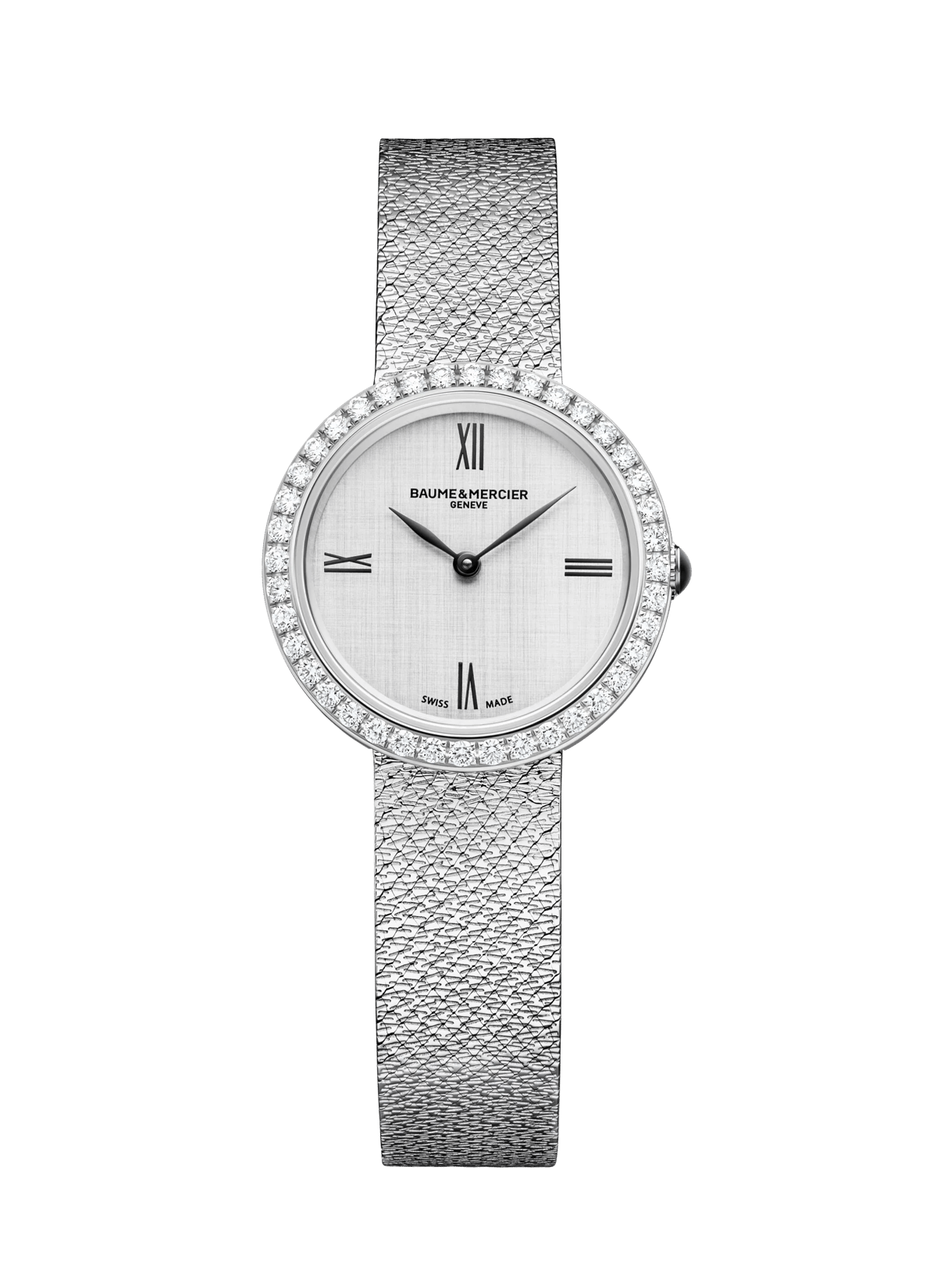
The Joia is a jewelry piece first. Its case is scaled for a jewelry-watch silhouette rather than a sports-watch one, its dial is treated as a decorative surface, and its bracelet is designed to be looked at as much as worn. It is not a tool watch with a jewelry finish. It is not a daily beater with a diamond bezel bolted on. And it is not, in any meaningful sense, a horological object — the movement inside exists to keep time reliably and stay out of the way.
That distinction matters because collectors routinely misprice jewelry watches. They apply enthusiast logic — movement architecture, finishing, complications, service costs — to a purchase that was never about any of those things. The Joia's competition is not a Tudor Black Bay. It is a Cartier Panthère, a Bulgari Serpenti, a Chopard Happy Sport, and the hundreds of unbranded fashion jewelry watches that trade purely on look. Judged against that set, the Joia's proposition is straightforward: Swiss-made, Richemont-owned, jewelry-adjacent, and priced below the French and Italian houses.
Case, dial and bracelet: the design argument
Baume & Mercier has built the Joia around a compact, jewelry-scaled case in stainless steel, with a sapphire crystal over a dial meant to be read as a decorative element rather than an instrument. There is no luminous treatment anywhere on the watch — a deliberate choice, and the correct one. Lume on a jewelry piece would be a tell that the design brief had gone wrong. The watch is delivered on a matching metal bracelet closed with a folding clasp, which keeps the silhouette continuous from case to wrist and avoids the visual break a leather strap would introduce.
Proportion is the whole argument. A jewelry watch lives or dies on whether it disappears into a stack of bracelets or fights them, and Baume & Mercier has clearly designed the Joia to sit in the former camp: low-profile, integrated, and visually quiet enough to be worn alongside other pieces. That is not an accident. The stacking trend of the early 2020s rewired how this customer buys, and every house in the segment responded by making bracelets that play well with others.
Water resistance is not published for this reference, and we have left it blank rather than assume a figure. Treat the Joia as a watch you take off before you get wet. Whatever the actual rating turns out to be, this is not a piece anyone should be swimming in, and the sooner an owner accepts that, the longer the bracelet will look new.
Movement: the honest answer
Here is the straightforward version: the Joia is quartz-driven. Baume & Mercier's jewelry-oriented references have historically been battery-powered, and the Joia follows that playbook with a Swiss quartz caliber. The brand does not publish a caliber designation for this reference, so we have not invented one.
For the intended buyer, this is a feature, not a compromise. A quartz movement means no winding, no setting after a week in a drawer, no service interval measured in thousands of dollars, and accuracy a mechanical watch at ten times the price cannot match. A standard Swiss quartz movement of this class holds within roughly ±15 seconds per month — figures that make a COSC-certified mechanical look sloppy by comparison.
What you give up is the thing this audience mostly does not care about: mechanical romance. There is no rotor, no escapement, no finishing to admire through a display back. If that matters to you, the Joia is the wrong watch and the Clifton Baumatic is the right one. If it does not, quartz is simply the more sensible engineering choice for a piece that will spend most of its life being looked at rather than wound.
On the wrist
Jewelry watches are worn differently from sports watches, and they should be reviewed differently. The Joia's design brief points toward a light, close-fitting wear that keeps the case flat against the wrist and lets the bracelet do the visual work. There is no crown-guard bulk to catch on a sleeve and no thick caseback levering the watch off-centre. On a correctly sized wrist, that translates into the kind of wear you forget about — which is exactly the point.
The caveat is sizing. A compact, integrated-bracelet watch has far less tolerance for a poor fit than a chunky sports watch with a micro-adjust clasp. If the bracelet cannot be sized to sit snugly, the case will rotate and the piece will look borrowed. Buy it from someone who will size it properly, and if you are buying pre-owned, budget for an adjustment or an extra link.
Accuracy and daily ownership
Quartz accuracy is boring in the best way. Expect the Joia to run within about ±15 seconds a month — drift you will not notice between battery changes. There is no positional variation to learn, no break-in period, and none of the magnetisation anxiety a mechanical owner experiences. The only maintenance event that matters is the battery, and the only real risk is a jeweller who opens the case without proper sealing tools and compromises the gasket.
For a collector used to tracking daily rates, this will feel like a holiday. For a first-time luxury buyer, it removes an entire category of anxiety. The trade is that a quartz watch gives you nothing to talk about at a dinner table full of mechanical enthusiasts — and if that matters, it matters.
The market: who actually buys this, and why
Now the part that decides whether the Joia is a good buy. Baume & Mercier's secondary market is soft, and it has been soft for years. Steel Baume & Mercier references routinely change hands pre-owned at a substantial discount to retail — think in the region of forty to sixty percent off for mainstream models — and jewelry references with diamond content do not fare better. Diamonds on a watch are a retail-margin story, not a value-retention story.
Set against that, the Joia competes in the one watch segment where brand equity is everything. Cartier's Panthère and Tank families hold value because Cartier is Cartier. Bulgari's Serpenti holds because it is instantly recognisable. Van Cleef & Arpels holds because it is jewelry first and a watch second, and the jewelry market has its own gravity. Baume & Mercier has none of that pricing power in the jewelry-watch space, and no amount of design quality changes the arithmetic.
What the brand does have is a widening gap between what it charges and what the piece is worth on the secondary market — which, counterintuitively, makes the Joia a better buy used than new. If you can find one pre-owned at a meaningful discount, you have removed most of the depreciation risk from the transaction before you have even worn it. That is the single most useful piece of advice in this review.
Resale math: hold versus sell
Hold-versus-sell for a piece like this is almost never a real decision, because almost nobody buys a Joia as an investment. The correct framing is: buy it as a cost of enjoyment, and accept that resale value is a partial refund, not a return.
If you already own one and are considering selling, the calculus depends on how you acquired it. Bought at retail, you are looking at a loss of roughly half, and holding longer will not repair it — this is not a watch with a collector base that will bid it up in a decade. Bought pre-owned at a discount, your downside is far smaller, and the piece becomes a genuinely low-risk way to own a jewelry watch. In either case, do not expect an auction result to rescue you. Baume & Mercier jewelry references essentially do not appear at Phillips, Christie's or Sotheby's watch sales, and when they surface they trade at levels that disappoint anyone who paid retail.
One practical note on pricing: Baume & Mercier's line-up and retail pricing shift frequently, and diamond content varies by SKU, so treat any figure you see quoted for a Joia as a segment benchmark rather than a quote. Confirm current pricing with an authorised dealer before you commit.
Variants, siblings and the wider family
The Joia is a collection rather than a single SKU, and Baume & Mercier has historically spread its women's lines across dial treatments, diamond-set and non-set bezels, and metal finishes. Reference M0A10847 is the specific configuration reviewed here. Because the brand does not publish a complete technical sheet for every Joia reference, we have not listed sibling reference numbers we cannot verify — a fabricated reference is worse than an absent one, and that rule applies to every number in this article.
Within the broader Baume & Mercier catalogue, the closest relatives are the Promesse, Linea, Classima Lady and Hampton Lady families — all women's references with quartz-dominant line-ups and a similar buyer profile. If you like the Joia's design language but want mechanical content, the Clifton Baumatic is the brand's technical flagship and a completely different proposition.
Alternatives at the same money
At the Joia's money, the alternatives split into two groups. The first is the established jewelry-watch hierarchy: Cartier's Panthère and Tank Française, Bulgari's Serpenti, Chopard's Happy Sport, Hermès's Nantucket, Chanel's Première. These cost more — often considerably more — but they hold value in a way the Joia will not, and for many buyers that difference in resale is worth the higher entry price.
The second group is the value play: Longines' PrimaLuna, Tissot's Bellissima, Tudor's Clair de Rose, and Omega's Constellation in its smaller sizes. These deliver Swiss quartz or mechanical movements with broader service networks and, in the case of Tudor and Omega, meaningfully stronger secondary markets. If the Joia's design does not specifically sing to you, one of these will almost certainly be the better financial decision.
And if the look is the point while the budget is not, there is no shortage of quartz jewelry watches that deliver the silhouette for a few hundred dollars. They will not hold value either — but at those prices, value retention was never the deal.
Service and long-term cost
Quartz service is cheap and infrequent by mechanical standards. A battery change is a routine, low-cost errand, and a full movement service, when it eventually becomes necessary, is a fraction of what a mechanical overhaul costs. Baume & Mercier is a Richemont brand with an established service network, so parts and authorised servicing are not a concern — but the brand's service centres are not everywhere, and turnaround times can run long.
The real long-term cost of a jewelry watch is cosmetic, not mechanical. Polished bracelets and cases pick up scratches, and every polish removes metal. Owners who want the piece to look new in ten years should resist the urge to have it refinished at every battery change. A light polish once, late in life, is usually the better strategy.
Final verdict
The Joia M0A10847 is a well-executed jewelry watch from a brand with real heritage and limited secondary-market leverage. Buy it because you love how it looks and you intend to wear it for years. Do not buy it because you think it will hold value, and do not buy it new if you can find it pre-owned at a discount.
Judged on its own terms — a Swiss-made, Richemont-backed jewelry piece priced below the French houses — it is a defensible purchase with a clear ownership case. Judged as an investment, it is not one, and no amount of design quality will change that. The honest summary: wear it, enjoy it, and keep your investment capital somewhere else.