Bell & Ross BR-03 Astro: The Collector's Read
Bell & Ross trades hands for planets. We look at what that costs, and whether it holds.
First take: a watch that trades legibility for wonder
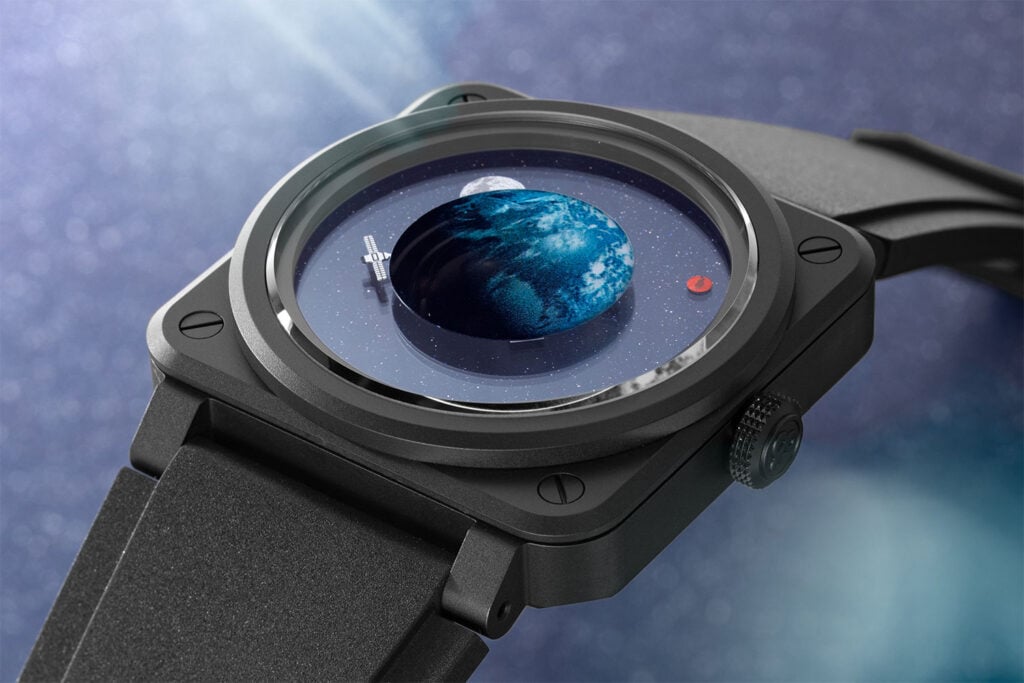
Most watches in the Bell & Ross catalogue are exercises in legibility. The whole brand premise — aviation instruments, cockpit readability, four screws and a square case — is built on the idea that a watch should be read instantly, in bad light, at a glance. The BR-03 Astro does the opposite. It removes the hands entirely and replaces them with a small planetary system: Mars tracks the hours, the Moon tracks the minutes, and a tiny satellite orbits the Earth once a minute, quietly doing the job of a seconds hand.
This is not a rational watch, and pretending otherwise would be dishonest. It is a piece of mechanical theatre with a competent automatic inside it, wrapped in matte black ceramic and produced as a numbered limited edition. The correct question for a collector is not whether it tells time well — it does, eventually — but whether the object justifies the money and whether the premium survives contact with the secondary market.
Short answer: the object justifies itself, the premium does not. Longer answer below.
Brand context: how Bell & Ross got here
Bell & Ross was founded in Paris in 1992 by Bruno Belamich and Carlos Rosillo, two friends who built a brand around the aesthetics of instrument panels rather than the traditions of Swiss watchmaking. The circle-in-square dial, the bolted bezel, the utilitarian case — these became the house signature long before the brand had the production capacity to match its ambitions.
Chanel's investment in 1998 changed the arithmetic. It gave a small French design studio access to Swiss manufacturing, and by the mid-2000s the BR 03 square case had become the brand's commercial backbone. That matters here because the Astro is not built on a new platform. It uses the same chassis as the standard black ceramic BR 03, which means the case, the strap interface, the crystal and the general build quality are all known quantities. What is new is the dial, and the dial is the entire pitch.
Concept watches are also something of a house tradition. Bell & Ross has spent the last several years turning the BR 03 into a canvas for graphic and mechanical experiments — radar displays, gyrocompass dials, skeletonised movements. The Astro is the most romantic of that series and, arguably, the most commercially risky, because romance is harder to justify at the till than a skeleton dial.
The dial: Earth, Mars, Moon and a very busy satellite
The dial is a deep black field with three spherical elements arranged across it. The Earth dominates the lower centre, rendered as a blue globe with enough surface detail to read as a planet rather than a disc. Mars, small and rust-red, sits up and to one side as the hour indicator, rotating through a marked track. The Moon, pale and cratered, handles the minutes. A minuscule satellite travels a circular path around the Earth to count the seconds.
In practice, reading the time takes two or three seconds longer than it should. The hour track is not indexed with numerals the way a conventional dial is, so you learn to read position rather than value, and the minute indication requires you to find the Moon before you can judge it against the printed scale. This is fine. Nobody buys an orbital display for speed. What matters is that the system is coherent: the planets are large enough to be seen, the tracks are printed cleanly, and the satellite seconds are genuinely delightful the first fifty times you catch one mid-lap.
One thing to accept before purchase: there is no meaningful luminous treatment here. Whatever Super-LumiNova you may be used to on other BR 03 references, this is a daylight watch. At night the dial goes dark and the planets disappear. If you need a watch to read in a cinema, this is not it, and no amount of enthusiasm about the design changes that.
Aesthetically the composition works because it is disciplined. Three spheres, one black field, one accent colour per element. It could easily have become a novelty — a snow globe on the wrist — and it does not, largely because the ceramic case frames it like a bezel rather than a toy.
Case and ceramic: the familiar chassis, done well
The case is the standard BR 03 architecture: a cushion-square with four exposed screws at the corners, a flat sapphire crystal, and a bezel that sits proud of the case middle. In matte black ceramic it is a genuinely handsome object. The bead-blasted finish absorbs light rather than reflecting it, so the watch reads as a dark, quiet shape on the wrist until someone looks closely — at which point the dial does the talking.
Ceramic is the right material for this design. It is light relative to steel, it will not pick up the hairline scratches that a polished steel bezel accumulates within a month, and it holds its colour perfectly. The trade-off is the one every ceramic owner knows: it is scratch-resistant, not shatterproof, and a hard knock against a stone edge is a case replacement rather than a polish. Wear it as a daily and accept that risk, or treat it as a rotation piece and avoid doorframes.
The rubber strap is well judged — soft, tapered, and moulded so that it follows the case line rather than flaring out from the lugs. It keeps the profile low beneath a cuff and makes the watch feel like a single object rather than a case sitting on a strap. The pin buckle is a small point of contention; a deployant would be more elegant, but the pin buckle is lighter and less fussy in daily use.
Wrist feel: flat, light, and wider than you expect
The BR 03 case is a broad, flat shape, and ceramic makes that geometry feel friendlier than it looks on paper. There is no head-heavy wobble because the case is light, and because the lugs are short and drop vertically, the watch sits centred rather than cantilevering over the wrist bone. On an average wrist it is comfortable from the first wear, with no break-in period and no sharp edges to find.
What you do notice is the footprint. This is a disc on the wrist, not a contoured case — the square shape occupies more visual real estate than a round watch of comparable mass, and on a slender wrist it will read as large even though it does not feel heavy. That is a design consequence, not a flaw; the BR 03 has always worn big for its size, and the Astro leans into it.
Sleeve clearance is good thanks to the slim profile and the soft strap, so it functions as a daily wearer with a jacket. It is not, however, a watch you forget you are wearing — the dial draws eyes across a table, and that is the point.
The movement: competent, sourced, and not the story
Inside is the BR-CAL.302, Bell & Ross's designation for a sourced Sellita base, adapted to drive the orbital display discs. It runs at 28,800 vibrations per hour and carries roughly 38 hours of power reserve — enough for a daily wearer, not enough to survive a weekend in the box. It is not chronometer-certified, and it is not in-house.
For some collectors that is a dealbreaker at this price. It should not be. The Sellita base is a slim, proven, widely understood architecture, and it is precisely the sort of movement you want underneath a novelty display, because it can be serviced by any competent watchmaker and parts are not a hostage negotiation. Bell & Ross has dressed it plainly — industrial finishing, nothing decorative — which is honest, if unexciting.
The real engineering question is the display module that converts three hands' worth of rotation into three orbital tracks. That is where the watch earns whatever premium it commands, and it is also where long-term ownership risk concentrates: if a disc train develops a fault, the fix is a module repair rather than a regulation.
Accuracy: what to expect day to day
A well-regulated Sellita of this type should hold roughly -5 to +12 seconds per day in real wear, with the usual positional spread — fast dial-up, slower crown-down — widening as the power reserve drops below a third. Daily winding keeps it tight; a week in a drawer means you reset it.
Judging accuracy here is a slightly different exercise because there is no sweeping seconds hand to watch. You compare the minute display against a reference over a day or two and accept that the satellite is not a precision instrument. That is fine. Nobody regulates an orbital display to the second, and the watch is honest about what it is.
The market: retail, secondary, and the hold-versus-sell call
The Astro launched in the region of $5,900, and as a numbered limited edition it was never going to be discounted at the boutique. On the secondary market the picture is more nuanced. Concept-led limited editions from mid-tier brands follow a predictable arc: a launch spike on novelty and scarcity talk, then a slide as the next concept arrives and the buying pool narrows to people who actually want the design. Realistic pre-owned transactions currently sit in the $4,300 to $5,600 band, with complete sets and unworn examples at the top of that range.
That is a depreciation of roughly fifteen to twenty-five percent from retail, which is normal for the category and materially better than a standard BR 03 in steel. The limited production gives the watch a defined collector pool — small, but real — and that pool is what prevents the floor from falling out. What it does not do is create the sort of scarcity that pushes a piece above retail and keeps it there.
The hold-versus-sell judgement is therefore straightforward. If you bought at retail and the dial still makes you smile, hold it and wear it; you have already absorbed the depreciation and the watch will not deteriorate further in value. If you bought at retail and the novelty has worn off, sell into the launch window rather than after it — the first twelve months are when the premium is strongest and the buyer pool is widest. And if you are buying now, buy secondary. At the lower end of the range this is a lot of watch for the money; at full retail it is a fair price for a design object and a poor price for a movement.
There is no meaningful auction history for this reference, and there likely will not be for some years. Treat it as a collector's object rather than an appreciating asset.
Alternatives, and what they reveal about the Astro
The most direct comparison is inside the building: the standard black ceramic BR 03. Same case, same strap, same movement family, conventional hands, and a considerably easier proposition to live with. If you want one square ceramic watch to wear every day, buy the standard model and put the difference into something else.
Outside the brand, the closest spiritual relative is Christopher Ward's C1 Moonglow — an astronomical display at a fraction of the price, with a moonphase rather than a solar system. It does not have the ceramic case or the design confidence, but it proves the point that celestial dials are not inherently expensive to make.
At the opposite end, Van Cleef & Arpels' Midnight Planétarium takes the same conceit into high jewellery, where planets rotate on real astronomical periods and the price climbs into six figures. The Astro sits in the middle: more considered than an entry-level novelty, far more accessible than a jewelled planetarium, and priced accordingly.
Service and ownership
Bell & Ross does not publish a rigid service interval, and the practical advice for a Sellita-based watch is to service on symptoms rather than a calendar. The base calibre is familiar territory for any competent watchmaker, which keeps costs sane for the category. The orbital display module is the caveat — if a disc train misbehaves, an authorised centre is the safer route, because module-specific parts are not sitting on independent shelves.
Ceramic adds its own consideration: it does not scratch, but it chips, and a chipped ceramic case is replaceable rather than repairable. Insure accordingly and avoid wearing it where hard edges are unpredictable.
Verdict
The BR-03 Astro is Bell & Ross at its most confident — a design-led object that uses the square ceramic chassis as a stage rather than a tool. It is not a value proposition on movement alone, and it will not hold retail the way a steel sports watch might. But as a limited-edition conversation piece in a collection that already has its legible boxes ticked, it earns its place.
Buy it below retail, wear it in daylight, and treat it as art that happens to tell time. That is the honest, and ultimately the most satisfying, way to own it.