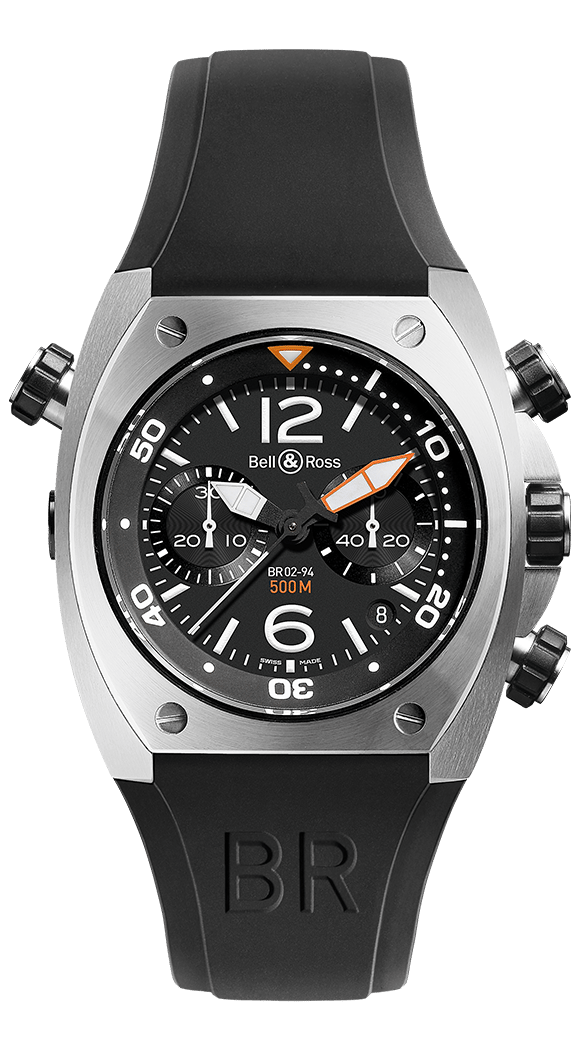
The Round One
Bell & Ross is a brand that made its name with a square. The BR 01 took the cockpit clock as its template and turned it into a wristwatch so literal-minded that it became a design statement in its own right, and everything the company has done since has been measured against that square. Which is exactly why the BR 02 deserves a second look.
The BR 02 is the round one — the branch of the family that applied the same instrument-first philosophy to a circular case with a distinctly aquatic brief. Reference BR 02-92 is the simplest expression of that idea: hours, minutes, seconds, a date, and nothing else. No chronograph registers, no second-time-zone hand, no power-reserve scale. A broad brushed steel case, an oversized crown guard, and a dial built for reading rather than admiring.
It has been out of production for years now, which is part of its appeal. The BR 02-92 sits in that useful middle ground of watch collecting: overlooked enough by the market to remain affordable, well enough made to be worth owning, and distinctive enough that nobody will mistake it for anything else on the wrist.
Bell & Ross, Briefly
Bruno Belamich and Carlos A. Rosillo founded the company in Paris in 1992 with a proposition that was almost provocative in its simplicity: design watches to the standard of professional instruments, not jewellery. The founding principle — function shapes form — was not a marketing line so much as a brief that could be handed to a designer and enforced.
The early years saw the brand working with German tool-watch specialists Sinn, an association that left a permanent mark on the house style: legibility first, case construction ahead of decoration, and a tolerance for visual mass that more polite brands avoided. When the square BR 01 arrived, it crystallised all of that into a single recognisable silhouette.
The BR 02 was the counterargument. It took the same engineering values and asked what they would look like on a round case with a diver's priorities — water, grip, and unaided legibility. The answer was a watch that reads unmistakably as Bell & Ross without borrowing a single line from the BR 01.
The Case and Its Crown Guard
The defining element of the BR 02 is not the dial but the crown guard. Where most dive watches bolt a pair of shoulders onto the caseband, Bell & Ross grew the guard out of the case itself — a substantial, angular mass of brushed steel that rises proud of the mid-case and visually anchors the whole design. It is the feature that makes the watch legible from across a room as a Bell & Ross, and it is the feature that most divides opinion.
In the hand, the casework is honest rather than delicate. Surfaces are brushed with a consistent, slightly coarse grain; transitions between planes are crisp and clearly cut rather than softly blended. There is no polishing on the flank to catch light — this is a watch that treats reflection as a distraction. The sapphire crystal sits flush enough to disappear into the design, and the whole assembly feels engineered to survive contact with a door frame.
That is the correct priority. The BR 02 was conceived as a dive-oriented instrument, and the case architecture reflects it: a wide, flat-topped bezel to protect the crystal, a guard substantial enough to keep the crown out of trouble, and a caseback designed to sit flat against the wrist rather than perch on it. Nothing here is decorative, and nothing here looks accidental.
The Dial: Legibility as a Discipline
Bell & Ross's great strength as a designer of dials is restraint. The BR 02-92's black dial is not trying to be beautiful. It is trying to be read.
Contrast is the entire story. Markers are large, luminous, and set against a matte black ground that absorbs light rather than reflecting it — a deliberate choice, because a glossy dial turns into a mirror the moment the sun is behind you. The minute track is broad and clearly indexed, so elapsed time can be read to the marker rather than approximated. The hands are wide enough to survive a wet glove and long enough to reach their respective scales, which sounds like a minimum standard until you notice how many dive watches fail it.
The date aperture is the single concession to everyday convenience, and it is placed where it does not disturb the symmetry of the reading experience. It is a small window, correctly sized, without a cyclops. Purists will approve.
Luminous performance is the practical test of any instrument dial, and Super-LumiNova applied in this quantity does what it should: the hands and markers remain distinguishable hours after the lights go out, with the minute hand reading clearly against the chapter ring. It is not a torch, but it is dependable — which is the point.
Movement: BR-CAL.302
Inside the BR 02-92 sits the BR-CAL.302, Bell & Ross's designation for a thin automatic ébauche drawn from the ETA 2892 / Sellita SW300 lineage. It is a sensible rather than a romantic choice: 42 hours of power reserve, a beat rate of 28,800 vibrations per hour, and a profile slim enough that the case does not have to grow vertically to accommodate it.
This is one of the most thoroughly understood automatic movements in Swiss watchmaking. It winds efficiently from the rotor, it is stable across positions once regulated, and it can be serviced by any competent watchmaker with access to parts. For a tool watch, that is a far more valuable attribute than a hand-finished bridge nobody will ever see.
Finishing is industrial and unapologetic about it: a striped rotor, cleanly finished bridges, no hand-applied anglage. Bell & Ross has never pretended otherwise, and there is something refreshing about a movement that has been assembled to tolerances rather than to a photograph. What matters here is that the architecture supports the case — thin, reliable, and free of the service complications that plague modular designs.
There is no chronometer certification. Do not expect one, and do not pay for one.
On the Wrist
The BR 02 is not a watch that whispers. The mid-case is broad and flat-topped, the crown guard is a substantial block of brushed steel, and the whole assembly sits high enough that it announces itself under a shirt cuff. What saves it is the lug geometry: the strap meets the case close in, so the head does not overhang the wrist the way a long-lugged dive watch can. On a medium wrist it reads as substantial rather than unwieldy.
The moulded rubber strap is the correct pairing, and not merely for water. It is thick enough to balance the mass of the head, it does not crease the way leather will after a summer, and the pin buckle keeps the profile low against the wrist. Owners who fit the steel bracelet report a noticeably heavier, more top-heavy feel; the rubber is the honest configuration, and it is the one to look for when buying.
Balance, in short, is good rather than perfect — a watch you notice on the wrist all day, but never one that fights you. It slips under a loose cuff and complains under a tight one. That is the trade you make for a case with this much presence.
Accuracy and Daily Behaviour
The BR-CAL.302 is not chronometer-certified, and Bell & Ross has never claimed otherwise. In practice, a well-regulated example of this ébauche settles into the region of a few seconds a day in either direction, with positional variation doing most of the work. Expect it to gain slightly dial-up and lose a touch crown-down; that is normal behaviour for a lever escapement, not a fault.
A watch that has never been serviced in a decade will drift considerably more, and the correct response is a service rather than a regulation. For day-to-day wear, the rate is entirely unremarkable in the best sense — you will not be resetting it weekly, and you will not be thinking about it at all.
Ownership: Service and Parts
The good news is mechanical. The ébauche is common enough that any competent independent watchmaker can service it, and the movement's architecture is straightforward enough that no specialised tooling is required beyond the usual. The less good news concerns the case: gaskets, crowns, and original rubber straps are best sourced through an authorised Bell & Ross service centre, and a discontinued model means those parts take patience.
The practical recommendation is to buy an example with its original strap and buckle, and to have the watch pressure-tested before you trust it in water. A tool watch with perished gaskets is a dress watch with extra steps.
The Market
Here the BR 02-92 is genuinely interesting. Bell & Ross has never commanded the collector premium of its Swiss peers, and discontinued round models sit well below the square BR 01 in desirability. That softness is your advantage. Secondary-market examples trade in a bracket that would buy you a very ordinary mid-tier diver — or, instead, a Swiss automatic with a case architecture nobody else was making.
Do not expect appreciation. The trend is flat to gently depreciating, and the model has no meaningful auction history to point to. What it offers is a low cost of ownership: buy well, service when needed, and the money you lose on resale will be modest. This is a wear-it watch, and it should be bought as one.
Alternatives Worth Considering
If the crown-guard silhouette is what drew you in, the Panerai Luminor Base is the obvious spiritual ancestor — larger, more expensive, and considerably more self-conscious about it. If what you actually want is a modern, unshowy dive watch with better finishing and a warranty, the Tudor Pelagos does the job with titanium and a superior clasp.
The Sinn U1 is the closest philosophical match: German, submarine-steel tooling, and a refusal to decorate for decoration's sake. Given the two brands' shared history, that comparison is not accidental. And if the budget is tighter, the Oris Aquis Date offers a sharper case and a more conventional dive-watch experience at similar secondary-market money.
For those testing the shape before committing, the inexpensive homage market will tell you within a week whether a broad, high-presence case suits your wrist. It is not the same watch, and it is not meant to be — but it is a cheap experiment.
The Verdict
The BR 02-92 is the model that proves Bell & Ross's instrument philosophy was never really about the square. It is a legible, robust, unpretentious tool watch with one of the more characterful case designs of its era, and it asks very little of your wallet.
It is not perfect. It is heavy, it is tall enough to be fussy under a tight cuff, it carries no certification and no collector premium, and the day will come when you need to hunt for a gasket. But those are the compromises of a watch designed to be used rather than preserved, and they are honest ones.
Buy it because you want to wear it every day. On those terms it is quietly excellent, and on investment terms it was never trying to be.