Brand context: Boldr as a microbrand tool-watch specialist
Boldr Supply Co. was founded in Singapore in 2015 and built its following with rugged, affordable tool watches aimed at outdoor and everyday use. The brand’s catalog leans on legible dials, sturdy cases, and practical straps, which makes the Conquer a natural extension of its field-watch language. Boldr is a microbrand rather than a legacy manufacture, so the Conquer should be judged as a focused daily wearer rather than a heritage collectible.
That matters for expectations. You are not buying a century of archives or a movement made in-house. You are buying a watch designed around use, often with a strong price-to-spec ratio and a clear aesthetic point of view. The Conquer’s job is to be the watch you grab when you do not want to think about your watch. That is a modest brief, but it is harder to execute well than it sounds.
Design and legibility: the dial does the work
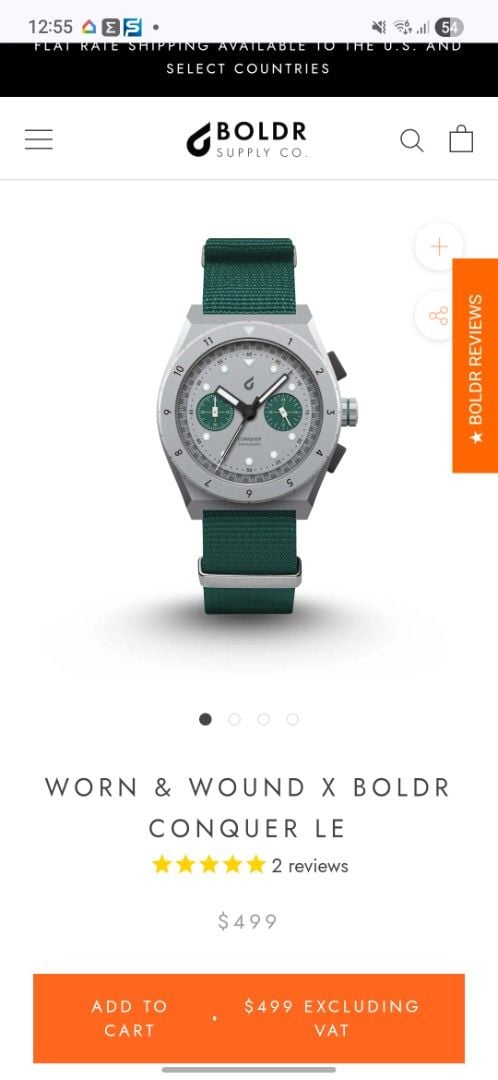
A daily-wear field watch lives or dies by legibility. The Conquer understands the assignment. The dial is built around high-contrast markers and a clean read, which is exactly what you want when you check the time in a meeting, on a bike, or in bad light. Boldr does not make shrinking-violet dials here; the Conquer is meant to be read, not decoded.
The case finishing is similarly purposeful. The titanium case gives the watch a lighter, more liveable feel than steel, and it keeps the Conquer from becoming a desk-diving paperweight. Titanium can sometimes look a little flat or grey compared with polished steel, but that is part of the charm in a tool watch. It flies under the radar. It does not sparkle. It just gets on with the job.
The sapphire crystal is the right call for this kind of watch. You are going to wear it with sleeves, bags, car keys, and the occasional doorway, and sapphire is the practical answer. The same logic applies to the lume. Boldr treats lume as a real feature rather than a decorative afterthought, and a field watch needs that. You should be able to read the Conquer after a long day and into the night without tilting your wrist under a lamp like you are solving a puzzle.
Where the exact reference matters is in the details: dial color, strap or bracelet, and whether your example carries a date or another function. Those are the things to confirm with the seller. The overall design language is clear, but the Conquer is not a single fixed specification across every listing.
Movement: automatic, but verify the exact caliber
The Conquer is an automatic watch, which is the right default for a daily wearer in this class. An automatic movement means you can pick it up, put it on, and go without worrying about a battery. It also gives the watch a mechanical character that many young collectors want from their first serious tool watch.
That said, I would not quote a caliber for VE-RTCC26-41-20 unless it is confirmed on the caseback or by the brand. Boldr has used third-party automatic movements across its range, and the exact movement can vary by model and production batch. The honest advice is simple: ask the seller for a movement photograph and a caseback reference, and confirm the caliber before you pay. Do not assume that a specification from another Conquer variant applies to this exact reference.
In daily use, the automatic movement should be treated as a practical engine rather than a showpiece. The Conquer is not a COSC-certified chronometer, and it is not an in-house movement. That is fine at this level. What matters is stable rate, easy serviceability, and parts availability. A third-party automatic is generally straightforward for a qualified watchmaker to service, and that matters more than a fancy movement name on a watch designed to be worn hard.
Specs and the importance of reference-level verification
This is where I want to be careful. Case diameter, case thickness, lug-to-lug, water resistance, and exact movement details are the numbers buyers use to compare watches online, but they are also the numbers that get repeated incorrectly across listings. For the Boldr Conquer VE-RTCC26-41-20, I would verify those figures against the brand or a trusted dealer before making a purchase decision. A microbrand catalog can change, and sellers often mix specifications between variants.
The practical takeaway is not to ignore specs. It is to use them properly. A watch can have perfect numbers and still wear badly, and a watch with unremarkable numbers can feel excellent on the wrist. The Conquer’s wearability comes from the overall package: titanium lightness, a legible dial, and a case that does not fight the wrist. That is more important than memorizing a figure that may belong to a different Conquer.
On the wrist: comfort, balance, and real-week wear
The Conquer’s first advantage is that it does not need to announce itself. On the wrist, the titanium case gives it a lighter, less top-heavy feel than a comparable steel tool watch, and that matters over a full day. The case is not trying to be a dress watch, but it also does not wear like a slab. The lugs and caseback are where this kind of watch either works or fails, and the Conquer is at its best when the strap is adjusted properly and the watch sits close to the wrist rather than sliding around.
I would treat the strap or bracelet as part of the review, not an afterthought. A field watch lives or dies by how quickly you forget you are wearing it, and the Conquer benefits from a secure, simple setup that does not require fuss. If the supplied strap is not to your taste, swapping it is straightforward, but keep the balance in mind: a thick aftermarket strap can make a light titanium case feel tippy, while a thin one can make it feel more compact. The Conquer is comfortable enough for daily wear, but it rewards a little setup.
Over a real week, I would wear it to the office, on errands, and through a weekend of movement. The watch should disappear under a cuff and stay put during activity. The titanium case helps here because it reduces fatigue at the end of the day. The Conquer is not a heavy statement piece. It is a quiet daily companion, and that is exactly what many collectors need alongside their more precious watches.
Accuracy and daily timekeeping
Because the exact movement calibration for this reference should be verified, I would not quote a laboratory figure. In real-world automatic wear, what matters is consistency: how the watch behaves across a week, whether it gains or loses in a predictable direction, and whether the rate changes when it sits overnight. Expect a third-party automatic in this class to be a practical timekeeper rather than a chronometer.
Wear it for a week, note the daily deviation, and decide whether the rate is stable enough for your habits. If precision matters, have a watchmaker regulate it rather than chasing a generic spec sheet. A daily watch does not need to be perfect to the second. It needs to be predictable enough that you are not resetting it every morning. The Conquer should clear that bar, but the exact movement in your reference is the thing to confirm.
Occasions: where the Conquer fits
The Conquer is a daily wearer first and foremost. It is happiest with casual clothes, a field jacket, a T-shirt, or a weekend bag. It can handle sport and travel without drama, and it is legible enough to be a practical travel companion. It is not a formal watch. If you are wearing a tuxedo, this is not the watch you reach for. But for the rest of life, it makes a strong case.
Its best role is as a one-watch weekender or a rotation piece that takes the knocks so your nicer watch does not have to. It is the watch you wear when you do not want to think about whether it matches. That is not a criticism. It is exactly what a tool watch should do.
Wrist presence
On a scale of one to five, the Conquer has about a three for wrist presence. It is purposeful rather than flashy. It has enough visual weight to feel like a real tool watch on the wrist, but it does not dominate a cuff or draw attention across a room. If you want a watch that gets noticed, this is not it. If you want a watch that feels substantial without becoming a nuisance, the Conquer is in the right zone.
Variants and family context
Boldr has offered the Conquer in multiple configurations, so the exact reference is the key. Dial color, strap or bracelet, and movement details can vary. For VE-RTCC26-41-20, confirm the specification with the seller or the brand. The Conquer family sits alongside other Boldr tool watches such as the Venture, Odyssey, Expedition, and Safari. Each has a slightly different brief, but the through-line is practical, legible, wearable design.
If you are comparing within the brand, decide whether you want the Conquer’s specific case and dial package or whether a Venture or Expedition better matches your wrist and style. Do not buy based on a model name alone. Buy based on the exact reference and how it wears.
Similar watches and alternatives
The obvious comparison is the Hamilton Khaki Field Auto. It is the default field watch for many collectors, with strong legibility and a heritage story. The Conquer answers with a more overtly rugged, titanium-focused package. The Seiko Alpinist SPB121 is another option, though it is more decorative and less of a pure tool watch. The Vaer C5 Field is closer in spirit, with a direct-to-consumer value proposition and a practical daily-wear brief. The Marathon GSAR is heavier and more militarized, for buyers who want maximum ruggedness over lightness.
If you are shopping lower, the Timex Expedition North Field Post Solar and Bertucci A-2T capture some of the same no-nonsense appeal at a much lower price. They are not direct substitutes for the Conquer’s titanium case and automatic movement, but they show how much daily utility a simple legible dial can deliver.
Investment value and ownership
The Conquer is not an investment piece. It is a microbrand tool watch, and its resale value will depend on condition, documentation, and the exact variant. Buy it because you want to wear it, not because you expect it to appreciate. If you buy used, compare against current retail and recent private sales, and be prepared to accept a softer resale market than you would with an established Swiss brand.
The better financial case is to buy the right reference once and wear it hard. A daily watch earns its value through wrist time, not through auction results. Keep the box and papers if you can, but do not let them stop you from using the watch.
Service and long-term ownership
Service intervals for automatic watches vary with use, but a daily wearer will eventually need attention. The exact interval and cost for this reference should be confirmed with Boldr or a qualified watchmaker. Boldr’s service network varies by region, so authorized service may not be convenient everywhere. A good independent watchmaker can handle a third-party automatic, but make sure they can source parts and test water resistance.
Long-term ownership is about more than the movement. Gaskets, crowns, crystals, and bracelets all wear. A watch like the Conquer is designed to be used, so budget for maintenance rather than treating it as a disposable object.
Pros and cons
The pros are clear: easy legibility, a comfortable titanium case, and a rugged brief that suits real use. The Conquer is the kind of watch that makes sense in a small collection because it fills the daily-wear slot without asking for special treatment.
The cons are equally clear. Exact reference specifications are not consistently published, so you need to verify before buying. Microbrand resale is softer than established brands. And at this price, you are not getting COSC certification or an in-house movement. Those are not deal-breakers for the right buyer, but they are part of the honest picture.
Final verdict
The Boldr Conquer ref. VE-RTCC26-41-20 is a purpose-built daily watch: legible, comfortable, and honest about its field-watch brief. It is not a dress watch or an investment piece, but for a young collector who wants a titanium wearer with character, it makes a convincing case. Confirm the exact reference’s caliber, dimensions, and water resistance before you buy, then judge it on the wrist where it belongs.