The microbrand diver problem, and one answer to it
Microbrand dive watches have a credibility problem that has nothing to do with quality. The category is crowded, the design language is convergent, and the marketing is increasingly indistinguishable from one another. Everyone promises adventure, everyone uses a Seiko movement, everyone photographs the caseback on wet slate. The result is that a genuinely good watch can disappear into the noise simply because it looks like everything else on the same Instagram grid.
Boldr, founded in Singapore in 2016, has navigated this better than most. The brand's design language is legible without being derivative, its product families are distinct from one another, and it has resisted the temptation to chase ever-higher price points in search of perceived legitimacy. The Odyssey is its flagship dive platform, and the Ember is a limited colourway within that family — a watch that takes the standard Odyssey architecture and wraps it in a warm, burnt-gradient dial that is either the reason you buy it or the reason you don't.
That dial deserves the attention it gets, but it is not the whole story. What makes the Ember interesting is how much of the underlying platform has been resolved properly: the case shape, the crystal, the lume, the strap interface. This is a watch where the spec sheet is modest and the execution is not.
Boldr, briefly
Singapore is an underrated watchmaking city. It sits at the centre of the Asian collector market, it has a deep retail culture around horology, and it has produced a handful of brands — Boldr among them — that have chosen to build internationally rather than domestically. Boldr's founding brief was straightforward: robust mechanical watches designed for outdoor use, sold direct, priced so that owning one did not require justification.
The Odyssey line is where that brief is most fully expressed. It is a dive watch platform that has been iterated rather than reinvented, with each successive colourway or material variant serving as a test bed for something — a dial finish, a bezel treatment, a strap configuration. The Ember belongs to that tradition. It is not a flagship halo piece; it is a working model with a specific aesthetic point of view, produced in limited numbers and then discontinued. That is a model that suits a brand of this size, and it is a model that suits collectors who dislike seeing their watch on every second wrist.
The case: restraint as a design decision
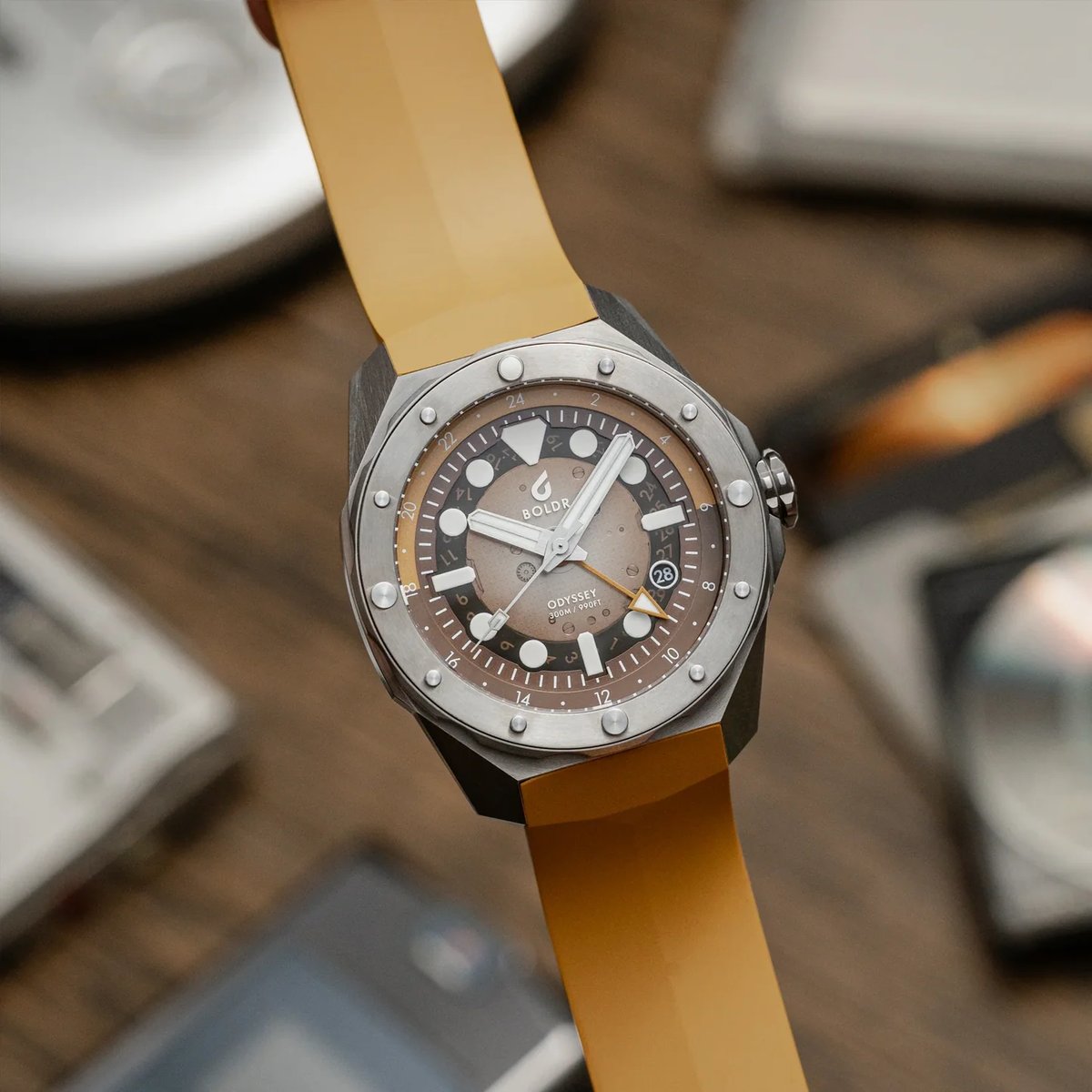
Boldr builds the Odyssey case in stainless steel, and the finishing is a hybrid: brushed surfaces on the top of the lugs, a degree of contrast at the case flanks, and a bezel assembly that sits proud enough to grip but not so proud that it catches on a shirt cuff. The overall silhouette is a classic dive-watch shape — a broad bezel, a strong mid-case, lugs that curve downward — but it has been tightened and refined rather than simply copied.
The detail that matters most in daily use is the lug geometry. The lugs curve away from the case sharply, which means the watch sits down into the wrist rather than balancing on top of it. This is the single most consequential design decision in a tool watch, and it is the one most often got wrong. Boldr has it right here. The result is a head that wears considerably smaller and flatter than its on-paper proportions might suggest, and a watch that stays put through a full range of wrist positions.
The bezel is unidirectional, as it should be on a dive watch, with a grip pattern that works with wet hands and does not shave your knuckles when you rotate it. The action is positive — not Swiss-smooth, but decisive, with clear detents and minimal backlash. The crown is a screw-down type, appropriately sized: large enough to manipulate, small enough that it does not press into the back of the hand. These are small things individually. Collectively, they are the difference between a watch you wear and a watch you own.
The crystal is sapphire, which is no longer remarkable at this price but remains welcome, and it is treated with an anti-reflective coating that keeps the dial legible from oblique angles. The caseback is solid and engraved, which serves a practical purpose — it keeps the case profile low against the wrist — and a philosophical one: Boldr is not pretending that the NH35 inside is something to look at.
The dial: what the Ember is actually about
Gradient dials are hard. Done badly, they read as novelty — a colour shift that belongs on a fashion watch and undermines everything the case is trying to say. Done well, they create depth and a sense of light moving across the dial as the wrist rotates, which is precisely what a dive watch needs to stay legible in changing conditions.
The Ember's dial is in the second category. The gradient runs from a deep, almost burnt orange at the top of the dial down to near-black at the bottom, and the transition is smooth enough that it reads as atmospheric rather than graphic. Under direct light, the orange warms and lifts; in low light, the dial closes down to something closer to charcoal. It is a dial that changes character, and that is a rare thing at this price.
The applied indices are faceted, which is what gives the dial its legibility at angles — the polished chamfers catch light and throw it back at the eye, so the markers remain readable even when the dial itself is in shadow. The hands follow the same logic: broad, sword-adjacent shapes with luminous inlays and polished edges. The seconds hand has a distinctive counterweight and a luminous tip, which is a small thing that makes a disproportionate difference to how the watch reads in motion.
Lume is Swiss Super-LumiNova, applied generously to the indices and hands. Boldr is known for taking lume seriously, and the Ember does not disappoint: the initial charge is bright, the fade is gradual, and there is still useful legibility after several hours in darkness. It is not a professional-dive-instrument level of luminosity, but it is comfortably better than what most watches in this bracket deliver.
The date complication sits at the usual position and is executed discreetly, with a colour-matched disc that does not interrupt the gradient. It is there if you need it and invisible if you don't — which is the correct brief.
The movement: an argument for pragmatism
Inside the Ember is a Seiko NH35, and that single fact will determine how a certain kind of collector reads this entire review. The NH35 is not exotic. It is not finished. It is not in-house, and it is not COSC-certified. What it is, however, is one of the most thoroughly proven automatic movements in the world, with 24 jewels, a frequency of 21,600 vibrations per hour, a power reserve of roughly 41 hours, hacking seconds, and a quickset date.
The architectural case for the NH35 in a watch at this price is unassailable. It is bidirectional-winding, which means it reaches full power quickly on the wrist. It is dimensionally consistent, which means case designers can build around it without surprises. Its parts are available everywhere, which means a service does not require shipping the watch back to Singapore. And it is cheap enough that in practice, many watchmakers will simply replace a worn movement rather than overhaul it — an outcome that keeps long-term ownership costs low and downtime short.
The counterargument is also real: the NH35 is not a movement that rewards close inspection. Its finishing is industrial. Its rate stability is decent rather than excellent. And its presence behind a solid caseback is an implicit acknowledgement that there is nothing worth showing. But this is a tool watch, not a demonstration of craft. The correct comparison is not to a Swiss chronometer movement; it is to the alternative of paying twice as much for a Swiss movement that delivers a marginal improvement in daily rate and a dramatically worse service story. On that comparison, the NH35 wins.
On the wrist
The Ember arrives on a rubber strap with a pin buckle, and this is the configuration in which the watch makes the most sense. The rubber holds the case head steady — no rotation, no sliding — and the pin buckle allows for the kind of fine adjustment that a deployant clasp cannot offer on a hot afternoon. The strap itself is supple enough to be comfortable from the first wear, with a texture that reads as functional rather than decorative.
Worn this way, the watch is genuinely unobtrusive. The low-slung case sits flat, the crown stays clear of the hand, and the whole assembly is light enough that you forget it is there. This is not a watch that demands a particular kind of sleeve or a particular kind of occasion. It works under a cuff, it works with a t-shirt, and it works in the water — which, given the name and the design brief, is the point.
Buyers who want a bracelet can add one, and Boldr's steel bracelets are competent, but it is worth knowing what you are trading. A bracelet will add weight, shift the centre of gravity upward, and change the watch's character from adventure-tool to everyday-sports. Neither is wrong. But the Ember as delivered is a better-resolved object than the Ember on a bracelet, and that is worth respecting.
Accuracy and ownership
Expect something in the region of −10 to +15 seconds per day out of the box. The NH35 is not regulated to chronometer standard, and Boldr does not claim otherwise. In practice, most examples settle toward the tighter end of that range after a few weeks of wear as the lubricants distribute across the escapement, and a little positional discipline — resting the watch crown-down overnight if it runs fast, dial-up if it runs slow — can pull the average back toward zero.
If precision matters to you, an independent watchmaker can regulate an NH35 for a modest fee, and the movement responds reasonably well to it. What you should not expect is the long-term rate stability of a Swiss chronometer movement, because that is not what this is. A four-to-five-year service interval is typical, and a service should cost somewhere in the low hundreds of dollars — with the caveat that many owners simply have the movement swapped, which is faster and often cheaper. The key point is availability: the NH35 can be serviced anywhere in the world, which is a meaningful advantage for a watch designed to travel.
Value, and what it is not
The Ember sits in a crowded price band where the competition is genuinely good. Orient will sell you an in-house automatic diver with sapphire for less. Seiko will sell you a Prospex with a better-known service network for a bit more. Christopher Ward will sell you sharper case finishing and a Swiss movement for a step up. Boldr's argument is not that it beats those watches on any single metric; it is that the combination of a limited-run gradient dial, a well-resolved case and a serviceable movement produces something none of those alternatives offer.
That argument holds, but it holds conditionally. The Ember is not an investment. Limited microbrand runs depreciate more slowly than open-production models, but they still depreciate, and secondary-market liquidity is thin. Buy it because you want to wear it, because the dial makes you happy, and because the case disappears on your wrist in the way a well-designed tool watch should. Do not buy it because you think it will be worth more in five years, because it will not be.
The verdict
The Odyssey Ember is the sort of watch the microbrand segment exists to produce: a thoughtfully resolved, honestly engineered dive watch with a dial you will not see on three other wrists at the same dinner. It does not pretend to be a Submariner, and it does not need to. The case has been thought through, the movement has been chosen for the owner's benefit rather than the spec sheet's, and the whole thing is priced with a straight face.
It is not perfect. The accuracy is adequate rather than impressive, the solid caseback is an admission, and the absence of a standard bracelet limits its range. But those are the correct compromises for a watch of this type, made in the correct order and for the correct reasons.
Buy it as a daily-wearing tool with a bit of colour, service it every few years, and it will outlast the enthusiasm that sold it to you. That is a higher bar than it sounds.