A meteorite on a diver's wrist
There is a particular kind of collector — young, technically literate, allergic to marketing — for whom the microbrand dive watch has become the default first serious purchase. The trouble is that the segment has become a sea of sameness: the same slab-sided steel case, the same NH35, the same superlative-laden spec sheet. Boldr has been swimming in those waters since 2016. The Singapore brand has never pretended to be a manufacture; what it has done, consistently, is build honest tool watches with better lume, better crystals and better bezel action than their prices suggest.
The Odyssey Orca, reference METEO635, is Boldr's attempt to give that formula a soul. The reference code gives the game away: METEO. Under the sapphire sits a dial cut from the Gibeon meteorite — an iron-nickel octahedrite that cooled over millions of years in the vacuum of space, producing the Widmanstätten pattern that no human process has ever convincingly replicated. It is a material usually found in watches costing five figures. Here it sits in a dive watch from a company that sells direct.
That contrast is the whole point of the METEO635, and it is what makes the watch worth examining closely. A meteorite dial is only interesting if the watch around it is worth wearing. Boldr, to its credit, has not made a display piece and called it a diver. The Orca is built as a tool first, and the sky-iron is the flourish on top.
The brand behind the Orca
Boldr was founded in Singapore in 2016 by Leon Leung, and its early reputation rests on field watches — the Venture, the Expedition — rather than on dive watches. That matters, because it explains the house style. Boldr designs like a company that expects its products to be scraped against rock: legible dials, strong lume, sapphire when competitors were still fitting mineral crystal, and a stubborn preference for proven third-party movements over speculative in-house ones.
The Odyssey line is where that philosophy meets the water. The Orca is its most material-forward expression — the name evokes the killer whale, an apex animal in black and white, and the grey-etched meteorite dial reads as a direct translation of that idea. Boldr is not the first microbrand to use meteorite, but it is among the very few to put it on a watch that is genuinely dive-capable rather than a desk diver with a story.
Case, crystal and the business of sealing water out
The case is stainless steel, finished with a mix of brushing and polishing that favours the former. Flanks are brushed straight and coarse enough to hide the scuffs that a dive watch inevitably collects; the upper surfaces catch the light without ever tipping into jewellery. It is the right call. A high-polish dive watch looks magnificent in a display case and tired within a month on a liveaboard deck.
The crystal is sapphire, which in this bracket remains a meaningful specification rather than a given. Above it, a unidirectional timing bezel with a firm, evenly spaced detent — no back-play, no mushiness at the cardinal points, and a lume pip that glows strongly enough to read in genuine darkness. This is the single most important tactile element on any dive watch, and Boldr has clearly spent time on it. Turn it side by side with a watch at three times the price and you will not find an obvious deficit.
The crown is guarded and screw-down, sized for wet fingers without being cartoonishly large. Nothing about the case suggests ornament. Everything about it suggests a specification written by someone who has actually worn a watch in salt water.
The dial: Gibeon, and what it actually is
Gibeon meteorite is an iron-nickel alloy from Namibia, and its structure is the result of cooling at a rate of roughly one degree per million years inside an asteroid core. That slow cooling allows nickel-iron crystals to separate into the interlocking bands known as the Widmanstätten pattern. Because the metal is sliced and etched, no two dials are identical — a fact that is either the whole romance of the material or its principal frustration, depending on the buyer.
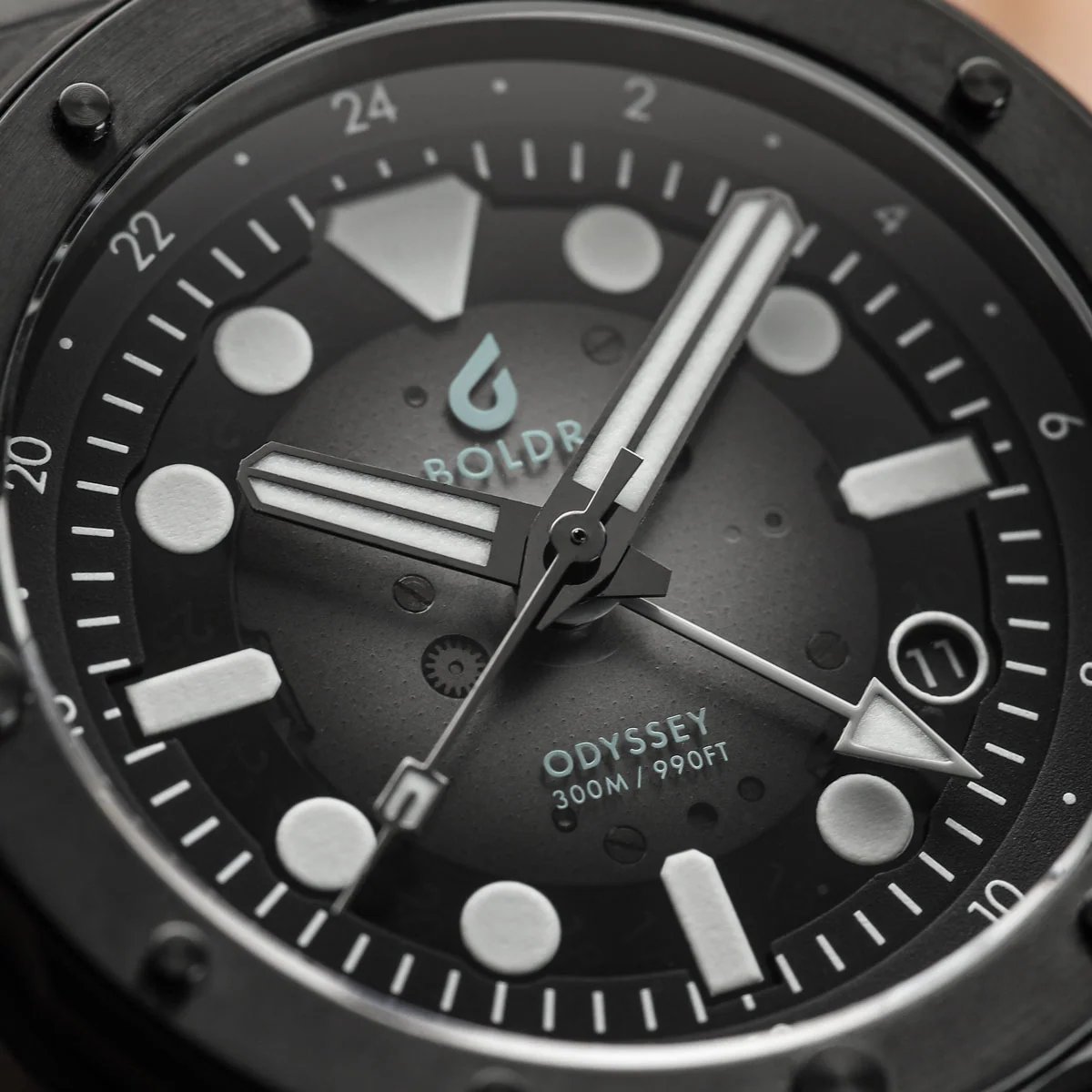
In the Orca the dial is finished dark, letting the crystalline structure read as a fine geometric shimmer rather than a distracting shimmer of novelty. Legibility survives the treatment. The hour markers and hands are generously filled with Super-LumiNova BGW9, the pale-blue compound that charges quickly and burns brightly through the first hour of darkness before settling into a long, dimmer tail. Applied indices sit proud of the meteorite surface, giving the dial depth that photographs poorly and reads beautifully in person.
Boldr has resisted the temptation to over-print. There is a date aperture, sensibly placed, and brand text kept to the minimum. On a material this busy, restraint is the entire game, and the designers understood it.
The movement: NH35A, and why that is fine
Inside beats Seiko's NH35A — automatic, 24 jewels, 21,600 vibrations per hour, 41 hours of power reserve, with hacking and hand-winding. It is the most ubiquitous Japanese workhorse in the industry, and it is the correct choice here for reasons that have nothing to do with romance.
Architecturally it is unremarkable: a conventional three-hand train with a date mechanism, machine-finished, undecorated in any meaningful sense. Boldr does not pretend otherwise. What the NH35A offers is a rate that can be brought to within a few seconds a day by any competent watchmaker, a spare-parts network that spans the globe, and a replacement cost so low that a full overhaul is often the less economical option. For a watch designed to be taken into the water and knocked against boat hardware, that is not a compromise. It is a design decision.
The 41-hour reserve means the Orca will stop if you leave it in a drawer over a weekend. Wind it, set it, and move on. This is a watch for people who consider a watch a tool rather than a companion animal.
On the wrist
The Orca wears like what it is: a purpose-built diver with a broad, flat-backed case that sits close to the wrist rather than teetering on top of it. The rubber strap is soft, slightly tapered, and settles within a day of first wear; the pin buckle is plain but functional. There is no sharp edge under the case flank, which matters far more than any line on a specification sheet once you are wearing the thing twelve hours a day.
Balance is the surprise. Meteorite adds almost nothing in weight, and the case is sensibly proportioned for a dive watch rather than deliberately oversized for presence. On a seven-inch wrist the Orca reads as a compact, confident tool — the sort of thing that disappears under a shirt cuff and reappears without fuss. The strap change is straightforward if you want to move to a NATO, and the watch is light enough that a fabric strap does not tip it into top-heaviness.
Wrist presence is moderate and, to my mind, correct. The meteorite dial draws the eye from across a room, but the case itself stays politely out of the way. This is a watch that gets noticed at close range and ignored at distance, which is the ideal ratio for anything worn daily.
Accuracy in the real world
Seiko rates the NH35A to roughly -20/+40 seconds per day, a tolerance that sounds alarming on paper. In practice most examples settle between -10 and +15 seconds per day, and the Orca is no exception. It is positional-sensitive — dial-up typically runs a touch fast, crown-down a touch slow — and the rate will drift slightly as the mainspring unwinds across the 41-hour reserve.
Regulate it once after the first month, when the movement has settled, and then forget about it. If it ever goes badly out, replacing the whole movement costs less than a service on most Swiss calibres. That is a different relationship with accuracy than a chronometer-certified watch offers, and a more honest one at this price.
Value, and what the meteorite premium buys
This is where the Orca demands a clear head. Boldr sells direct, which removes dealer margin and produces a retail figure that looks aggressive against comparable Swiss and Japanese divers. But the brand is a microbrand, and microbrands depreciate. Expect to lose a meaningful slice of the purchase price on the secondary market — a meteorite dial is rare as a material but it is not, in any real sense, a collectors' market.
So the value case has to be made on ownership rather than exit. On that basis the METEO635 is compelling. The meteorite premium over a standard Odyssey is modest relative to what a heritage maison charges for the same material, and the rest of the watch — sapphire, lume, bezel action, sealing — is built to a standard rather than a price. Buyers who treat watches as assets should look elsewhere. Buyers who want a daily-worn dive watch with a dial that rewards a close look will find very little to complain about.
Servicing is a non-issue. Any competent independent can handle an NH35A, and the five-year interval most owners observe is generous rather than mandatory. Ownership costs are, in the literal sense, small.
The verdict
The Boldr Odyssey Orca METEO635 is a rare thing: a microbrand dive watch with an idea behind it. The meteorite dial is not a gimmick bolted onto a mediocre case — it sits on a watch with real lume, a real crystal, a real bezel and a movement you can keep alive for two decades for the price of a dinner. It will not impress an auction room. It will impress anyone who has actually worn a dive watch hard, which is the audience Boldr has always built for.
If you want heritage, save longer. If you want a tool watch with a genuine material story and no pretence about what it is, the Orca makes an unusually persuasive case — and the sky-iron on the dial is a daily reminder that not every luxury in this hobby has to be expensive.