A titanium field watch with a lunar dial
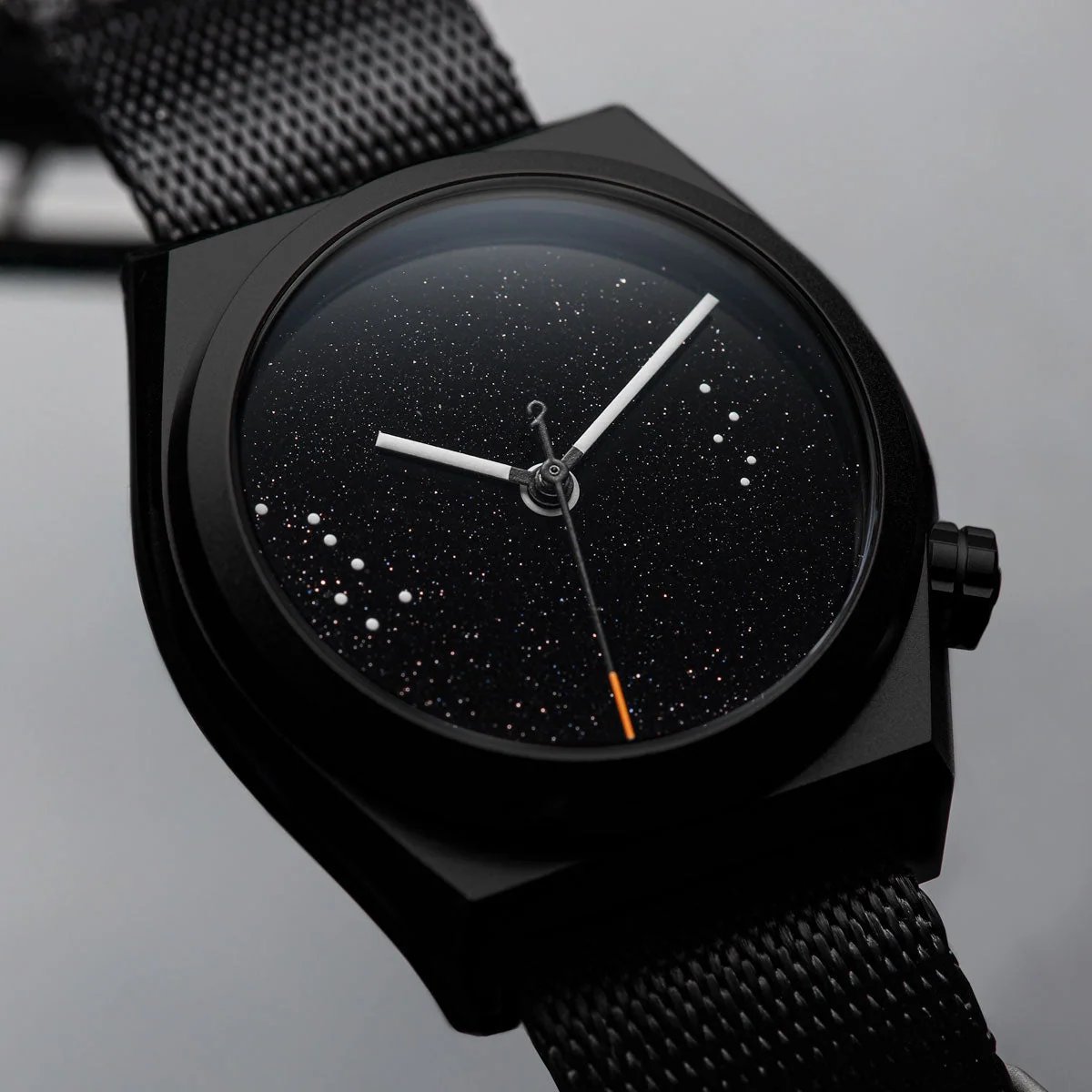
There is a particular discipline to making a watch that costs less than a set of tyres and still asks to be taken seriously. Boldr has practised that discipline since 2015, and the Polaris Moonstone is the most articulate expression of it I have handled from the Singaporean brand. The premise is simple: a 38 mm titanium case, a sapphire crystal, 200 metres of water resistance, and a dial that behaves less like painted metal and more like a stone held up to a window.
Moonstone is a feldspar, and when it is cut en cabochon it produces adularescence — a soft, billowing sheen that appears to move beneath the surface rather than sit upon it. Translating that into a watch dial is not straightforward. Most attempts at iridescence end up looking like a petrol station sticker. Boldr's version is more restrained: pale and cool in flat office light, warmer and faintly drifting as you rotate your wrist, with a quality that rewards a second look rather than demanding a first one.
But a watch is not a dial alone. The question worth asking is whether the Polaris Moonstone holds up as an object — whether the case finishing, the movement, the lume, and the wearing experience justify the price of admission. After extended time with reference VE-PO-TI-38-20, the answer is a considered yes, with the usual microbrand caveats noted plainly.
Boldr, briefly
Boldr was founded in Singapore in 2015 with an explicit outdoor brief. Its catalogue — Odyssey, Expedition, Venture, Field Medic — is built around legibility, titanium construction, and honest Japanese movements rather than heritage it does not have. That is worth stating plainly: this is a young brand, and anyone buying on the assumption of a century of archives is buying the wrong thing.
What Boldr does have is a coherent design language and an unusually clear sense of who its customer is. These are watches for people who hike, dive, travel light, and would rather spend the difference on a flight than on a rotor with Geneva stripes. The Polaris line extends that grammar into a smaller, more refined case architecture — a genuine evolution rather than a re-skin.
Case and crystal
Titanium is the correct material here, and not merely as a marketing line. The Polaris is built in titanium throughout, and the effect on the wearing experience is the single most persuasive thing about the watch. Titanium has mass without heft; it reads as dense and solid in the hand while sitting almost weightlessly on the wrist. For a field watch intended to be worn for long stretches, that distinction matters more than any specification.
The 38 mm diameter is a confident choice in a market that has spent a decade inflating. It reads as a proper tool watch rather than a fashion object scaled down for the sake of a trend. The bezel is fixed and clean, the crown screws down, and the caseback sits flush enough that the watch does not rock on the wrist. Finishing is brushed on the flanks with polished transitions that catch light without shouting — modest, but consistent and free of the soft edges that betray hurried machining.
The crystal is sapphire, which at this price point remains a meaningful commitment rather than a given. Water resistance is rated to 200 metres, which is more than the majority of owners will ever need and precisely the point: a field watch should not require you to think about water before you reach for it.
The dial
The moonstone surface is the reason most people will look twice, but the layout is what makes it liveable. Applied indices sit raised against the dial and catch the same shifting light as the surface beneath them, so that the markers never quite disappear. The hands are simple and generously filled with Super-LumiNova X1, with a clear hierarchy between hours and minutes and no decorative flourishes competing for attention.
There is no date window, which is the right decision. A moonstone dial is a continuous surface, and interrupting it with a framed aperture would have broken the effect entirely. The trade-off is a watch that requires you to know the date yourself — an entirely reasonable proposition for a piece with this brief.
Lume is competent rather than spectacular. Super-LumiNova X1 charges quickly and glows with a clean pale green that fades evenly over the course of a night. It will read clearly at 3 a.m. and it will not embarrass itself, but it does not match the luminous endurance of the very best tool watches on the market. For the money, it is exactly what it should be.
The movement
Inside sits a Miyota 9039, the dateless sibling of the widely used 9015. The architecture is conventional and proven: a free-sprung balance running at 28,800 vibrations per hour, bidirectional winding, hacking, and hand-winding. Power reserve is a stated 42 hours, which is adequate rather than generous — put it down on Friday evening and it will still be running on Sunday morning, but not by much.
Finishing is industrial rather than decorative. There is perlage on the bridges and a plain rotor, and no attempt to dress a workhorse movement as something it is not. I regard that as a virtue. At this price, money spent on hand-bevelled bridges is money not spent on the case, the crystal, or the bracelet — and Boldr has correctly prioritised the things you actually touch.
The other advantage is serviceability. The Miyota 9039 is understood by virtually every competent independent watchmaker, and parts availability is broad. That is a genuine ownership benefit over in-house microbrand movements, many of which require a return to the maker and a lengthy wait.
On the wrist
The Polaris Moonstone is a watch that disappears in the best sense. The titanium case and bracelet combine to keep the whole assembly light enough that you stop registering it within an hour of putting it on. The bracelet articulates tightly and tapers sensibly, and the folding clasp sits flat against the underside of the wrist — no sharp edges, no pressure point, no constant micro-adjustment.
Balance is good. Lightweight cases paired with heavy steel bracelets often feel head-heavy and flop forward, but here the bracelet is titanium too, so the centre of mass sits close to the middle of the wrist. On a nylon pass-through or a soft leather strap it becomes even more forgettable, which is precisely what a field watch should be. The screw-down crown is small but deeply knurled enough to grip with a thumbnail, and the caseback sits flush enough that the watch does not rock during desk work.
This is a watch you can wear for sixteen hours, sleep in, and forget you have on until you look down at that dial again.
Accuracy and daily life
The Miyota 9039 is not a chronometer and Boldr does not present it as one. Out of the box, expect a spread of roughly plus five to plus twelve seconds per day, with positional variation that rewards leaving it crown-up overnight if you are running fast. Across a week of mixed wear, most examples will average inside ten seconds daily. That is entirely respectable for the price, and the movement is stable rather than merely accurate — it settles into a consistent rate rather than wandering.
Day to day, the watch asks nothing of you. It winds on the wrist, it survives a shower, it handles a weekend of hiking without complaint, and it reads clearly in every lighting condition except the deliberate darkness of a cinema, where you have the lume. It is a genuine one-watch proposition for someone who wants a mechanical object without the ceremony of ownership that comes with more expensive pieces.
Value and ownership
At an MSRP in the region of $699, the Polaris Moonstone buys a titanium case, a sapphire crystal, 200 metres of water resistance, a proven Japanese automatic, and a dial with genuine optical character. That is a fair trade. On the secondary market, examples trade meaningfully below retail, which makes a lightly used piece one of the better-considered field watches available at the price.
What it will not do is appreciate. Microbrand titanium field watches depreciate predictably, and the moonstone dial — however appealing — is unlikely to alter that trajectory. Buy this watch to wear it. Service intervals of roughly five years at around $180 from an independent watchmaker are entirely manageable, and the absence of an authorised-only service requirement is a real advantage.
The verdict
The Boldr Polaris Moonstone is the rare affordable watch with an idea behind it. The titanium case and 38 mm proportions make it a genuine all-day wearer, the movement is sensible rather than aspirational, and the dial gives you something to look at on the tenth hour of a long day.
It will not impress a room and it will not make you money. But it will be the watch you reach for most mornings, and that is a harder thing to engineer than a moonstone sheen.