A field watch that behaves like one
Field watches are the last honest category in horology. They were designed to be read at a glance in poor light, to survive a knock, and to cost little enough that losing one was inconvenient rather than catastrophic. Very little of that original brief survives in the modern market, where the category has largely been absorbed into heritage branding and priced accordingly. The Boldr Venture Earth is an attempt to restate the brief in modern terms: a 38mm titanium case, a sapphire crystal, a screw-down crown, 200 metres of water resistance, and a dial whose surface pattern is derived from the planet itself. The price is well under four hundred dollars.
Boldr is a Singaporean direct-to-consumer brand founded in 2016. It has never pretended to be a manufacture, never invented a fictitious founding date on Lake Geneva, and never priced its watches against the Swiss. Instead it has built a catalogue of tool watches around proven Japanese movements and materials that punch above their cost. The Venture line — titanium, small, purposeful — is the clearest expression of that philosophy, and the Earth is its most design-led variant.
Case architecture and finishing
The case is the first argument. Titanium at this price is not common, and the grade used here is the practical, widely available alloy rather than anything exotic. What matters more than the metallurgy is the finishing strategy: Boldr has gone almost entirely matte. The flanks are bead-blasted or brushed to a uniform grey, with no polished bevels to catch light and no mirror surfaces to show scratches. It is a coherent decision, not a cost-saving accident. Polished titanium shows wear quickly and looks cheap when it does; a uniform matte surface simply acquires a patina of micro-abrasion and continues to look like what it is.
The case sides are relatively straight, rising to a flat upper surface around the crystal, and the lugs curve down in a conventional manner. The crown is screw-down — an essential detail at this water resistance — and is proportioned generously enough to grip without being obtrusive. At 38mm, the watch sits in the sweet spot that has quietly become the default for tool watches: large enough to read, small enough to be genuinely comfortable, and conservative enough to wear with anything.
The crystal is sapphire, which at this price point still deserves comment. Mineral crystal is the norm below four hundred dollars, and sapphire's scratch resistance is one of the few specification upgrades that produces a daily, tangible benefit. The caseback is solid, which keeps cost and thickness in check and removes any temptation to decorate a movement that does not warrant decoration.
The dial as a piece of design
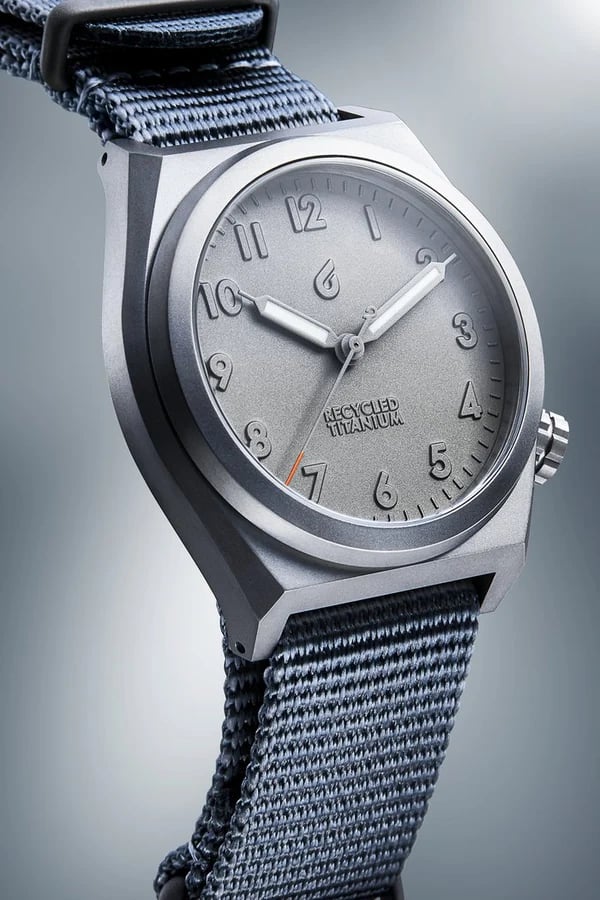
Most field watches are legible and nothing more. The Venture Earth's dial is the reason the model exists as a distinct reference rather than another colourway. Its surface is treated with a texture derived from satellite imagery of the earth, giving the dial a topographical quality that shifts with the light without ever compromising contrast. It is the sort of detail that reads as gimmick on a screen and as good sense in person: a flat, plain dial at this price can look cheap, whereas a textured one gives the eye something to do.
Against that surface, the markers are applied and the hands are broad and sword-shaped, filled with Super-LumiNova. Legibility is the priority and it is achieved: the hour and minute hands are clearly differentiated, the chapter ring provides a minute track that can actually be used, and the whole arrangement remains readable at a glance, which is the only test that matters. The date window sits at three o'clock, framed simply. Purists will argue the dial would be cleaner without it; pragmatists will note that a date is genuinely useful and that Boldr has not made a fuss of it.
Lume performance is solid rather than spectacular. Super-LumiNova in this application charges readily under daylight and delivers usable low-light reading for the first several hours, tapering to a faint glow by morning. It is entirely adequate for a night in a tent or a dark stairwell; it is not a dive watch's torch.
The movement, honestly considered
The Venture Earth runs the Seiko NH35, an automatic three-hander with a date, 24 jewels, a 41-hour power reserve, and a beat rate of 21,600 vibrations per hour. There is no decoration to speak of, no Geneva stripes, no anglage — and there should not be, given that a solid caseback hides it from view. What the NH35 offers instead is the most valuable quality a movement can have in a watch at this price: it can always be fixed.
The NH35 is a descendant of Seiko's long-running 7S family, refined with hacking and hand-winding. Its regulation system is a simple cam-and-lever arrangement rather than a free-sprung balance, which means any watchmaker with a timing machine can nudge it into tolerance in a matter of minutes. Parts are inexpensive and universally available. A rebuild costs a fraction of what a Swiss calibre would, and in many cases less than sending the watch back to the brand.
The 41-hour reserve is the movement's one real limitation. Take the watch off on Friday evening and it will have stopped by Sunday afternoon. That is a minor inconvenience rather than a flaw, but it is worth naming: if you rotate a small collection, a wind before you set it down becomes part of the ritual.
On the wrist
Wearing the Venture Earth for an extended period is an exercise in forgetting. The titanium case weighs so little that the watch effectively disappears under a shirt cuff, and the 38mm diameter means it never catches on a jacket sleeve or obstructs a wrist when typing. On the supplied NATO strap the assembly acquires a little more visual mass, and the watch rides slightly proud of the wrist rather than settling into it — the standard trade-off of any single-pass nylon strap.
The lightness is the point and also the potential objection. Anyone conditioned by steel sports watches will pick this up and wonder whether something has been left out. It has: mass. Whether that reads as a virtue depends on use. For hiking, climbing, cycling, or a long day at a desk, the absence of weight is unambiguously good. For an evening where a watch is meant to contribute to a look, the Venture Earth is honest to the point of reticence. It is not trying to be jewellery, and it is not quietly hoping you will mistake it for something more expensive.
Water resistance is rated to 200 metres, backed by the screw-down crown. That figure is well beyond what a field watch needs and is exactly the sort of margin that produces confidence over the long term: you can swim, shower, and get caught in weather without ever thinking about it. Boldr has not built a dive watch, but it has built something you need not protect.
Accuracy and ownership
The NH35 is not certified by any chronometer standard and no accuracy claim is made. In real use, expect something in the region of minus ten to plus fifteen seconds per day, with individual variation doing most of the work; many examples settle into single digits. Positional variation is modest at 21,600 vph, and the watch is easy to regulate if a particular example drifts outside your tolerance.
Servicing is straightforward. Because the movement is a mass-produced Seiko design, any competent independent watchmaker can handle it, and there is no need to rely on an authorised channel — a meaningful advantage at this price, where a manufacturer service can approach a substantial fraction of the watch's value. The solid caseback and robust crystal mean there is little to go wrong between services.
Value and the wider field
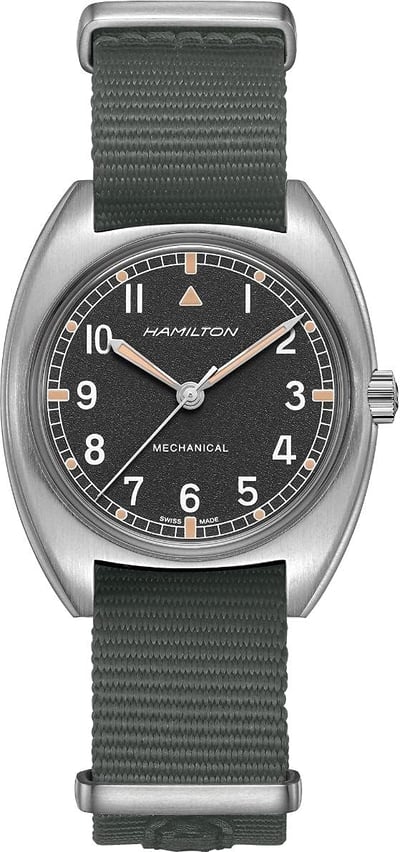
At retail, the Venture Earth sits comfortably below the point at which buyers start expecting a Swiss name on the dial. What the money buys is not heritage but material honesty: titanium, sapphire, 200 metres, a screw-down crown, applied markers, and a dial with actual design intent. Compare it with the obvious alternatives and the specification sheet holds up. A Hamilton Khaki Field Mechanical is a more romantic object with a genuine military lineage, but it is steel, hand-wound, and more expensive. A Seiko 5 Sports field model offers the same movement family at a lower price but in a heavier steel case with less water resistance. Timex's Expedition North Titanium Automatic gets close on materials and price but lacks the dial work.
Where the Venture Earth does not compete is resale. Microbrand field watches depreciate on purchase and trade at roughly half of retail on the secondary market. That is not a reason to avoid the watch; it is a reason to buy it used, or to buy it new with the intention of wearing it until it stops. Treat it as a consumable tool, which is what it is, and the economics are entirely rational.
Verdict
The Boldr Venture Earth is not a watch that will be discussed at auction or passed down through generations. It is something less fashionable and more useful: a well-considered tool that solves the field-watch brief at a price that makes the specification feel almost unreasonable. The titanium case is light and honestly finished, the sapphire crystal will not scratch, the crown screws down, the dial has an idea behind it, and the movement can be serviced for pocket money by any competent watchmaker on earth.
Its weaknesses are real but predictable: a short power reserve, a movement with no aesthetic dimension, a lightness that some will read as insubstantial, and negligible resale. None of those undermine the central proposition. If you want a field watch to actually do field-watch things — to be worn hard, forgotten, and relied upon — the Venture Earth makes a more persuasive case than watches costing several times as much.