Boldr Venture Umbra: A Shadow With Substance
There is a particular kind of watch that collectors come to late, and usually with some embarrassment. It is the watch that costs less than a service on a Swiss chronograph, that gets worn without a second thought, and that somehow ends up on the wrist more often than the pieces that live in the safe. The Boldr Venture Umbra is exactly that watch. It arrives in modest packaging, weighs almost nothing, and makes no claim to heritage it does not possess. And yet it is, in the most practical sense, one of the more convincing arguments in the contemporary field watch category.
Boldr is a Singaporean brand, founded in 2015 by Leon Leong, that built its identity around a single proposition: adventure-ready tool watches that do not require a collector's budget. The Venture line is the purest expression of that idea, and the Umbra — Latin for shadow — is its darkest and most self-assured variant. This review examines it as an instrument rather than an ornament.
The Brand Behind the Caseback
Boldr occupies an unusual position in the market. It is not a heritage house with a century of archives, nor is it a fashion brand slapping a logo on a generic case. It sits in the crowded but genuinely interesting space occupied by microbrands that specify their own cases, choose proven movements and sell direct. The result is a product where a disproportionate share of the retail price goes into materials rather than marketing.
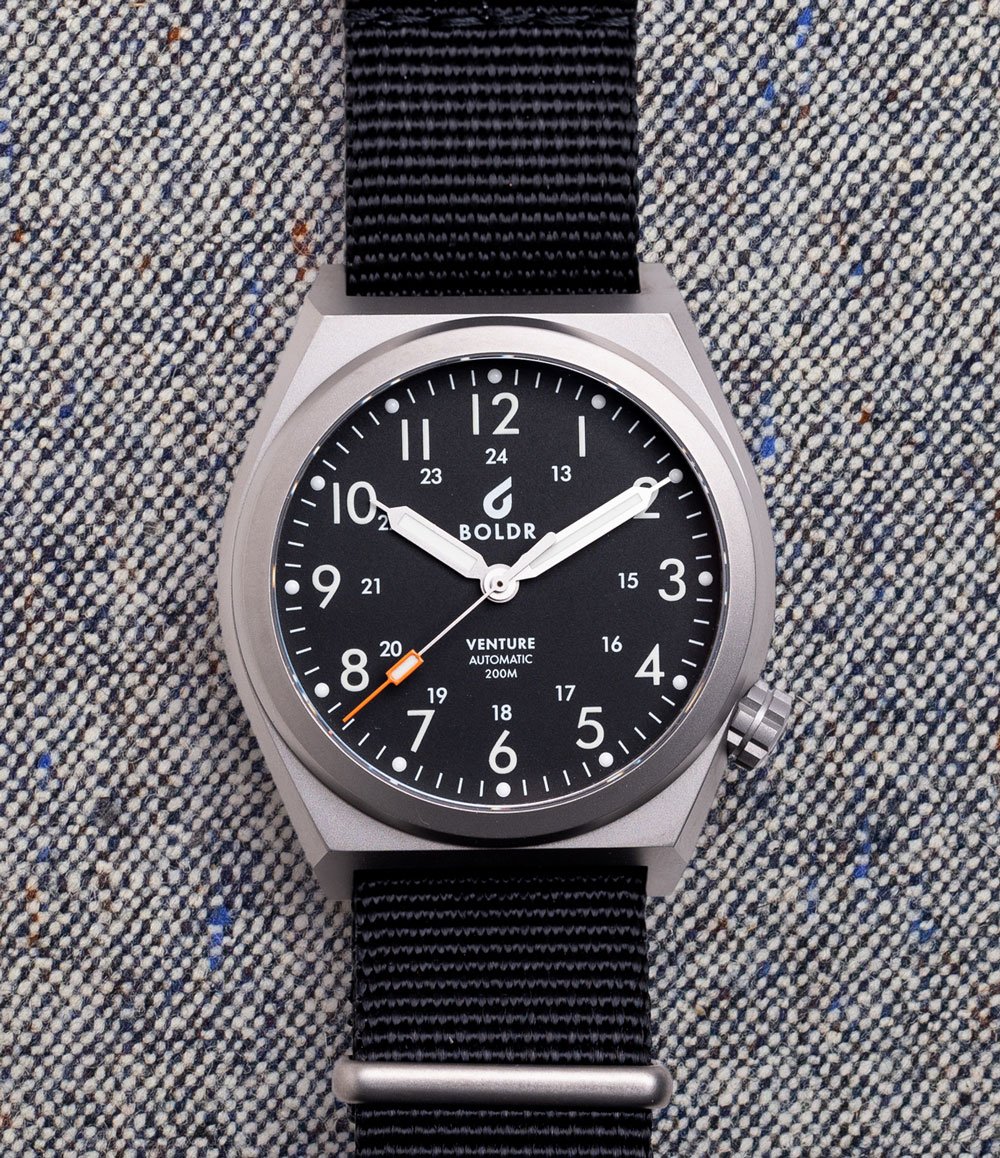
The Venture established the brand's reputation. A titanium case in a compact diameter, a sapphire crystal, a screw-down crown, a proper water resistance rating and an automatic movement — these were not novel ideas individually, but the combination at the price was. The Umbra takes that formula and applies a visual treatment that reads as deliberate rather than decorative: matte, low-contrast, almost monochrome, with the dial's luminous elements emerging only when the light drops.
Case, Crystal and Finishing
The case is titanium, and that single fact shapes everything about how the watch behaves. Titanium is roughly forty percent lighter than steel for the same volume, and the difference is immediately apparent in the hand. Where a steel field watch announces itself with a small but perceptible mass, the Umbra simply does not. On the wrist this translates into a watch that disappears — which, for a tool intended to be worn through activity, is the highest compliment available.
The finishing is a sandblasted, matte treatment that suits the material and the brief. There is no polishing to speak of, no mirror surfaces to catch light and draw attention. The Umbra's aesthetic is consistent to the point of austerity: case, dial and hardware all conspire to reduce reflectivity. It is a watch designed to be looked at only when you need the time, not when you want to admire it.
The crystal is sapphire, which at this price point is a meaningful statement. Sapphire's scratch resistance is what allows a field watch to remain legible after years of contact with rock, strap buckles and door frames. Water resistance is rated to 200 metres, backed by a screw-down crown rather than a push-pull one — a distinction that matters more than most buyers realise. The drilled lugs are a small but welcome detail, making strap changes straightforward and reducing the risk of scratching the case with a spring bar tool.
The Dial: Legibility as Philosophy
The Umbra's dial is where the design's tension lives. A blacked-out watch is, by definition, a compromise: reducing reflectivity and contrast also reduces legibility in poor light. Boldr resolves this by leaning entirely on the luminous elements. In daylight the dial reads as a dark, restrained surface with markers picked out subtly. In darkness, once charged, the Super-LumiNova does the work, and the watch becomes a pure instrument.
This is a legitimate design philosophy rather than a gimmick. The markers are applied rather than printed, which gives the dial a depth that printed indices cannot match, and the handset is clean and unambiguous. There is no clutter — no day window, no date aperture breaking the symmetry. It is a time-only watch in the traditional sense, and the restraint is welcome.
The trade-off is real, however. In dim but not dark conditions — a restaurant, a dimly lit room — a black-on-black dial requires a moment longer to read than a conventional white-on-black layout. Buyers should understand this going in. The Umbra is not the most legible Venture; it is the most atmospheric one.
Movement: The Seiko NH35 Examined
Inside sits the Seiko NH35, and the honest assessment is that it is a workhorse, not a showpiece. The architecture is conventional: a bidirectional automatic winding system, a 41-hour power reserve, a beat rate of 21,600 vibrations per hour and 24 jewels. The finishing is industrial — clean, orderly, and entirely without the anglage, black polish or circular graining that a collector of Swiss movements would look for. There is nothing here to admire under magnification.
What the NH35 offers instead is something arguably more valuable in a tool watch: ubiquity. The movement is produced in enormous volumes, understood by essentially every watchmaker on earth, and inexpensive enough that replacement is often more economical than repair. Its 41-hour reserve is adequate rather than generous — set it down on Friday evening and it will likely have stopped by Sunday morning — but it winds efficiently and hacks reliably for accurate setting.
It is worth being clear about what this is not. It is not COSC-certified, it is not in-house, and it is not finished to any decorative standard. It is a dependable engine chosen for cost, reliability and serviceability, and in a watch at this price that is the correct choice.
On the Wrist
The 38mm case diameter is the specification that matters most here, and it is well judged. It is compact enough to slip under a shirt cuff without complaint, large enough to read at a glance, and neutral enough to suit a wide range of wrist sizes. Combined with the titanium construction, the wearing experience is one of near-total absence. The watch does not shift, does not tip, and does not demand attention.
The crown operation is positive without being stiff, and the screw-down threads feel well cut. Balance across the wrist is neutral — there is no dial-heavy tipping and no crown intrusion into the back of the hand. On the supplied nylon strap, the whole assembly is light enough that you will occasionally check that it is still there.
This is not a watch that photographs spectacularly. It is a watch that becomes indispensable. Those are different qualities, and the second is harder to engineer.
Accuracy in Daily Use
The NH35 in practice delivers what the specification promises and no more. Expect something in the region of minus ten to plus fifteen seconds per day, with the rate settling after a few weeks of consistent wear as the movement beds in. That is well within the tolerance expected of a field watch, where the question is generally 'is it roughly lunchtime' rather than 'is it 12:03:47'.
For owners who care, the movement is straightforward to regulate, and the low cost of replacement means a watchmaker's quote will never be a source of anxiety. This is one of the quiet advantages of a widely used Japanese caliber: the ownership economics are benign in a way that a proprietary Swiss movement never is.
Value and the Secondary Market
At an MSRP in the region of $399, the Umbra asks a fair price for what it delivers: titanium, sapphire, 200 metres of water resistance and a proven automatic movement. Comparable specifications from established Swiss brands typically carry a significant premium, and while those brands offer heritage, dealer networks and stronger residuals, they do not offer a lighter or more capable watch at this price.
The secondary market tells a predictable story. Microbrand tool watches depreciate, and pre-owned Umbras typically change hands in the $250 to $340 range depending on condition and completeness. That is a shallow enough curve that buying new and wearing hard is entirely rational. This is not a piece to buy as an investment; it is a piece to buy because you will use it.
How It Compares
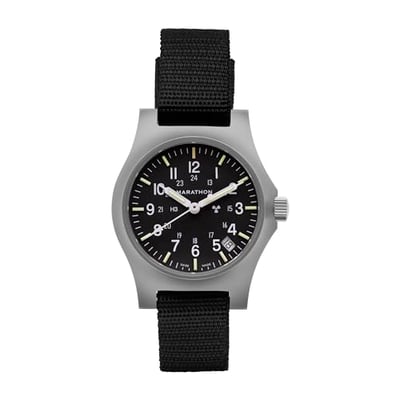
The obvious benchmark is the Hamilton Khaki Field Mechanical, which offers genuine heritage and a hand-wound movement but neither titanium nor a 200-metre rating. The Marathon General Purpose Quartz brings authentic military pedigree and tritium illumination, trading the automatic movement for quartz reliability. Vaer's S3 Standard Issue makes a similar direct-to-consumer value argument. Each is a legitimate alternative; none combines the Umbra's specific package of light weight, compact diameter, sapphire, screw-down crown and automatic winding.
Within Boldr's own catalogue, the Wayfarer remains the more legible and arguably more versatile choice, while the Carbon Black occupies similar territory with a slightly different finish. The Umbra is for the buyer who has decided that the stealth aesthetic is worth the small legibility penalty.
Service and Ownership
Ownership costs are modest. A service interval of around five years is reasonable, and because the NH35 is so widely supported, an independent watchmaker can handle the work — or replace the movement outright — for a figure in the region of $120. There is no need to ship the watch to an authorised service centre, no proprietary parts bottleneck, and no reason to fear the long-term cost of keeping it running.
Verdict
The Boldr Venture Umbra is not trying to be a luxury watch, and that is precisely why it succeeds. It is a compact, lightweight, genuinely water-resistant titanium field watch with a movement that will still be serviceable in twenty years. Its weaknesses — industrial movement finishing, a dial that asks a little more of the eye in low light, and the soft residuals common to all microbrands — are the honest consequences of its price.
For a young collector assembling a first serious rotation, the Umbra makes a persuasive case as the watch you actually wear. It will not impress at a dinner party. It will, however, be the one you reach for when you are doing something worth wearing a watch for.