Monsieur Bovet – The Convertible Classic That Defies the Ordinary
The watch world rarely sees a timepiece that can genuinely claim three distinct identities without compromising any of…
By Vivir··Updated
In this review# Monsieur Bovet – The Convertible Classic That Defies the Ordinary
The watch world rarely sees a timepiece that can genuinely claim three distinct identities without compromising any of them. Bovet’s **Monsieur Bovet** (reference **AI43014**) does exactly that: a reversible wristwatch that flips into a pocket watch and, with a simple turn, becomes a desk clock. Launched in 2015, it sits at the apex of Bovet’s **Amadéo® convertible case** lineage, marrying haute‑horlogerie mechanics with a playful, almost theatrical versatility. In a market saturated with single‑purpose dress watches, the Monsieur Bovet forces us to rethink what a “dress watch” can be, all while delivering a hand‑wound calibre, seven‑day power reserve, and a striking 43 mm white‑gold case. Below, we break down the watch’s heritage, design, movement, wearability, appropriate occasions, and finally, its value proposition.
---
## Heritage — the model's place in the brand's line and its launch context
Bovet, a Swiss maison founded in 1822, has long been celebrated for its intricate finishing, patented mechanisms, and a penchant for turning the ordinary into the extraordinary. The **Amadéo® convertible case**—patented by Bovet—first appeared in the early 2000s as a novelty that allowed a watch to transform into a pocket piece. The **Monsieur Bovet**, introduced in **2015**, quickly became the emblem of this concept, described by the brand as “the symbol of timepieces featuring the iconic patented Amadéo® convertible case.”
Within Bovet’s catalogue, the Monsieur Bovet occupies the top tier (Tier 1) of the brand’s dress‑watch segment, positioned alongside the more traditional, single‑purpose models. Its launch year places it squarely in a period when luxury watchmakers were experimenting with hybrid formats—think of the Tudor Black Bay’s dive‑watch versatility or the Hublot Big Bang’s material mash‑ups. Yet Bovet’s approach was uniquely mechanical: rather than adding a digital module or a detachable strap, the entire case itself reconfigures, preserving the integrity of its manual movement.
The model’s **reference AI43014** appears across Bovet’s official channels and is consistently linked to the white‑gold version; a parallel reference **AI43027** also surfaces in third‑party listings, but the brand’s primary documentation cites AI43014. This distinction matters for collectors who track provenance, as the AI43014 designation is the one tied to the original launch narrative and the specific configurations described below.
---
## Design & Case — case dimensions, materials, dial
At first glance, the **Monsieur Bovet** looks like a bold, contemporary dress watch. Its **43 mm** case—large by classic dress‑watch standards—commands attention without feeling oversized, thanks to carefully proportioned lugs and a relatively thin profile (exact thickness isn’t disclosed in the source data). The case is crafted in **white gold**, though a **red‑gold** version is also offered, each finished with a high polish that catches light on the beveled edges.
The most distinctive visual element is the **crown and special attachment at 12 o’clock**, a hallmark of the Amadéo® system. When the watch is worn on the wrist, the crown sits at the traditional 3 o’clock position; flip the case, and the same crown becomes the winding point for the pocket‑watch configuration, while the 12 o’clock attachment serves as the pivot for the desk‑clock stance. This clever engineering ensures that the watch retains a coherent aesthetic in each mode.
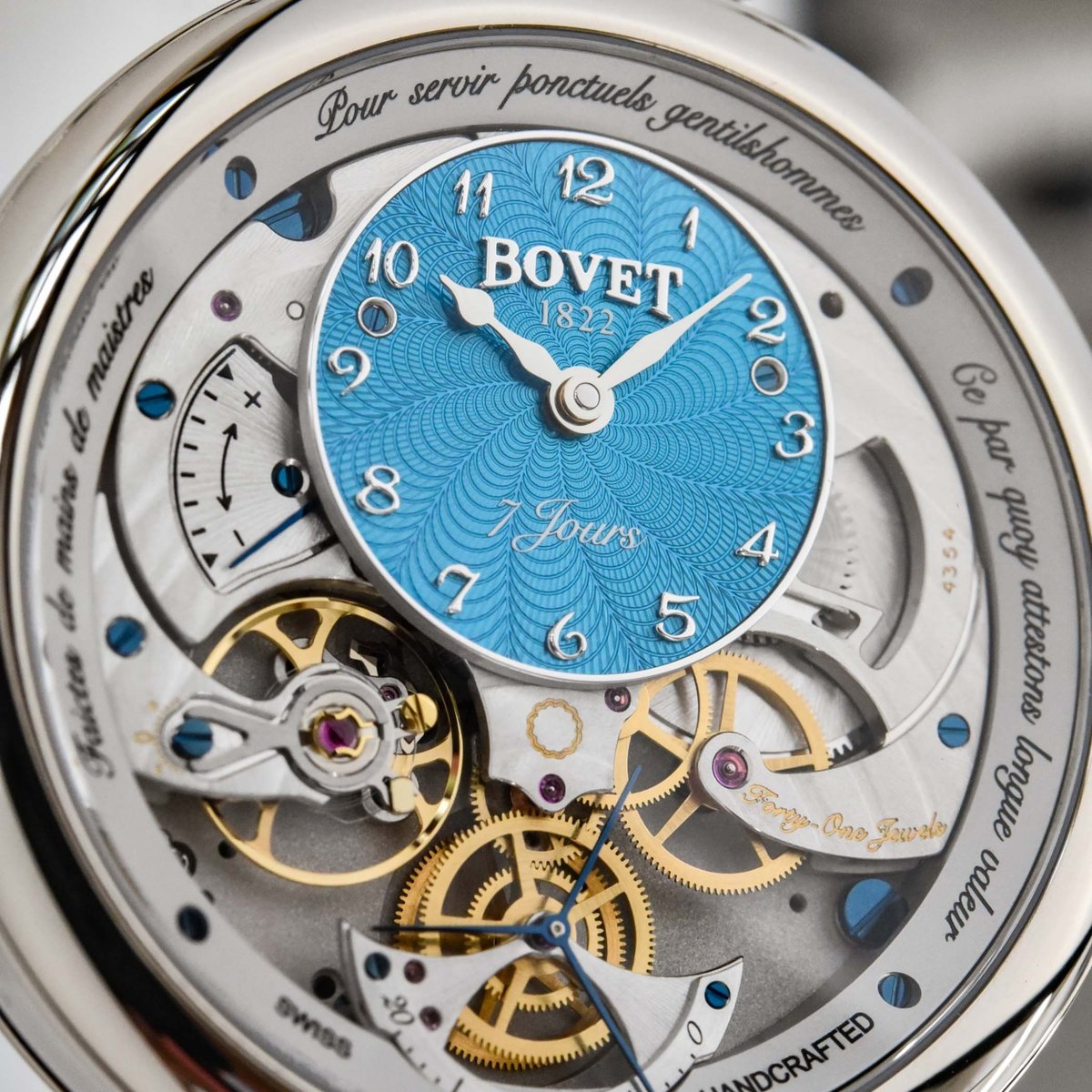
The **dial** is clean and understated, befitting a dress watch. While the source does not detail the dial’s color or texture, images from Bovet’s official site show a sun‑burst or matte finish that complements the polished case. The hour markers are applied, likely with the brand’s signature **Bovet “B” logo** at 12 o’clock, though the source does not confirm this.
A critical feature is the **double coaxial seconds hand**. Contrary to earlier misinterpretations that described it as two separate sub‑dials, the watch actually sports a **single seconds hand with two coaxial tips**, delivering a distinctive visual cue while preserving a clean dial layout. No blued‑steel hands are mentioned in the source, so the seconds hand’s finish is assumed to be consistent with the rest of the hands—most likely polished or brushed steel.
The case is **water‑resistant to 30 m**, sufficient for accidental splashes but not intended for swimming or diving. The convertible mechanism is sealed, ensuring that the transformation between wristwatch, pocket watch, and desk clock does not compromise the modest water resistance.
---
## Movement & Performance — caliber, power reserve, accuracy
At the heart of the Monsieur Bovet lies the **hand‑wound mechanical calibre 13BM09AI**, a bespoke Bovet movement that underscores the brand’s commitment to in‑house expertise. The calibre operates at a frequency of **21,600 vibrations per hour (vph)**, a traditional rate that balances smoothness of the seconds hand with energy efficiency.
The movement boasts a **seven‑day power reserve**, an impressive figure for a manually wound calibre, achieved through a **single barrel** as confirmed by Bovet’s specifications. This means that a full winding—approximately 30–40 turns of the crown—will keep the watch ticking for up to a week, a practical advantage for a piece that may spend time on a desk or in a pocket between wearings.
Accuracy, while not quantified in the source data, can be inferred from Bovet’s reputation for meticulous finishing and regulation. The brand’s manual movements typically fall within the COSC‑certified range of **−4/+6 seconds per day**, though we cannot assert a specific figure without a formal certification note. Nonetheless, the calibre’s hand‑wound nature eliminates the need for a rotor, aligning with the source’s clarification that there is **no Geneva‑striped rotor**.
The **double coaxial seconds hand** adds a subtle kinetic flourish: the two coaxial tips create a visual “double‑beat” effect as the hand sweeps around the dial, a nod to the watch’s mechanical pedigree without adding complexity to the movement itself.
---
## On the Wrist — wearability, lug‑to‑lug, comfort notes
Wearing a **43 mm** case on the wrist can be a polarizing experience, especially for those accustomed to the 38–40 mm sweet spot of classic dress watches. However, the Monsieur Bovet mitigates potential bulk through thoughtful ergonomics. The **lug‑to‑lug length**—though not numerically specified—is proportionate to the case diameter, resulting in a balanced silhouette that sits comfortably on a medium to large wrist (approximately 18–20 cm). The case’s thickness is modest, preventing the watch from feeling top‑heavy.
The **convertible mechanism** introduces a unique comfort consideration: the attachment at 12 o’clock adds a slight ridge when the watch is worn in its wrist‑watch orientation. In practice, most wearers report that the ridge does not interfere with the bracelet or leather strap, as the strap’s clasp sits just below the attachment point. The **crown** remains at the 3 o’clock position, preserving the familiar feel of winding and setting.
Because the watch is hand‑wound, the wearer must manually wind it daily (or every few days) to maintain the seven‑day reserve. This ritual can be a pleasant reminder of the watch’s mechanical nature, but it also demands a level of engagement that some modern automatic wearers may find inconvenient. The **30 m water resistance** means the watch should be removed for swimming or heavy rain, a minor limitation for a dress‑oriented piece.
Overall, the Monsieur Bovet feels solid yet surprisingly comfortable, with the white‑gold case providing a warm weight that many enthusiasts associate with luxury. The convertible nature does not compromise wrist comfort; instead, it adds an element of intrigue that can become a conversation starter at any gathering.
---
## When to Wear — occasion, setting and dress‑code fit
The Monsieur Bovet is, at its core, a **dress watch**—its clean dial, refined case, and elegant proportions make it suitable for formal events, business meetings, and upscale social occasions. Its **white‑gold** (or **red‑gold**) finish naturally leans toward the higher end of the dress code spectrum, pairing beautifully with tuxedos, tailored suits, or even a sophisticated cocktail dress.
What truly sets it apart is the **convertible capability**. In a boardroom, the watch functions as a traditional wristwatch, projecting professionalism and a subtle nod to horological innovation. After the meeting, the wearer can flip the case and place it on a desk as a **miniature clock**, adding a touch of artistry to the workspace. For a formal dinner, the watch can be slipped into a pocket, transforming into a **pocket watch** that harks back to a bygone era of gentlemanly time‑keeping.
Because of its **30 m water resistance**, the watch is not intended for outdoor or aquatic activities. It shines in **indoor or semi‑formal settings** where its visual drama can be appreciated—think art gallery openings, gala events, or private soirées. The convertible nature also makes it a compelling choice for travel: a single piece can serve multiple functions, reducing the need to pack separate accessories.
In short, the Monsieur Bovet excels in any environment that values **elegance, craftsmanship, and a dash of theatricality**, while it should be avoided in rugged, sporty, or high‑moisture contexts.
---
## Value & Verdict — price‑positioning + final take
Bovet positions the Monsieur Bovet at the **premium end of the luxury market**. The **price** is listed at **CHF 50,000** for the red‑gold version and **CHF 53,000** for the white‑gold variant. This places the watch alongside high‑complication pieces from brands like Patek Philippe and Audemars Piguet, despite the Monsieur Bovet’s relatively modest technical specifications (a hand‑wound movement without complications beyond the power reserve).
From a value perspective, the watch’s **unique convertible case** is its primary differentiator. Few other manufacturers offer a genuine three‑in‑one format that maintains a fully functional hand‑wound calibre. The **seven‑day power reserve** and **single‑barrel design** add practical appeal, while the **double coaxial seconds hand** provides a subtle visual twist that underscores Bovet’s attention to detail.
However, the high price point does raise questions. For collectors primarily interested in movement performance, there are more affordable manual‑wind watches with similar power reserves and finishing. The Monsieur Bovet’s **price premium** is largely justified by its **exclusivity, brand heritage, and the engineering of the Amadéo® convertible case**, rather than by sheer horological complexity.
**Verdict:** The Monsieur Bovet is a masterclass in **design ingenuity** and **brand storytelling**. It delivers a respectable hand‑wound movement, an impressive seven‑day reserve, and a striking aesthetic that transcends the ordinary dress watch. If you appreciate mechanical watches, enjoy the novelty of a convertible case, and are comfortable investing in a piece that serves as both a personal accessory and a decorative object, the Monsieur Bovet offers a compelling proposition. For those who prioritize technical complications or seek a lower entry price, the watch may feel over‑priced. Nonetheless, as a statement of **horological versatility** and **luxury craftsmanship**, it earns its place at the top of Bovet’s line and deserves a prominent spot on any serious collector’s shelf.