Breguet Classique Répétition Minutes 7365: A Discreet Summit of the Watchmaker's Art
The Breguet Classique Répétition Minutes 7365 is a watch that rewards a certain kind of attention. It does not rely on a skeletonized dial, a giant case, or a sporty silhouette to make its point. Instead, it asks the wearer to appreciate the quiet complexity of a minute repeater, the discipline of a hand-wound movement, and the specific visual language that Breguet has carried forward from the age of the pocket watch. In the Classique collection, that language is well established: silvered gold dials, hand-guilloché finishing, Roman numerals, open-tipped Breguet hands, and a case that feels formal before it feels technical.
The 7365 is a serious object within that tradition. It is a minute repeater, which means it chimes the hours, quarters, and minutes on demand through a slide in the caseband. It is also a Breguet Classique, which means the complication is presented with restraint. The dial is not a technical dashboard. The case is not a statement of size. The repeater is there for the owner, not for the room. That balance between acoustic complexity and classical discretion is the heart of the watch.
This review focuses on the reference 7365BR/15/9V6 in rose gold, the version most often cited, while acknowledging the white-gold sibling. The goal is not to pretend that a minute repeater is a rational first purchase. It is to explain what the 7365 does well, where it sits in the Breguet family, and why a collector might choose it over a more extroverted complication.
Manufacture history and context
Breguet was founded in Paris in 1775 by Abraham-Louis Breguet, a watchmaker whose influence extends far beyond the brand that carries his name. His work on repeating watches, chronometry, and pocket-watch architecture helped define what serious horology could be. The modern maison, now part of the Swatch Group, continues to draw on that legacy through the Classique collection, where guilloché dials, Breguet hands, and the secret signature are treated as living signatures rather than museum references.
The 7365 belongs to that lineage. It is not a tribute watch in the narrow sense, but it is unmistakably Breguet. The repeater is integrated into a classical dress-watch format, and the finishing is intended to be examined through the caseback. This is a watch that assumes the owner knows the history and wants the complication expressed in the brand's own dialect. It is also a reminder that Breguet's historical work with repeating watches was not a side note; it was part of the maison's broader pursuit of mechanical intelligence in portable timekeeping.
Movement and architecture
The 7365 is powered by the hand-wound Cal. 567.2, a movement built around the demands of a minute repeater. The caliber runs at 18,000 vph and offers a power reserve of 40 hours. Those figures are traditional rather than modern-sporty, and that is appropriate. A repeater is a mechanical instrument, and its architecture is shaped by the need to house gongs, hammers, and a reliable striking train without compromising the timekeeping side of the movement.
Through the sapphire caseback, the owner sees a movement that is meant to be read slowly. The bridges are hand-bevelled, the steel components are polished, and the repeater mechanism occupies a central place in the composition. This is not the kind of finishing that shouts from a display case; it is the kind that rewards a loupe and a quiet room. The hand-wound discipline also suits the watch. Winding a repeater is part of the ritual, and the 40-hour reserve gives the owner a reason to interact with the movement regularly.
The acoustic side is the real test. A minute repeater must deliver the hours, quarters, and minutes with clarity and separation. The quality of the chime depends on the gongs, the hammers, the case alloy, and the tuning of the entire assembly. In the 7365, the rose-gold case contributes a warm tonal character, and the repeater is designed to be heard rather than merely demonstrated. It is not a novelty function. It is the reason the watch exists.
Dial, case, and finishing
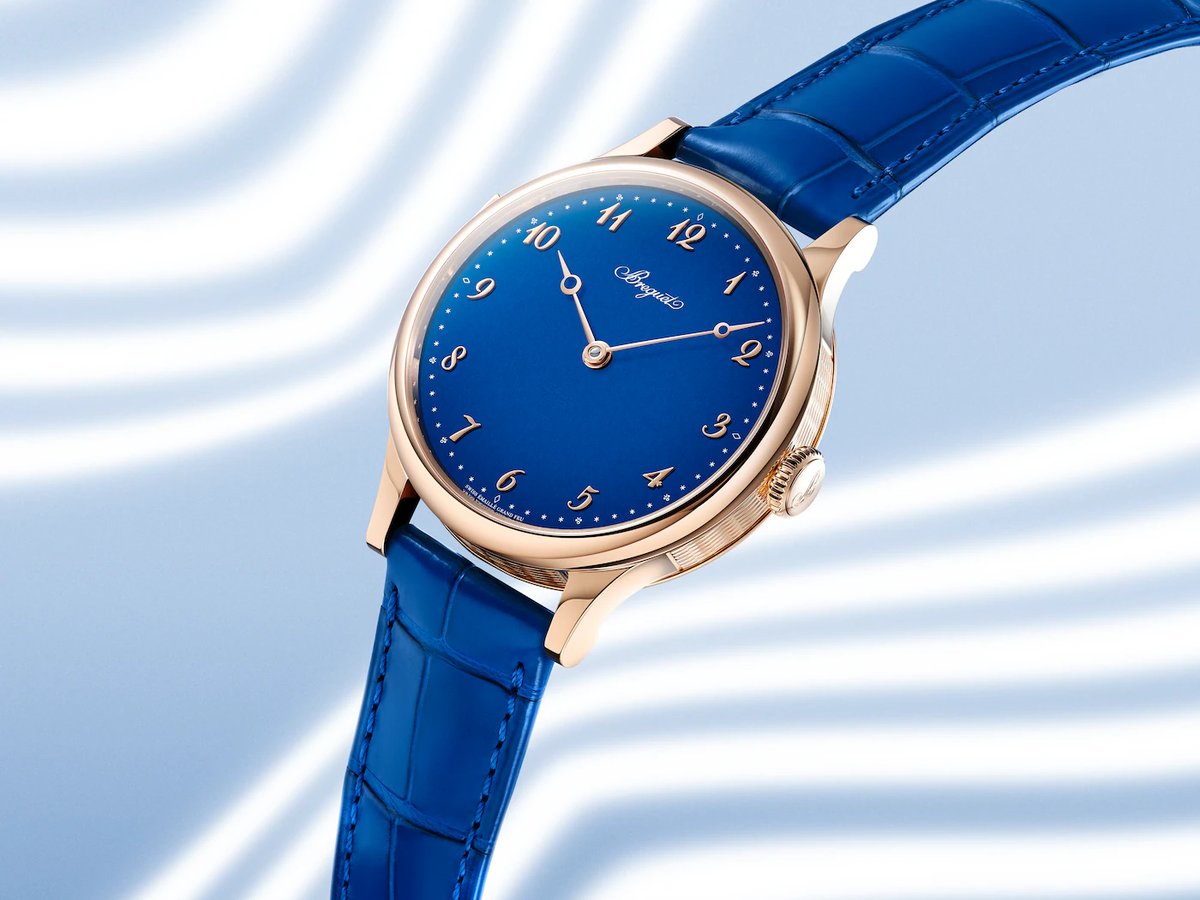
The dial is classic Breguet. A silvered gold base is hand-guilloché, with the kind of repetitive geometric texture that only works when the execution is precise. Roman numerals, open-tipped hands, a small seconds display, and a power-reserve indication complete the layout. The power reserve is a useful addition on a hand-wound repeater, because it tells the owner whether the watch is in a safe state to chime. The small seconds adds a quiet sense of life without disturbing the symmetry.
The case is gold, with a profile that feels descended from the pocket watch rather than the sports watch. The repeater slide is set into the left caseband, where it can be operated deliberately. The crystal is sapphire, the strap is leather, and the clasp is a pin buckle. There is no lume, no date, and no attempt to make the watch something it is not. Water resistance is minimal by modern standards, as expected for a dress watch of this type. The 7365 is not designed for the beach, the gym, or a downpour. It is designed for a cuff.
The finishing is where the watch justifies its place in the market. The guilloché dial is not a printed texture; it is cut and finished with the kind of handwork that Breguet has made a signature. The case edges are polished and refined, the lugs are shaped to keep the watch formal on the wrist, and the secret signature adds a small private pleasure for the owner. None of this is loud. All of it is deliberate.
On the wrist
The 7365 wears like a classical dress watch. The gold case has presence, but it is balanced rather than top-heavy. The leather strap and pin buckle keep the package formal, and the watch sits close enough to disappear under a shirt cuff. It is not a watch that demands a wide wrist or a casual outfit. It is at its best with tailoring, a quiet shirt, and a room where a chime can be heard without competing with noise.
The repeater slide is the one element that changes the physical experience. It requires a deliberate thumb movement, and that is a good thing. A minute repeater should not be activated by accident. The slide has a firm, mechanical action that reminds the owner this is a piece of engineering, not a smartphone feature. The watch feels refined rather than fragile, but it is clearly a precious object. It is not the watch you wear to move furniture or wash a car. It is the watch you wear when you want to feel the weight of traditional horology on your wrist.
Accuracy and ownership
The 7365 is not a chronometer-certified sports watch, and it should not be judged by the standards of one. A well-regulated Cal. 567.2 will keep stable time in normal dress-watch use, but the owner should expect a traditional hand-wound rate rather than quartz-like precision. The more important measure of health is the repeater: the chime should be clear, the strike should be consistent, and the slide should feel correct. If the sound changes or the rate drifts, the watch should go to an authorized watchmaker.
Service is a serious consideration. Minute repeaters are specialized mechanisms, and the acoustic setup is not a general watchmaker's task. Breguet or an authorized specialist should handle service, and the owner should budget accordingly. The watch is not fragile in normal wear, but it is not a tool watch. It should be kept away from water, shocks, and magnetic fields. Full winding before a repeater activation is good practice, and the power reserve makes that easy to monitor.
Variants and alternatives
The core reference in this review is the 7365BR/15/9V6 in rose gold, with a silvered gold hand-guilloché dial and a leather strap. The white-gold sibling, 7365BB/15/9V6, offers the same architecture with a cooler case tone. Within the Breguet family, the Classique 7637 Répétition Minutes is the more overt repeater sibling, while the Classique 7337 and Classique 5177 show the broader range of Breguet's classical dress-watch language. Other notable Breguet models include the Tradition 7047 Tourbillon Fusée and the Marine 5517, though neither is a direct substitute for the 7365's particular blend of repeater and restraint.
Among similar watches, the Patek Philippe 5078G Minute Repeater is the obvious benchmark, with an enamel dial and a similarly discreet presence. The Vacheron Constantin Patrimony Minute Repeater offers a comparable classical dress-watch interpretation, while the A. Lange & Söhne Zeitwerk Minute Repeater takes the complication in a very different, architectural direction. There is no credible direct homage to the 7365. Minute repeaters remain expensive to produce, and the market for affordable lookalikes is essentially nonexistent. That is part of what makes the 7365 a genuine connoisseur's object.
Value and verdict
The 7365 is a price-on-request watch, and the secondary market is scarce. It should be treated as a long-term collection piece rather than a liquid asset. The value proposition is not about getting a minute repeater cheaply. It is about getting a Breguet minute repeater with classical design, hand finishing, and a movement that rewards ownership. The trend is stable rather than speculative, and the hold recommendation is simple: buy it because you want the complication and the Breguet language, not because you expect to flip it.
The pros are clear. The repeater acoustics and finishing are exceptional, the dial is classic Breguet, and the hand-wound architecture is visible and satisfying. The cons are equally clear. The price is very high, the watch is not a daily beater, and service is specialized and costly. Those are not flaws so much as boundaries. The 7365 is not trying to be everything. It is trying to be a great Breguet repeater.
In the end, the Breguet Classique Répétition Minutes 7365 is a watch for the collector who values craft over spectacle. It is discreet on the wrist, serious in the hand, and rewarding through the caseback. It does not need to shout. The chime does that for it.