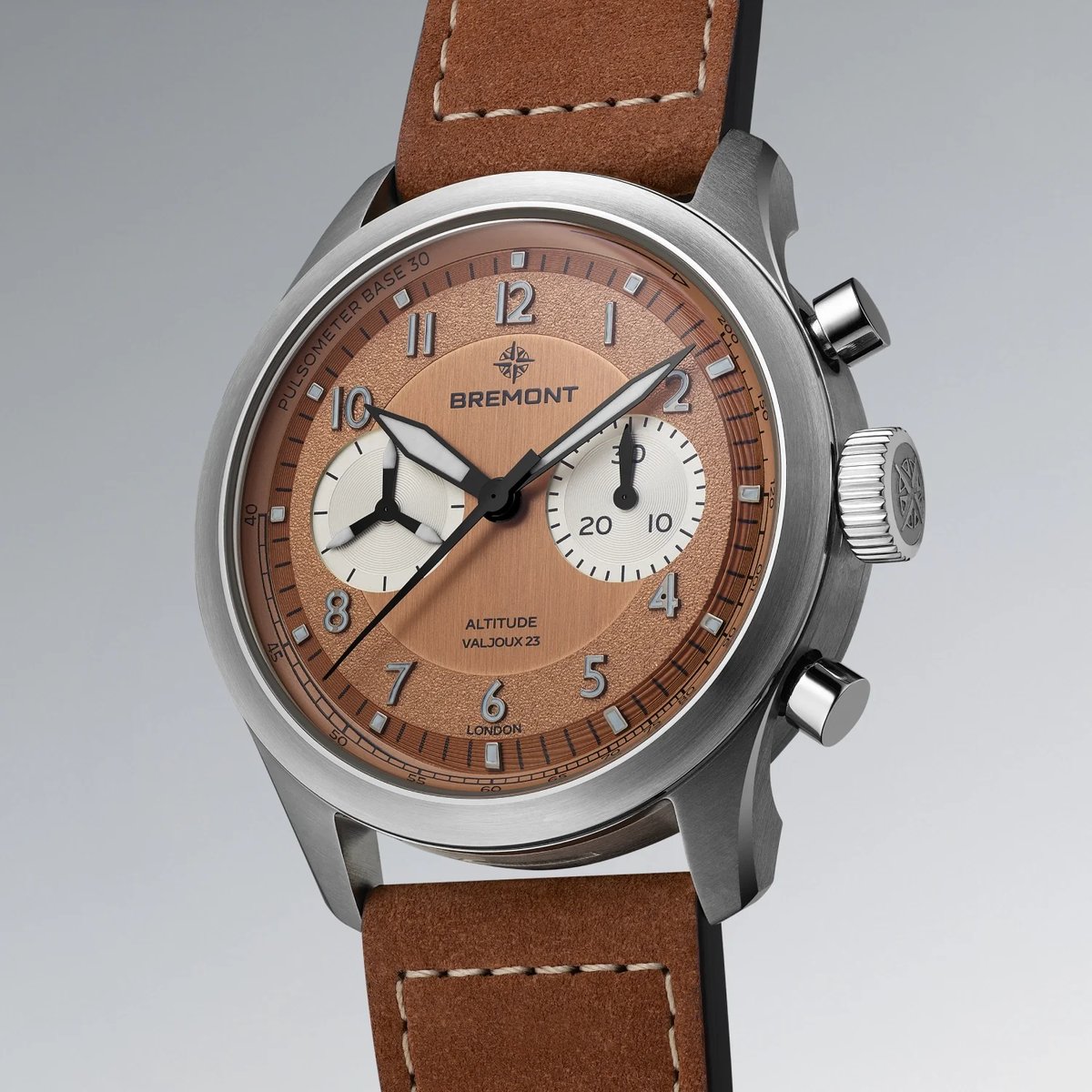
The High-Net-Worth Perspective on the Bremont Pulsograph Valjoux 23
In the rarefied air of luxury horology, we often talk about 'manufacture' movements as the end-all, be-all of value. But there is a secondary, more intellectual market that prizes the New Old Stock (NOS) movement. The Bremont Chronograph Pulsograph Valjoux 23 (Ref. ALT42-CHR-V-TI-SM-L-S) is the poster child for this movement. It doesn't just house a caliber; it houses a legend. This isn't about telling time—it's about owning a piece of the industrial revolution that has been polished and preserved for the 21st century.
The Architecture of a Legend: The Valjoux 23
To understand why this watch commands a five-figure price tag, you have to look past the titanium case and into the heart of the machine. The Valjoux 23 is a column-wheel chronograph movement that served as the backbone of the industry for decades. It was the precursor to the Valjoux 72 (the movement that powered the original Rolex Daytona). When you actuate the pusher on this Bremont, you aren't feeling a modern cam-actuated shimmy; you are feeling the precise, tactile engagement of a column wheel that was engineered before the digital age was even a dream.
Bremont didn't just find these movements in a drawer; they stripped them down, refinished the bridges, blued the screws, and regulated them to modern standards. This is horological taxidermy at its finest—taking a dead legend and breathing new life into it. From an investment standpoint, the rarity of these movements provides a 'floor' for the watch’s value. They aren't making any more Valjoux 23s, and that scarcity is the ultimate driver of long-term price appreciation.
The Titanium Hull: Modernity Meets Heritage
The case is where Bremont’s 'British Engineering' ethos takes over. Utilizing their signature Trip-Tick construction, the case is split into three distinct parts: the hardened steel or titanium bezel, the middle barrel, and the case back. In the case of the ALT42-CHR-V-TI, the use of Grade 5 titanium is a conscious choice for the modern collector. It offers a matte finish that screams 'tool watch' while maintaining the lightness required for a 43mm daily wearer.
The pulsometer scale on the dial—a 'doctor’s watch' complication—adds a layer of vintage charm. In an era where everyone has a heart rate monitor on their wrist via an Apple Watch, the pulsometer is a delightful anachronism. It’s a conversation starter at the yacht club, a way to signal that you value the mechanical over the electronic.
Market Analysis: Hold vs. Flip
Let’s talk numbers. The MSRP on these units was significant, pushing past the $20,000 mark. In the secondary market, Bremont typically takes a hit—this isn't a Patek 5711. However, the limited editions with NOS movements operate on a different curve. We’ve seen these pieces hold steady in the $15,000 to $18,000 range. Why? Because the supply is fundamentally capped by the number of movements Bremont could source.
If you’re looking to flip this in six months for a profit, you’re in the wrong asset class. But if you’re looking for a 'Hold'—a piece that will remain relevant and desirable to the 'movement-first' collector for the next twenty years—the Pulsograph is a strong candidate. It’s a hedge against the homogenization of modern watchmaking.
The Vivir Verdict
The Bremont Pulsograph Valjoux 23 is a watch for the man who has everything and wants something no one else has. It’s for the collector who understands that the soul of a watch is its movement, and that some souls are simply more storied than others. It wears its British heart on its sleeve and its Swiss soul in its case. It is, in every sense of the word, an investment in heritage.
Technical Deep-Dive
The 43mm case might sound daunting, but the lug-to-lug measurement of 49mm keeps it wearable even for those of us who didn't inherit the 'rugby player' build. The absence of lume is a stylistic choice that keeps the dial clean and focused on the pulsometer scale. The exhibition caseback is the star of the show here—don't be surprised if you find yourself taking the watch off just to watch the column wheel dance when you start the chronograph. It’s a mechanical theater that modern movements, with their bridges covering everything, simply cannot match.