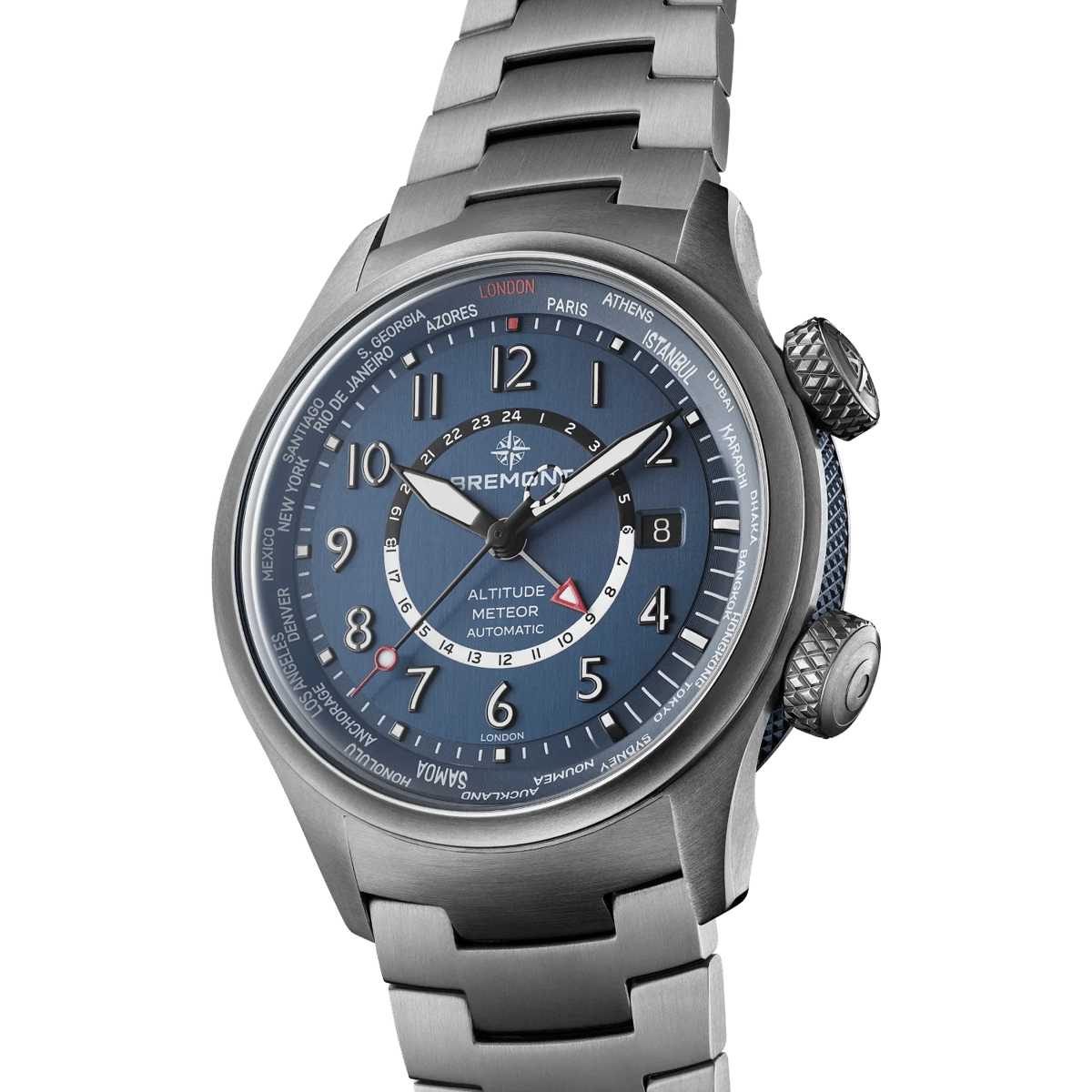
For the uninitiated, the Bremont MB series is more than just a collaboration; it is a technical benchmark. To earn the right to wear the red-barreled version of this watch, you actually have to have survived a live ejection from a Martin-Baker seat. For the rest of us, the MBII and MBIII provide that same level of over-engineering in a package available to the public. The Bremont MB Meteor Time Zones, however, introduces an element of the celestial to this gritty, earth-bound tool.
The Case: Engineering Survival
The heart of the MB Meteor is the 43mm Trip-Tick® case. Unlike traditional monobloc cases, Bremont uses a three-piece construction: a hardened steel top bezel, a central aluminum barrel, and a steel case back. This isn't just for aesthetics. The central barrel allows Bremont to experiment with colors and textures, but more importantly, it houses a rubberized anti-shock mount that suspends the movement. In a week of daily wear, this translates to a watch that feels incredibly solid. When you accidentally knock it against a granite countertop or a metal handrail, there isn't that heart-stopping 'ping' of damaged steel. The 2000 Vickers hardening process means the case looks as new on day seven as it did on day one.
The Dial: A Piece of the Cosmos
The standout feature is, of course, the Muonionalusta meteorite dial. This meteorite crashed into northern Scandinavia roughly one million years ago and is famous for its distinct Widmanstätten pattern—the cross-hatched nickel-iron crystals that only form over millions of years of cooling in space. In the context of a pilot’s watch, the meteorite adds a layer of depth and texture that a standard matte dial cannot match. Bremont has cleverly kept the markers and hands high-contrast. The GMT hand is tipped with a bright yellow pointer, ensuring that the second time zone remains legible against the complex geometric patterns of the stone. During my testing, I found the legibility to be surprisingly good, even in low-light conditions, thanks to the generous application of Super-LumiNova X1.
Daily Wear and Ergonomics
One of my frequent critiques of modern GMT watches is their 'top-heavy' nature. A GMT complication often adds thickness, making the watch wobble on the wrist. Bremont avoids this by keeping the lug-to-lug at a tight 50mm. For my 6.5-inch wrist, this is the absolute limit of what I can comfortably wear, but because the lugs are short and curved, the watch doesn't overhang. The 14.5mm thickness is noticeable, but the way the sapphire crystal is slightly domed helps it slide under heavier jackets and coats. The 'Roto-Click' bezel, operated by the crown at 4 o'clock, is a tactile joy. It uses a series of ball bearings to provide a satisfying click for every minute of rotation, allowing you to track a third time zone with ease.
The Movement: Reliable but Familiar
Inside beats the BE-93-2AV. While some purists may clamor for Bremont's newer ENG300 manufacture movements, the use of a modified ETA/Sellita base here is a pragmatic choice. It is a 'caller' GMT, meaning the GMT hand is independently adjustable, rather than a 'flyer' GMT where the local hour hand jumps. For most daily users who are tracking a colleague's time zone or a home office while traveling, this is perfectly functional. The 50-hour power reserve is adequate, though in a world where 70-hour reserves are becoming the standard, you will need to reset the watch if you leave it off for a full weekend.
The Verdict
The Bremont MB Meteor Time Zones is not a watch for the minimalist. It is a bold, technically impressive piece of equipment that happens to carry a piece of pre-history on its face. It excels as a daily wearer for someone who appreciates the 'Britishness' of the brand—the blend of aviation history, mechanical robustness, and a touch of eccentricity. It is a watch that survives the rigors of the modern world while reminding you of a much larger, cosmic timeline every time you check the time.