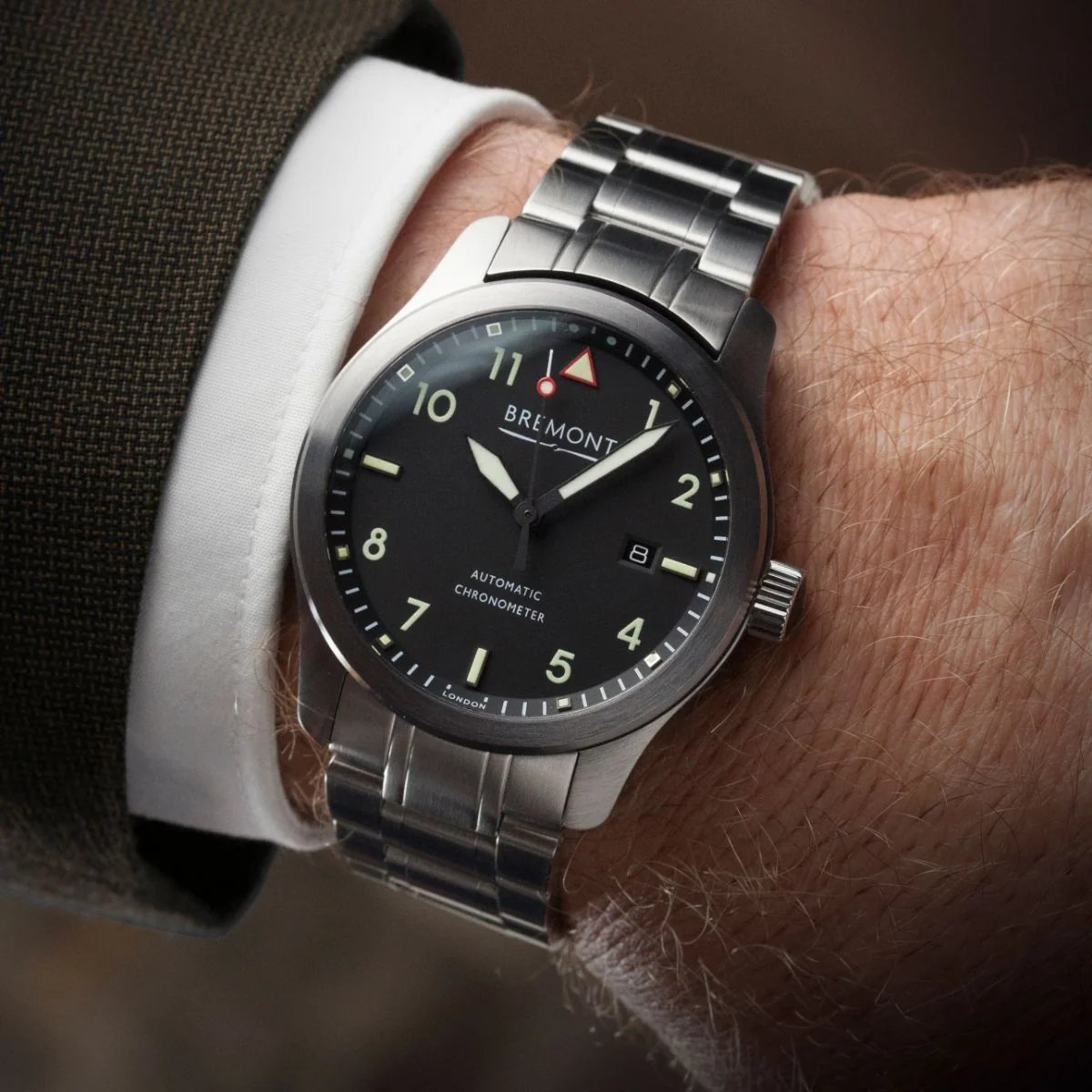
Introduction: The Philosophy of the Solo
In the hierarchy of the Bremont catalog, the Solo often sits in the shadow of the more complex Martin-Baker or the Supermarine divers. Yet, for the discerning collector at Vivir, the Solo represents the purest expression of the brand's ethos. It is a watch designed around a singular purpose: to be a reliable, legible instrument for pilots. But beyond the cockpit, the Solo/WH (the white-dial variant) serves as a masterclass in how a tool watch can transition into a sophisticated daily companion.
The Solo is not merely a design exercise; it is an engineering project. When Nick and Giles English founded Bremont, they were obsessed with the idea that a watch should be able to withstand the same forces as the vintage aircraft they flew. This led to the development of several proprietary technologies that are present in the Solo, despite it being the most accessible model in their range. To understand the Solo, one must look past the dial and into the very metallurgy of the case.
The Trip-Tick® Case: A Three-Piece Marvel
Most watch cases are stamped or milled from a single block of steel. Bremont takes a different path with their patented Trip-Tick® construction. The case of the Solo/WH is comprised of three distinct parts: the hardened steel top bezel, the DLC (Diamond-Like Carbon) treated middle barrel, and the steel case back. This construction is not just for show; it allows Bremont to use different materials and finishes to optimize both aesthetics and durability.
During my week of testing, the middle barrel—rendered in a ribbed, black DLC finish—served a vital ergonomic function. By contrasting with the brushed steel of the upper bezel and the lugs, it visually 'thins' the watch. On paper, 13.5mm might sound chunky for a three-hander, but on the wrist, it feels significantly leaner. The way the lugs are integrated into the top bezel and then curve sharply downward ensures that the 49.5mm lug-to-lug distance remains manageable, even on a 6.5-inch wrist. It hugs the arm, preventing the 'top-heavy' sensation that plagues many pilot watches.
Hardened Steel: The 2000 Vickers Advantage
The standout feature of the Solo is undoubtedly the hardening process of its 316L stainless steel. Through a process of heat treatment and carbon diffusion (often referred to as B-EBE2000 technology), the steel is hardened to 2000 Vickers. To put that in perspective, standard 316L stainless steel typically sits around 200 Vickers. This means the Solo is roughly ten times more scratch-resistant than a Rolex Submariner or an IWC Big Pilot.
I put this to the test. Throughout a week of commuting, office work, and a weekend hike, the watch inevitably came into contact with door frames, desk edges, and granite countertops—the natural enemies of a polished watch. At the end of the week, under a macro lens, the case remained absolutely pristine. Not a single 'desk diving' swirl was visible on the bezel. For the collector who suffers from 'first scratch anxiety,' the Solo is a therapeutic revelation. It is a luxury item that doesn't require you to baby it.
The Dial: Opaline Elegance and Legibility
While the black-dialed Solo is the more traditional choice, the SOLO/WH offers a level of sophistication that elevates the watch. The dial is not a flat, stark white; it is a rich, opaline silver that catches the light with a subtle grain. The Arabic numerals are applied, providing a depth that printed dials lack. They are filled with Super-LumiNova C3, which glows with a potent green hue that lasts well into the early hours of the morning.
Legibility is the hallmark of any pilot watch, and the Solo excels here. The heat-blued hands provide a stunning contrast against the white backdrop. In direct sunlight, they shimmer in a brilliant electric blue; in lower light, they appear almost black, maintaining the high contrast necessary for a quick glance. The date window at 3 o'clock is well-integrated, featuring a stepped frame that matches the indices, though some purists might prefer a no-date layout for perfect symmetry.
The Heart: BE-36AE Chronometer Movement
Inside the Solo beats the BE-36AE movement. While Bremont has recently moved toward in-house 'Engure' calibers for their higher-end pieces, the Solo relies on a modified ETA 2836-2. For the daily wearer, this is actually a benefit. The movement is a 'workhorse' in the best sense of the word—reliable, easy to service, and parts are universally available. Bremont doesn't just drop the movement in, however. They modify it to chronometer standards, ensuring it passes the rigorous COSC testing for accuracy in five positions and at various temperatures.
The movement is visible through a sapphire crystal case back, revealing a skeletonized and decorated rotor and blued screws. While it may not feature the haute horlogerie finishing of a Patek Philippe, it is cleanly executed and fits the industrial, high-tech aesthetic of the brand. The 38-hour power reserve is the only real sticking point; in an era where 70-hour reserves are becoming the norm, you will need to reset the Solo if you leave it off the wrist for a full weekend.
A Week on the Wrist: The Real-World Experience
Monday to Wednesday: The Office Grind
The Solo/WH paired effortlessly with a navy blazer and grey flannels. Because the dial is white, it feels more 'dressy' than a typical tool watch. It slipped under a French cuff with only a slight bit of tension, thanks to the beveled bezel. The leather strap, which is thick and high-quality, began to break in by Tuesday afternoon, molding to the shape of my wrist.
Thursday: The Travel Test
I wore the Solo through airport security and a three-hour flight. The legibility was a boon in the dimly lit cabin, and the 100m water resistance meant I didn't have to worry about the watch during a quick post-flight dash through a rainstorm. The watch feels robust; it's the kind of piece that gives you confidence when you're away from your usual toolkit.
The Weekend: Casual Utility
On Saturday, I swapped the leather strap for a grey NATO. This transformed the Solo. The white dial popped against the nylon, and the watch's tool-watch DNA came to the forefront. Whether I was at a farmer's market or working in the garden, the hardened steel case meant I never had to check for dings. It is truly a 'set and forget' timepiece.
Investment and Value Proposition
At a retail price of $4,195, the Bremont Solo sits in a competitive space, facing off against the IWC Mark XX and the Tudor Black Bay. Where the Bremont wins is in its case technology. Neither the IWC nor the Tudor offers a hardened steel case of this caliber. However, on the secondary market, the Solo can be found for nearly half its retail price. For the savvy young collector, a pre-owned Solo in the $2,300 range is perhaps one of the best value propositions in modern horology. You are getting a COSC-certified, over-engineered British timepiece for the price of a mass-produced entry-level Swiss watch.
Final Verdict
The Bremont Solo/WH is a testament to the idea that simplicity is the ultimate sophistication. It doesn't rely on gimmicks or heritage-inspired 'fauxtina.' Instead, it relies on high-grade materials, precision timing, and a design language that is uniquely British. It is a watch for the person who wants their luxury to be durable, their instruments to be legible, and their wristwear to tell a story of engineering rather than just marketing. If you can handle the 43mm size, the Solo is quite possibly the only daily watch you will ever need.