Introduction: When the Story Is the Complication
Most limited editions are marketing exercises with a fresh dial colour and a number engraved on the back. The Bremont Victory is not that. It was built around material physically recovered from HMS Victory — the first-rate ship of the line that carried Horatio Nelson to his death at Trafalgar in 1805, and which remains the oldest naval vessel still in commission anywhere in the world. Copper and oak from the ship itself are worked into the watch. That is not a colourway. That is an artifact.
For a certain kind of collector, that is precisely the appeal. British watchmaking has spent two decades searching for a voice that is neither Swiss pastiche nor heritage theme park, and Bremont's answer has always been mechanical engineering wrapped around a story. The Victory is the purest expression of that formula the brand has produced: a 250-piece run, stainless steel, on leather, with ship material in the movement and a case back that turns a wrist into a small museum.
But provenance is not a valuation model. Bremont's secondary market is soft, and even well-executed limited editions from Henley-on-Thames have spent the last several years trading well below original retail. The real question for a serious collector is therefore not whether the Victory is charming — it plainly is — but whether it earns a slot in a box that already holds a Speedmaster and a Submariner. That is what this review sets out to answer.
Bremont: A Brand Built on Machines and Stories
Bremont was founded in 2002 by brothers Nick and Giles English, and it remains one of the very few British watch companies to have achieved genuine international distribution in the modern era. The operation is headquartered in Henley-on-Thames, with assembly and finishing split between England and Switzerland, and the brand's DNA is unapologetically aviation- and military-led: hardened cases, chronometer-grade ambitions, and a long list of collaborations with squadrons, regiments, and — crucially for this reference — historic ships and aircraft.
The Victory sits inside a specific sub-family at Bremont: the artifact limited editions. These are watches that incorporate physical material from an object of historical significance. The Victory came first; the Wright Flyer and the Codebreaker followed, each with its own recovered material and its own collector base. The formula is simple and effective. Take a solid, legible, robustly built watch, then give the buyer a reason to keep it that has nothing to do with a spec sheet.
That formula also explains the Victory's place in the catalogue. It is not the brand's most complicated watch, nor its most technically ambitious. It is the one with the best story, and in the limited-edition game, story is the scarce commodity.
The Ship: Why HMS Victory Still Matters
HMS Victory was launched in 1765 and is best known as Nelson's flagship at Trafalgar, where the admiral was mortally wounded on her quarterdeck. She remains a commissioned ship of the Royal Navy, still manned, still flying the White Ensign, and still moored in Portsmouth Historic Dockyard, where she has been under continuous conservation for decades. There is no more potent symbol of British naval history, and there is no more difficult object from which to source material legitimately.
Bremont's access came through the ship's ongoing restoration programme, and the material recovered — copper and oak — is finite in the most literal sense. That matters for collectors. A limited edition built on a fixed, non-replenishable stock of ship material cannot be reissued. There will be no Victory II with a ceramic bezel and a new dial colour. When the 250 pieces are gone, the story is closed.
It is worth pausing on how unusual that is. Most watch brands manufacture scarcity by simply stopping production and then announcing a successor. Bremont's scarcity here is physical. That does not automatically make the watch valuable, but it does make it structurally different from the vast majority of limited editions on the market.
Case, Dial and the Material Story
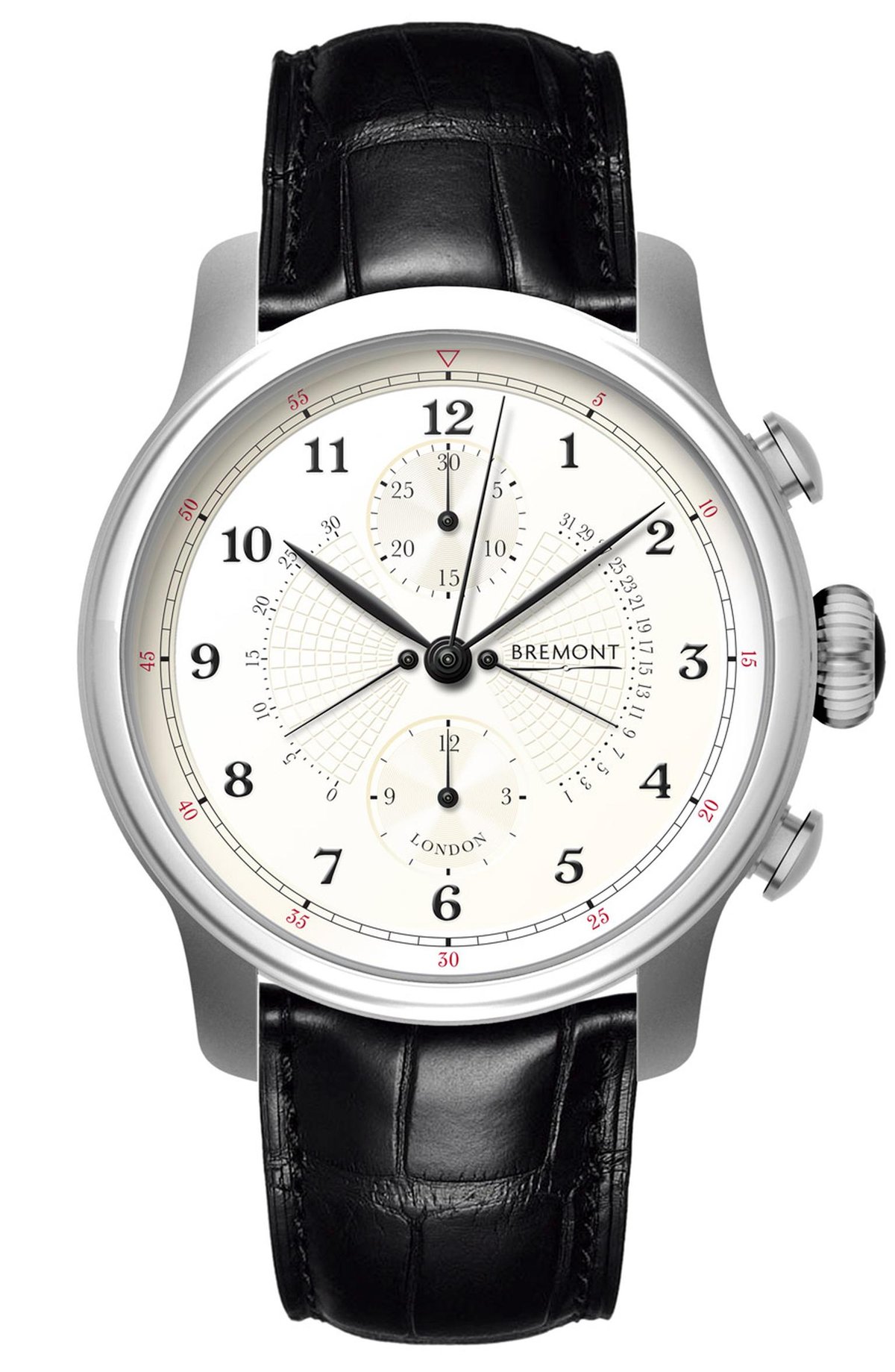
The VictorySS is a stainless steel watch, and it is deliberately not a showpiece. Where the brand's pilot references lean on instrument aesthetics, the Victory is quieter: a classical, period-inspired dial, restrained typography, and hands that read as precision instruments rather than sports equipment. It looks correct with a suit and slightly out of place with a wetsuit, which is exactly the intent.
The headline detail is at the back. The movement's rotor is made from oak recovered from HMS Victory, and copper from the ship is worked into the case back assembly, so that a sapphire exhibition back frames a piece of a 260-year-old warship every time you take the watch off. It is genuinely lovely theatre, and it is executed with more restraint than the concept suggests — no engraved battle scenes, no faux-aged bronze, no commemorative medallions competing for attention.
The crystal is sapphire, as you would expect at this price. The strap is leather, secured by a signed pin buckle, and the whole package is presented in a box that continues the naval theme. Bremont has always understood that unboxing is part of the ownership experience for a limited edition, and the Victory does not disappoint there.
Design-wise, the watch is best understood as a dressing watch with tool-watch bones. It is not trying to be a dive watch, and it is not trying to be a pilot's watch. It is trying to be a piece of naval history you can wear to a meeting, and on that brief it succeeds.
The Movement: BE-83AR
Inside is Bremont's calibre BE-83AR, a modified Swiss automatic running at 28,800 vibrations per hour with a power reserve of roughly 42 hours. It is not an in-house calibre, and Bremont has never pretended otherwise. Until the arrival of the brand's own engine programme in the 2020s, the value proposition was always case engineering, assembly standards and finishing rather than movement manufacture.
What matters here is that the base is a known quantity. It is a robust, well-understood architecture that any competent watchmaker can service, and it will run reliably for decades. The rotor is the interesting part: it is the component an owner will look at more than any other, and it is the one component made of something irreplaceable.
Finishing is industrial-clean rather than haute horlogerie. There is no hand-bevelled anglage to admire and no black-polished steel, and the movement is not COSC-certified. What you get is a well-executed, workmanlike automatic that does its job and provides a window onto the ship material. For this watch, that is the correct trade. A collector buying a Victory for movement architecture has misunderstood the brief.
On the Wrist
The Victory wears like a modern steel watch that has been dressed for dinner. There is real mass to the case, and the sapphire exhibition back adds a layer of visual depth that you notice when the watch is off the wrist rather than on it. Balance is good: the case sits flat, the lugs curve away cleanly, and there is no sense of the watch tipping forward or sliding around on the wrist.
The leather strap does most of the comfort work. It softens the visual weight of the steel and keeps the watch from reading as a sports piece, which is the right call for a commemorative object. On a NATO or a steel bracelet the Victory would look confused; on leather it looks like what it is, which is a dress-adjacent tool watch with a story.
Presence is the surprise. The dial is restrained, but the case back is a conversation piece, and the watch invites the question that every good limited edition wants to be asked: what is that made of? Expect it to draw attention from people who know ships rather than people who know watches, which is a refreshing change of pace.
Accuracy and Daily Running
Real-world performance from a well-regulated BE-83AR sits comfortably in the minus five to plus ten seconds per day range, which is entirely acceptable for a watch in this bracket. It is not COSC-certified, so there is no guarantee on the paperwork, but the modified Swiss base is a stable design and does not exhibit the drift you sometimes see in cheaper automatics.
Power reserve of roughly 42 hours means the Victory will happily survive a weekend on the nightstand, but not a long weekend plus a bank holiday. If you rotate watches, get into the habit of winding and setting it on Monday morning rather than expecting it to still be running. Setting is simple and the crown action is positive; there is nothing here that requires a manual.
One practical note for anyone buying second-hand: ask for a timegrapher reading before you commit. A watch that has sat unworn for years may simply need regulating, but it may also need a service, and that is a negotiating point.
Occasions: Where It Works
The Victory is at its best with tailoring. It is a formal-adjacent watch that works with a suit, a blazer, or a decent knit, and it will not embarrass you at a wedding. It is also a perfectly good daily wearer if your daily life involves a desk rather than a dive boat.
It is not a sports watch. The leather strap and the commemorative character both argue against wearing it to the gym or the beach, and there are better tools for travel if you need a GMT or a rotating bezel. Treat the Victory as a dress watch with a story, and it will reward you for years.
Variants and Family
The Victory was produced as a single stainless steel reference, VictorySS, in a run of 250 pieces. There is no gold version, no diamond-set variant, and no dial-colour matrix to navigate — which is a relief. If you want a Victory, there is exactly one Victory, and the only variables are condition and completeness.
Within Bremont's artifact family, the closest siblings are the Wright Flyer and the Codebreaker, both of which followed the same playbook with different source material. The Wright Flyer carries material associated with the 1903 Flyer; the Codebreaker draws on Bletchley Park. Both tend to trade at higher prices on the secondary market than the Victory, largely because they arrived later with more marketing weight behind them.
Within the wider brand, the natural comparison points are the ALT1-C chronograph, the ALT1-P, the MB series, the Supermarine dive watches and the Solo. None of them share the Victory's material story, but they share its case architecture and its general attitude.
Alternatives Worth Considering
If you want naval provenance at a similar price, the obvious comparison is a Tudor Black Bay or a vintage Tudor Submariner with Royal Navy issue markings — though the latter has become a serious collector market of its own, with serious collector prices to match. Omega's Seamaster 300 Heritage carries genuine military heritage and vastly better liquidity. Panerai's Radiomir line trades on Italian frogman history with a very different aesthetic.
If you want a dressier alternative with historical flavour, an IWC Pilot's Watch or a Longines Heritage piece will give you the same restrained dial language without the artifact premium. And if you simply want a well-made British-flavoured watch with a story, the Victory is nearly alone. That scarcity of alternatives is part of its appeal, and part of its problem: there is no competitive set to drive demand.
The Market: What It Costs and What It Is Worth
Original retail on the Victory was in the region of twelve thousand US dollars when it launched in the early 2010s, and the run sold out. Today there is no current retail price, because the watch is long discontinued and Bremont has not reissued it.
On the secondary market, expect to pay somewhere in the mid four figures to low five figures depending on condition, completeness, and whether the original box and papers are present. That is a meaningful discount to retail, and it is consistent with Bremont's broader secondary-market behaviour: the brand's watches typically trade at a substantial discount to MSRP, and limited editions slow the depreciation rather than reversing it.
The Victory does better than the standard catalogue. The finite material story, the low production number, and the fact that these watches rarely come up for sale all support the price. But do not buy one expecting appreciation. Buy it because the object is interesting, and treat any price stability as a bonus.
There is essentially no auction history to speak of. Bremont does not appear regularly at Phillips, Christie's or Sotheby's, and the Victory has not produced headline results. That is not a red flag for a watch at this price point — it simply means the market is dealer- and forum-driven rather than auction-driven, and that liquidity is thinner than it would be for a comparable Rolex or Omega. If you need to sell quickly, you will take a haircut.
The hold-versus-sell call is straightforward. If you own one and you bought it because you love it, hold it: the downside is limited at current levels and the story is not going to get less interesting. If you bought it as an investment, sell into the next wave of naval-history enthusiasm and redeploy into something with real liquidity. And if you are buying today, buy the best example you can find with full set, and negotiate hard — this is a buyer's market.
Servicing and Long-Term Ownership
Bremont recommends servicing on a multi-year cycle, and the modified Swiss base is straightforward for a competent independent watchmaker to handle. The complication is the artifact component: the wooden rotor and the copper case back assembly are not standard parts, and you do not want an unfamiliar workshop experimenting with them. For anything involving the rotor or the case back, send it to Bremont or an authorised service partner.
Budget for a routine service in the several-hundred-dollar range, and ask for a written estimate before work begins. Also ask the service centre to confirm they will not replace the rotor unless it is genuinely damaged — a well-meaning watchmaker who swaps the wooden rotor for a standard steel one has destroyed the watch's reason for existing.
Parts availability is the other long-term consideration. Bremont is a young brand with a growing archive, and owners of early limited editions should expect to work through the brand's own service channel for anything unusual. That is a mild inconvenience, not a dealbreaker, but it is worth knowing before you buy.
Pros and Cons
The case for the Victory is straightforward. It offers genuine artifact provenance that cannot be replicated, a genuinely small production run, and a design restrained enough to wear seriously. The case against it is equally straightforward: Bremont's secondary market is weak, there is no auction record to anchor value, and the watch is not COSC-certified.
Where it wins is on the intangible. There is no other watch at this price that puts a piece of a Trafalgar-era warship on your wrist, and no other watch at this price that will still have a story to tell when the current generation of hype references has been forgotten.
Final Verdict
The Bremont Victory is the most interesting thing the brand has made at this price point, and it is the rare limited edition whose story will still be true in fifty years. It is not an investment, and anyone who tells you otherwise is selling something. But as a wearable piece of naval history with a solid movement and a dial that behaves itself in polite company, it is genuinely hard to beat — provided you buy it at the right price and never let anyone near that rotor.
For the collector who already owns the obvious names, the Victory is the kind of watch that makes a collection feel personal rather than assembled. That is worth more than the depreciation curve suggests.