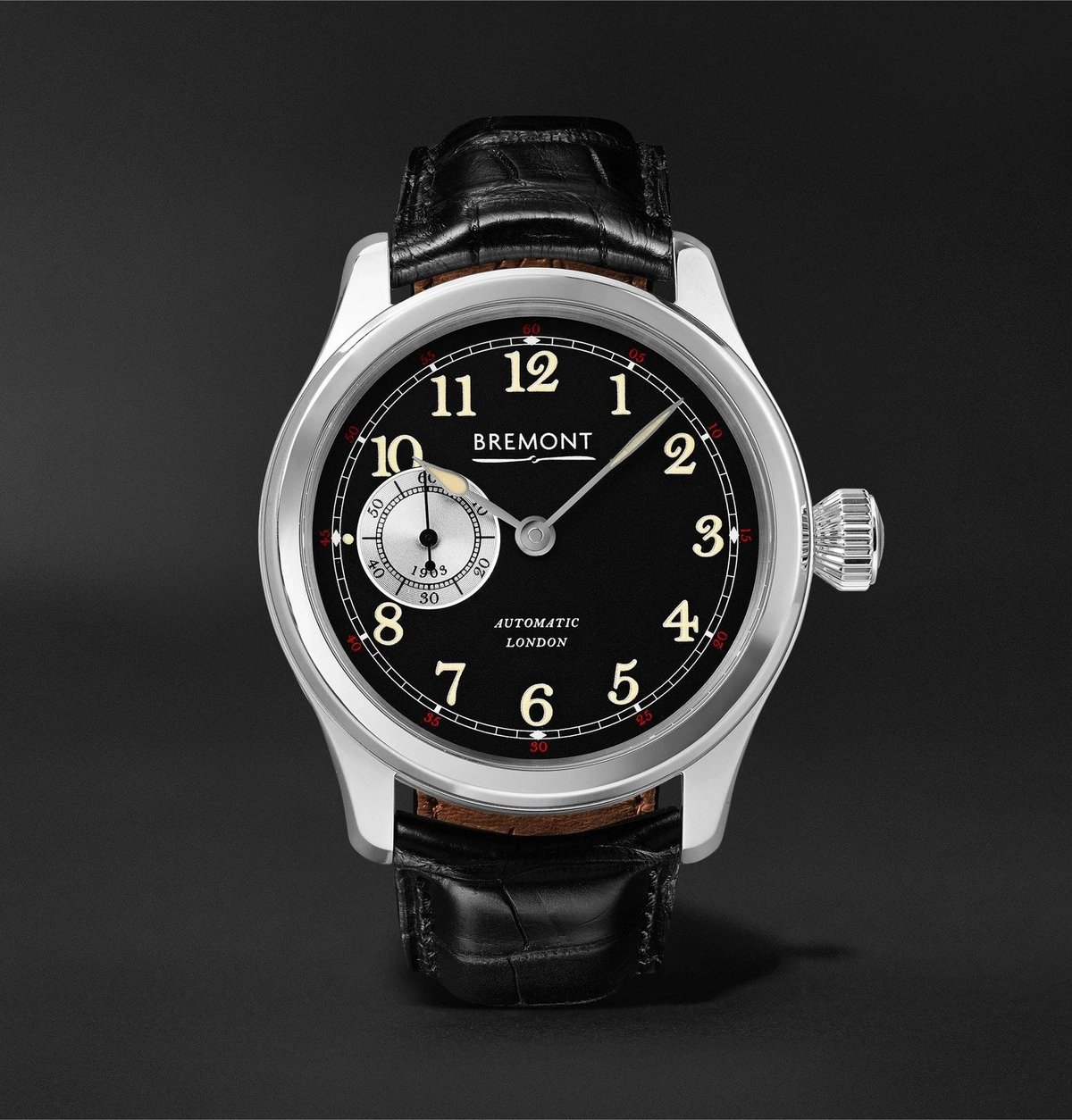
Some watches are bought for what they do. The Bremont Wright Flyer is bought for what it contains. Inside the case of this numbered limited edition sits the BWC/01, the first calibre to carry Bremont's own designation, and on the rotor, under a display back, is a fragment of the muslin wing fabric that lifted the 1903 Wright Flyer off the sand at Kitty Hawk. It is one of very few modern watches that can make that claim, and it is the reason the Wright Flyer still changes hands more than a decade after it sold out.
Strip the story away and you are left with a substantial stainless steel aviation watch with a date, a leather strap and a British badge on the dial. That is not a criticism. It is the honest starting point for anyone trying to work out whether this watch belongs in a collection, and whether it is worth what sellers are asking.
This review looks at the Wright Flyer as a wearable object, as a piece of mechanical engineering and as an asset. The verdict, as ever, depends on which of those three you care about most.
Bremont, briefly
Bremont was founded in 2002 by British brothers Nick and Giles English, and it built its reputation on two things: aviation and over-engineering. The brand's cases are made from a hardened stainless steel treated to roughly 2,000 Vickers, which puts them well beyond the hardness of a conventional Swiss sports watch and makes them unusually resistant to the desk-diving swirls that ruin softer cases. Bremont also spent years supplying watches to military aircrew and partnering with organisations such as Martin-Baker, the ejection-seat manufacturer. That is not marketing garnish. It is the reason the brand's pilot watches feel like tools rather than props.
What Bremont lacked for its first decade was a movement to call its own. Its early watches ran on modified Swiss ebauches, perfectly good but not the sort of thing that ends an argument in a collector's forum. The Wright Flyer, launched in 2014, was the answer. It was the first Bremont powered by the BWC/01, and it arrived with a story attached that no marketing department could have invented.
The story: Kitty Hawk, 1903
On the morning of 17 December 1903, on the sand flats four miles south of Kitty Hawk, North Carolina, Orville Wright flew a powered, heavier-than-air machine for twelve seconds and 120 feet. Wilbur flew further later that same day. The machine they built, spruce and ash and piano wire and a cotton muslin known as Pride of the West, became the most consequential object in the history of flight.
Bremont acquired a section of the original 1903 wing material and cut it into fragments small enough to sit inside a watch rotor. Each Wright Flyer therefore contains a physical piece of the first aeroplane, sealed under a display back, spinning every time you move your wrist. The watch is individually numbered, and it was produced in stainless steel and in 18k rose gold.
It is worth being clear-eyed about what this is and is not. It is not a watch that was flown, worn or owned by the Wright brothers. It is a modern watch containing a verified fragment of a historic aircraft, a category that includes everything from Omega's Moonwatch to various Bremont and Zenith limited editions. The question for a collector is not whether the fragment is real, but whether the watch is worth owning on its own merits. For the Wright Flyer, the answer is yes, with caveats we will get to.
Case, dial and the way it wears
The Wright Flyer uses a 43mm stainless steel case built in Bremont's three-piece Trip-Tick construction. That architecture, in which a hardened middle case is sandwiched between a bezel and a case back, is part of why Bremont watches feel denser and more solid than their dimensions suggest. The Wright Flyer is a big watch and it wears like one. It sits high on the wrist, it has real presence under a cuff, and it makes no attempt to be discreet.
That is the correct decision. A large aviation watch that tries to hide its size ends up looking apologetic; the Wright Flyer instead leans into the pilot-watch tradition of legibility first and elegance second. The dial is deliberately restrained. Bremont could have filled it with engraved aircraft, Kitty Hawk coordinates and a sepia photograph, and it did not. What you get is a vintage-flavoured layout with applied indices and a date aperture, finished well enough to hold up under a loupe but designed to be read at a glance. The Wright Flyer story is told on the back of the watch, where it belongs.
On the wrist, the balance is good for a watch of this mass. The case back sits flat, the lugs curve in a way that keeps the head from sliding around, and the leather strap gives the whole thing a warmer, more vintage character than Bremont's steel-bracelet models. The strap is the right choice aesthetically, though it does make the watch a seasonal proposition in humid climates and means you should factor in replacement costs over a long ownership.
Presence, then, is a four out of five: unmistakably a Bremont, unmistakably a pilot's watch, and just short of the wrist-dominating five that a Panerai or a large IWC manages. If you have a small wrist, try before you buy. If you do not, the Wright Flyer is one of the more comfortable big watches in its class.
The BWC/01: what is actually inside
The BWC/01 is an automatic calibre running at 28,800 vibrations per hour with a power reserve of around 42 hours. It is a conventional three-hand-plus-date design, with no chronograph, no world timer and no tourbillon, and that is entirely appropriate. The point of the BWC/01 was not complication. It was independence. Bremont wanted a movement it controlled, and the Wright Flyer was the platform on which it debuted.
The calibre is finished to a standard that rewards a display back without pretending to be haute horlogerie. The talking point is the rotor, which carries the Wright Flyer fabric fragment. It is a genuinely lovely piece of design: the sort of detail that makes you turn the watch over when you are stuck in a meeting, and the sort of detail that photographs beautifully for the forum post you will inevitably write.
There is no published chronometer certification for this calibre, so treat the Wright Flyer as a good-quality automatic rather than a certified chronometer. A well-regulated example should keep time to within a handful of seconds a day. If you are buying pre-owned, ask for a timegrapher reading. Not because the BWC/01 is fragile, but because any automatic that has sat unworn for years deserves a check before it becomes your problem.
Living with it: service and long-term ownership
Bremont services its in-house calibres through its own service network, and parts for the BWC/01 are not generally released to independent watchmakers. In practice that means a factory service is the realistic route, and you should budget for it as part of the cost of ownership rather than as a surprise. The upside is that Bremont's service operation is well regarded and the brand still supports the Wright Flyer. The downside is that you cannot hand this watch to the local watchmaker who has kept your vintage Seiko running for twenty years.
Day to day, the Wright Flyer is an easy watch to own. The hardened case shrugs off knocks that would mark a conventional steel case. The movement is robust. The date is useful. The leather strap is the only consumable, and it is easily replaced. The one thing to be aware of is the display back: it is a window into a piece of history, and it also means the watch is not something you should treat as a beater in a workshop.
The market: what a Wright Flyer is worth
Here is where the Wright Flyer gets interesting, and where a lot of collectors get it wrong.
Bremont's secondary market is not generous. The brand's core models routinely trade at substantial discounts to retail, and anyone who bought a Bremont at full price in 2015 has learned a hard lesson about British independents. The Wright Flyer is not immune to that gravity, but it sits at the better end of the spectrum. Limited editions with in-house movements and a genuinely unrepeatable story hold value far better than volume production, and the Wright Flyer has all three.
Realistic street pricing for a stainless steel Wright Flyer in good condition with box and papers sits in the $4,000 to $6,500 range, depending on condition, completeness and how motivated the seller is. That is a meaningful discount to the original retail, but it is also a long way above what a standard Bremont of the same era commands. The rose gold version trades higher, as you would expect, but it is a thinner market and harder to move.
The trend line is best described as depreciating but stabilised. The Wright Flyer has already taken its hit. The question now is whether it drifts lower with the rest of the brand or finds a floor because of the Kitty Hawk connection. Our read is that it finds a floor. Supply is fixed, the story is permanent, and the pool of buyers who want a piece of the 1903 Flyer on their wrist is not going to shrink.
Auction history is essentially nil. Bremont limited editions rarely appear at Phillips, Christie's or Sotheby's, and when they do they tend to sell within estimate rather than above it. This is not a watch you buy hoping for a headline result at a themed sale. It is a watch you buy because you want it, with the knowledge that you will not lose your shirt.
Hold or sell? If you already own one, hold it. The downside from here is limited, the watch is genuinely enjoyable to wear, and selling into a soft Bremont market crystallises a loss for no good reason. If you are buying, buy pre-owned, buy complete, and buy the steel version. It is the more liquid of the two metals and the one most collectors actually want.
Collector's notes before you buy
Because the Wright Flyer is a limited edition with a fragile paper trail, completeness matters more than usual. Insist on the original box, the numbered certificate and any documentation relating to the Wright Flyer material, because those items are what separate a full set from a loose watch and they will matter when you come to sell. Check that the rotor is intact and that the fabric fragment is secure and undamaged; it is the single element of this watch that cannot be replaced. And check the service history. A BWC/01 that has been looked after by Bremont is a very different proposition from one that has been sitting in a drawer since 2016.
Alternatives worth considering
If you are drawn to the Wright Flyer, you are probably drawn to aviation watches with a real story and an in-house movement. A few alternatives deserve a look.
The IWC Pilot's Watch Mark XX offers comparable aviation DNA, a far larger service network and stronger residuals. It does not have a piece of the Wright Flyer in it, but it will be easier to sell and easier to live with.
The Omega Speedmaster Professional is the obvious comparison for anyone who wants a watch attached to a moment in exploration history. It is more liquid, more recognisable and more expensive, and it does not carry a fragment of the machine it commemorates.
The Zenith Pilot Automatic gives you an in-house calibre, a genuine aviation pedigree and a secondary market that behaves similarly to Bremont's. If the Wright Flyer's story does not move you, Zenith is the more conventional choice.
And if the appeal is simply the look, there are flieger-style watches at every price point. The Laco Augsburg 39 comes from one of the original German pilot-watch manufacturers and costs a fraction of the Bremont. The Seiko 5 SNK809 and the Timex Expedition North Field Post Mechanical deliver the field-watch aesthetic for the price of a strap. None of them will ever contain a piece of the Wright Flyer, but then none of them pretend to.
Verdict
The Bremont Wright Flyer is a good watch with an extraordinary story, and the market has priced it accordingly: below retail, above the brand's baseline, and stable enough to buy without flinching. It is not a watch for someone who needs the approval of a forum, and it is not a watch for someone who wants to flip it in two years. It is a watch for someone who wants a piece of 17 December 1903 on their wrist, made by a company that took its first serious step into movement manufacturing to deliver it.
Buy it pre-owned, buy it complete, wear it, and do not expect it to make you money. Expect it to make you turn your wrist over at red lights, which is arguably the better return.