The house: Bulgari's Roman roots and watchmaking ambitions
Bulgari was founded in Rome in 1884 by Sotirio Bulgari, a Greek silversmith who set up shop on Via Sistina before the family moved to the now-iconic Via Condotti. For most of the twentieth century, the house built its reputation on bold jewelry — colored stones, cabochons, and a distinctly Roman sense of drama. Watches were a side dish, often made by others and signed by Bulgari.
That changed at the turn of the millennium. In 2000, Bulgari acquired Gerald Genta and Daniel Roth, two of the most respected names in complicated watchmaking. The move was a statement: Bulgari wanted horological credibility, not just a logo on a dial. The Assioma, launched in the years that followed, was part of that push — a design-led automatic that sat between the jewelry counter and the watch boutique, aimed at a younger buyer who cared about shape as much as spec.
Bulgari joined LVMH in 2011, and the watchmaking story accelerated from there: the Octo line, the Finissimo record-breakers, and a genuine claim to technical relevance. The Assioma belongs to the earlier chapter — the one where Bulgari was still earning the right to be taken seriously. That is part of its charm. It is a watch from a brand in motion, made before the Octo made everything look easy.
Design: the sculpted case that does the talking
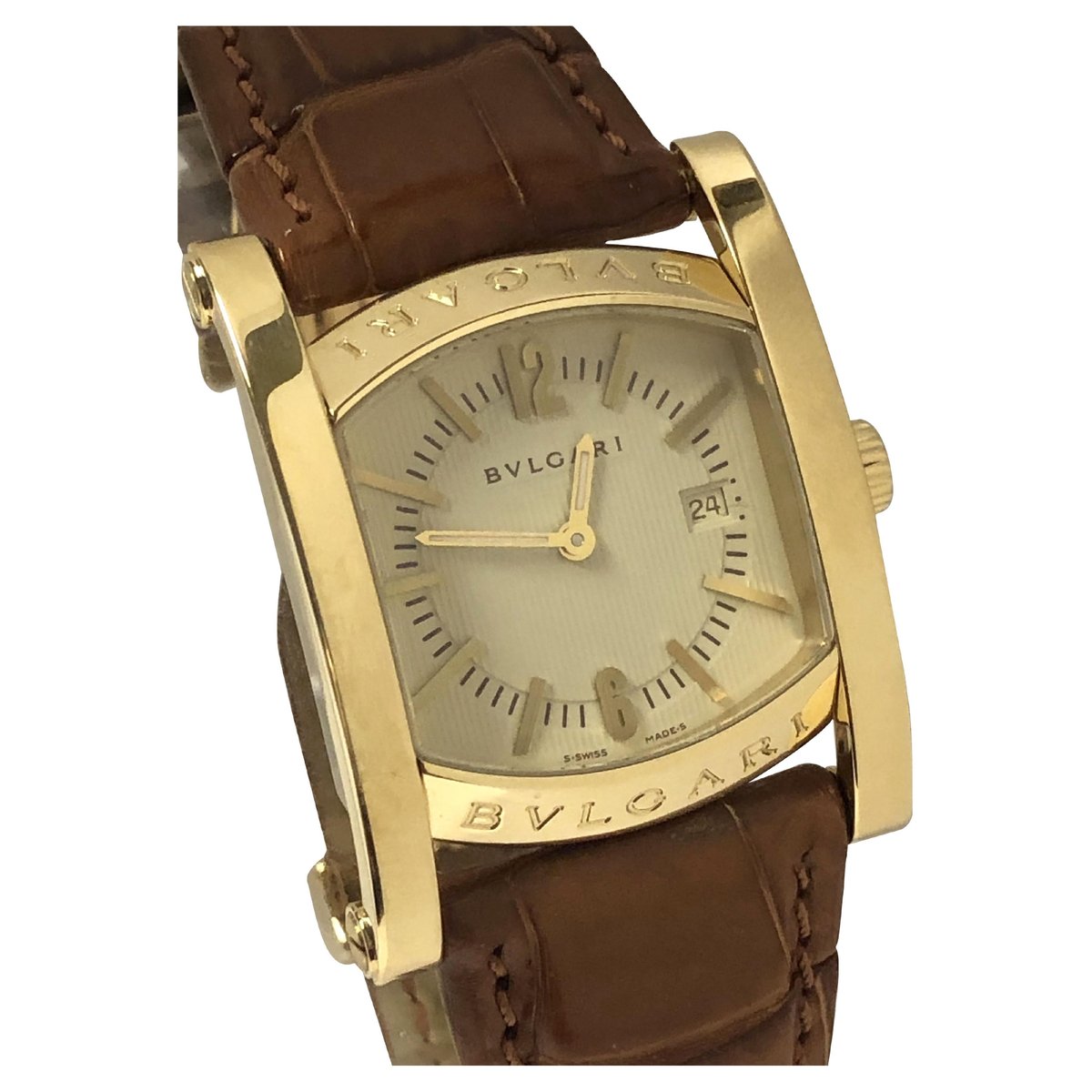
The Assioma's case is the whole point. It is a rounded, cushion-adjacent shape with lugs that appear to grow out of the case rather than attach to it, and a bezel that steps and curves in a way that catches light from unexpected angles. It is not a subtle watch, but it is not a loud one either — it reads as expensive in the way a well-cut suit does, through proportion rather than decoration.
The dial is deliberately restrained: applied indices, a date window at three, and the Bulgari wordmark kept small. The design trusts the case to carry the watch, which is the correct decision. On the wrist, the Assioma looks like nothing else in its price bracket — a genuine piece of Italian industrial design rather than a Swiss template with a different logo.
The reference under review, AA39S, is the core automatic model: steel case, clean dial, and a leather strap. It is the version to buy if you want the design without the noise of diamonds or chronograph sub-dials. The case finishing is a mix of brushed and polished surfaces, and the transition between them is one of the details that separates the Assioma from cheaper cushion-case watches.
It is worth saying something about the era. In the mid-2000s, the watch world was still figuring out what luxury meant in a post-bling moment. Bulgari's design language — bold, architectural, a little bit flash — was perfectly of its time, and the Assioma captures that moment better than almost anything else in the catalogue. It is a period piece in the best sense.
Movement: the honest workhorse
Inside, the Assioma runs a Bulgari-signed automatic built on an ETA 2892-A2 base. This is not a romantic movement, and Bulgari does not pretend otherwise — the caseback is solid, and there is no exhibition window to invite you to admire finishing that is not there. What you get instead is one of the best workhorse architectures ever made: thin, reliable, and easy to service.
The 2892 family runs at 28,800 vibrations per hour with roughly 42 hours of power reserve. It is the same base that powered countless slim dress watches from the era, and it is the reason the Assioma can be a genuinely wearable daily watch rather than a safe queen. It is not COSC-certified, and it is not in-house, and that is fine — this is a design watch, and the movement is there to do its job quietly.
If you want a Bulgari with an in-house calibre and a story about thinness records, save for an Octo Finissimo. If you want the Assioma's shape, the ETA base is a feature, not a bug: parts are available, independent watchmakers know it, and servicing is not a hostage negotiation. That matters more than ever as the watch ages into collectibility-adjacent territory.
On the wrist
The Assioma wears like a dress watch with a sporty streak. The case is compact and the profile is slim enough to slide under a cuff, but the sculpted lugs give it a bit of presence that a flat round case would not have. On a leather strap it feels balanced and light; the deployant clasp keeps the strap from creasing and makes it easy to take on and off.
The integrated-feeling lugs mean the watch sits close to the wrist rather than perching on top of it, which is a big part of why it wears so comfortably. It is not a heavy watch, and it does not try to be. Think of it as the watch equivalent of a well-tailored blazer: structured, comfortable, and better the longer you live with it.
Strap choice changes the watch more than you might expect. A black or brown leather strap keeps it formal; a textured or rally-style strap pushes it casual; the steel bracelet turns it into something closer to a sports watch. The lugs are the constraint — you will want to use straps that fit the case's curve — but the payoff is a watch that can cover more ground than its dressy looks suggest.
Accuracy and daily life
Real-world accuracy from an ETA 2892-A2 is typically within plus or minus ten to fifteen seconds a day, depending on how it has been regulated and how it has aged. That is not chronometer territory, but it is perfectly acceptable for a watch of this type. If you buy pre-owned, budget for a service if the seller has no recent service history — a fresh regulation will usually bring it back into a comfortable range.
Day to day, the Assioma is easy to live with. The date is useful, the dial is legible, and the strap can be swapped for something more casual without fighting the case. It is not a sports watch — there is no lume and no meaningful water resistance to speak of — so treat it as a dress-casual piece rather than a beater. Wear it to dinner, to the office, on a flight; leave it at home for the pool.
Occasions
The Assioma is at its best with a jacket. It works for formal events, for the office, for dinners, and for travel where you want one watch that looks good and does not attract the wrong kind of attention. It is not the watch for the gym, the pool, or a hike — and it does not need to be. Its job is to make you look like you know something about design, and it does that job well.
Variants and family
The Assioma line included chronograph versions, diamond-set bezels, and different dial and bracelet combinations. The AA39S is the core automatic, and it is the one most collectors gravitate toward because it is the purest expression of the design. Steel-bracelet versions exist and change the character of the watch considerably — more sporty, more integrated, and arguably more versatile.
Within Bulgari's wider catalogue, the Assioma sits alongside the Diagono as one of the house's design-led sport-chic lines, and it is a spiritual ancestor of the modern Octo in the way it treats the case as the main event. If you like the Assioma's approach, the Diagono is the other pre-owned Bulgari worth a look, and the Octo Finissimo is the modern endgame.
Similar watches and alternatives
If you like the Assioma, you probably like sculpted cases and jeweler-grade design. The Cartier Santos is the obvious French alternative, with a similar dress-sport intent and a stronger collector base. The Chopard Imperiale offers a rounded-square case and a jewelry-house pedigree at a comparable pre-owned price. Older Piaget Polo models bring integrated-bracelet sport-chic from another jeweler-turned-watchmaker. And the TAG Heuer Link offers a sculpted steel case and bracelet for buyers who want more bracelet and less strap.
At the homage end, the Assioma does not have a famous copy culture — which is part of its appeal. If you want the look for less, look at cushion-case dress watches from Seiko Presage, the Tissot PRX for integrated-bracelet energy, or microbrands like Brew for design-forward case shapes. None of them are Assiomas, but they scratch a similar itch.
Investment and pre-owned value
Let us be clear: the Assioma is not an investment. It is a discontinued, design-led watch from a jeweler, with an ETA-based movement and no meaningful auction record. It depreciates, and it will continue to depreciate. That is not a reason to avoid it — it is a reason to buy it used and wear it.
Pre-owned prices sit in a modest band, and condition, box, and papers matter more than the reference number for resale. If you find one with a recent service and a clean case, buy it and enjoy it. Do not buy it hoping to flip it into a down payment on a Daytona. The Assioma rewards the collector who buys with their eyes and their wrist, not their spreadsheet.
There is also a case to be made for the Assioma as a first real watch for a young collector. It has a recognizable brand, a distinctive design, and a price that does not require a home equity line. It teaches you what you like about watches without punishing you for the experiment.
Service
Because the movement is ETA-based, the Assioma is straightforward to service. Bulgari's authorized service centers can handle it, and a good independent watchmaker can too — often for less. If you buy pre-owned without service history, factor a service into your budget and use it as a negotiating point. A well-serviced Assioma is a reliable daily watch; a neglected one can become a paperweight with a nice case.
Pros and cons
- Pros: distinctive sculpted case; reliable and serviceable ETA-based automatic; genuine Italian design at accessible pre-owned prices; comfortable, slim, and versatile; a conversation starter that is not a Rolex.
- Cons: depreciates and lacks collector liquidity; not an in-house or technical movement; discontinued, so parts and service depend on Bulgari or independents; no lume and limited water resistance for sporty use.
Final verdict
The Bulgari Assioma AA39S is a watch for people who buy design first and specs second. It is not the smartest financial move in horology, but it is one of the more characterful ways to spend pre-owned money — a piece of Roman swagger with a reliable heart and a shape you will not see on every wrist. Buy it because you like looking at it, service it when it needs it, and wear it like you mean it.