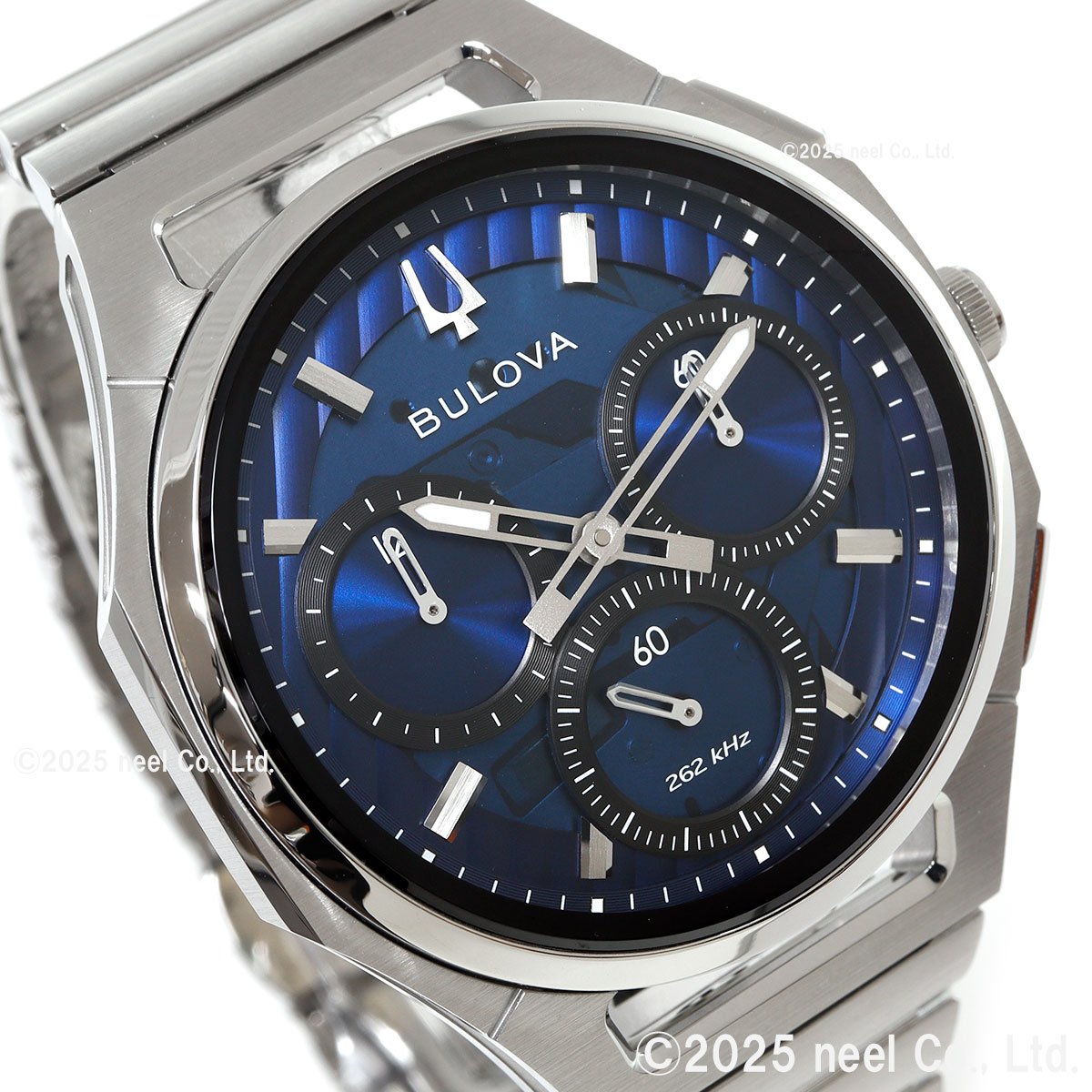
There is a small, specific pleasure in a watch that solves a problem nobody asked about. Bulova's CURV is that kind of object. When the collection landed in 2016, the company made a claim it could actually back: the first curved chronograph movement. Not a curved case wrapped around a straight caliber, which is what everyone else does, but a movement whose plates and battery and gear train are bent to follow the arc of a wrist.
That is engineering rather than styling, and it has a consequence at the exact point where watch reviews tend to go vague: how the thing actually sits on your arm for ten hours. I wore the 96A339 for a week — desk, school run, a flight, a dinner, a Saturday of errands — to find out whether the curve is a marketing line or a genuine advantage. Short answer: it is the latter. Long answer below.
Bulova in one paragraph, because it matters here
Joseph Bulova opened a jewellery shop in New York in 1875 and turned it into one of the great American watch houses. The company is credited with pioneering mass-market watch advertising in the 1920s and with the Accutron in 1960, the tuning-fork movement that was the first real electronic watch. Since 2008 Bulova has belonged to Citizen Watch Co., and that lineage explains a great deal about the CURV: the group builds quartz at a scale and a quality that few Swiss brands can approach in this price bracket. A curved quartz chronograph is exactly the sort of project a company like that can attempt and a company like that can afford to get right.
It is also why the CURV exists at all. Mechanical chronographs are expensive to bend. Quartz movements, once you have the tooling, are not. Bulova found a problem it was uniquely positioned to solve, and then solved it.
The curved case, and why it is not a gimmick
A conventional watch case is effectively a cylinder with lugs welded to the sides. Rest a cylinder on a round wrist and you get two points of contact and a gap in between, with the head of the watch cantilevered over the gap like a plank over a ditch. Every case designer in history has fought this with curved lugs, articulated end links, rubber shims — all of it cosmetic workarounds around a geometry that never actually changed.
Bulova changed the geometry. By curving the movement itself, the dial, the crystal and the caseback can all share one continuous arc. The sapphire is domed to match. On the wrist, the case makes contact across a band rather than at two edges, and the watch stops behaving like a puck balanced on a bone.
What does that feel like in practice? The 96A339 does not rock. That sounds like a small thing until you have spent a decade pushing flat steel chronographs back into position with your thumb. The mid-case flanks carry the curve through to the lugs, so the transition from case to bracelet is smooth rather than stepped, and the whole object reads as one engineered form rather than a dial glued onto a tube.
It also means the watch photographs badly and wears well, which is the opposite of most of the category. In a studio shot the curve flattens into an unremarkable steel chronograph. On an arm it looks deliberate.
Dial and legibility
The dial is where the curvature does quiet work. Because the surface bends away from the eye at the top and bottom, the outer edges catch light differently from the centre, and the applied indices pick up a gradient that a flat dial cannot produce. It is not a showy effect; it just makes the watch look considered.
Legibility is good without being exceptional. The hands are broad enough to find at a glance and carry luminous fill, and the markers are applied rather than printed, which matters more than it should at this price. The chronograph registers are recessed, so they read as instruments rather than decoration, and the hands stay clear of them. Under desk lighting the contrast is solid. In the dark, the lume is present and adequate — if you are arriving from a proper dive watch you will find it modest; if you are arriving from a fashion chronograph you will find it a revelation.
What I like most is that Bulova resisted the urge to fill the dial. There is a date, there are chronograph registers, there is a logo, and there is a lot of empty space that lets the indices breathe. Plenty of watches at twice the money get this wrong.
A week on the wrist
Monday. First proper test is always a shirt cuff, because that is where curved cases usually lose. The domed sapphire and the tall, rounded profile mean the watch sits proud of the wrist rather than sinking into it, so a close-fitting shirt will catch on it. A looser cuff swallows it without complaint. If you live in tailored shirts with narrow cuffs, try before you buy.
Tuesday and Wednesday. Desk days, which is where a watch either disappears or becomes an irritant. The 96A339 disappears. No pressure point under the caseback, no need to shake the wrist loose after a long typing session, no crown digging into the back of the hand. The pushers are well positioned for thumb activation without shifting the watch on the arm.
Thursday. A flight. This is where I usually notice weight, because airport wrists spend a lot of time resting on armrests and luggage handles. The CURV is a steel watch with honest heft — it is not a featherweight — but the load is spread rather than concentrated, so it never became a thing I was conscious of. It also sailed through a security scanner and across two time zones without any fiddling, which is the entire point of a quartz chronograph as a travel watch.
Friday and the weekend. Dinner, then errands, then a long walk. The bracelet is the unsung hero here: the end links meet the case along the same curve rather than jutting out at tangents, so there is no felt break where metal meets metal and no hair-pulling at the clasp. With short sleeves the case finally gets to do its party trick, catching light along that long curved flank. Two people asked about it. Neither guessed the price correctly in either direction.
The honest summary: this is one of the more comfortable steel chronographs I have worn, at any price, and the comfort comes from architecture rather than from a clever strap.
The movement: quartz, curved, and unapologetic about it
Bulova does not publish a consumer-facing caliber number for the curved chronograph movement, and I am not going to invent one. What is documented is the idea: a quartz chronograph caliber built on an arc, developed inside Bulova within the Citizen group and not sold to anybody else. It runs on a battery at the standard 32,768 Hz oscillator frequency, and it drives a chronograph and a date.
There will be readers who stop at the word quartz, and it is worth being blunt with them. At this price, a mechanical chronograph is a compromise dressed up as a virtue — a modular movement, a coarse pusher feel, a service bill waiting to happen. The quartz caliber here does the chronograph job better, cheaper and with less fuss. The pushers are crisp, the reset is instant and complete, and there is no winding ritual to perform before you time a pasta boil. What you give up is a sweeping seconds hand and the mild smugness of owning springs. That is the whole trade.
The one thing I would flag is that this is an industrial movement, not a decorated one. There is no exhibition caseback and no reason to want one. You service it with a battery and you get on with your day.
Accuracy, or the least interesting paragraph in this review
Bulova does not individually certify these movements and publishes no rate tolerance, so judge it as you would any modern quartz: expect it to hold within a few seconds a month. Mine did not drift enough over seven days to justify correcting it mid-week. It is quietly, boringly more accurate than any mechanical chronograph at the same money, and it will stay that way without a service for years.
Set it once a month, forget it, and spend your attention instead on how the chronograph feels in use. That is where quartz earns its keep in a watch like this.
Bracelet and clasp
The bracelet is steel, integrated into the case curve, and finished in the usual mix of brushed links and polished edges. It does the unglamorous work of making the case feel like part of a system rather than an accessory bolted on. The clasp is a deployant with a fold-over closure, which is the right call for a steel bracelet at this level — secure, quick to operate, and it keeps the leather-free promise of a watch you can wear in the rain.
Two practical notes. First, check the clasp for micro-adjustment before you commit, because a steel bracelet on a watch this shape lives or dies by fit, and wrists swell in summer. Second, if you swim or work out in it, rinse the bracelet; the polished inner links pick up grime faster than a fully brushed design.
Ownership economics
Here is the part where I stop being nice about the engineering and start being useful about the money.
The list price sits in the high hundreds, and the CURV does what most mid-tier quartz chronographs do the moment they leave the dealer: it drops. The secondary market is full of them at a fraction of retail, often barely worn, because the original buyer wanted a status object and got an interesting one instead. Buy there. Paying full MSRP for a Bulova quartz chronograph is a donation to the retail chain.
Running costs are trivial, which is the quietly great thing about quartz. Bulova does not publish a service interval for this caliber because it does not need one in the mechanical sense; any competent watchmaker can fit a battery and reseal the case, and it does not have to be an authorised service centre. A full movement replacement, if it ever came to that, would cost less than a mechanical chronograph's routine overhaul.
Resale, though, is not a plan. Buy this watch because you want to wear it for eight years, not because you want to flip it in two.
What else to look at
If you want the same brief without the ergonomic argument, the Tissot PRC 200 Chronograph gives you sapphire, a steel bracelet and a quartz chronograph for comparable money in a far more conventional case. If the appeal is the no-service mindset rather than the curve, a Citizen Eco-Drive chronograph removes the battery from the equation entirely and comes from the same corporate family. If you want the shape but a smaller budget, Seiko's Coutura line plays in similar ergonomic territory.
And if what you actually want is a mechanical chronograph, be honest with yourself and save for one. The CURV is not trying to be that watch, and it loses the argument the moment you decide that springs are the point.
Verdict
The CURV 96A339 is the rare affordable watch whose headline feature survives contact with a wrist. Bulova bent the movement so the case could follow the arm, and every hour you wear it, that decision quietly pays you back. It is not a collectible, the dial will not make anybody gasp, and you should not pay retail — but as a daily steel chronograph with a genuine engineering argument behind it, it earns its place in the rotation.
Wear it for a week. If you have ever pushed a flat chronograph back into position with your thumb, you will understand immediately.