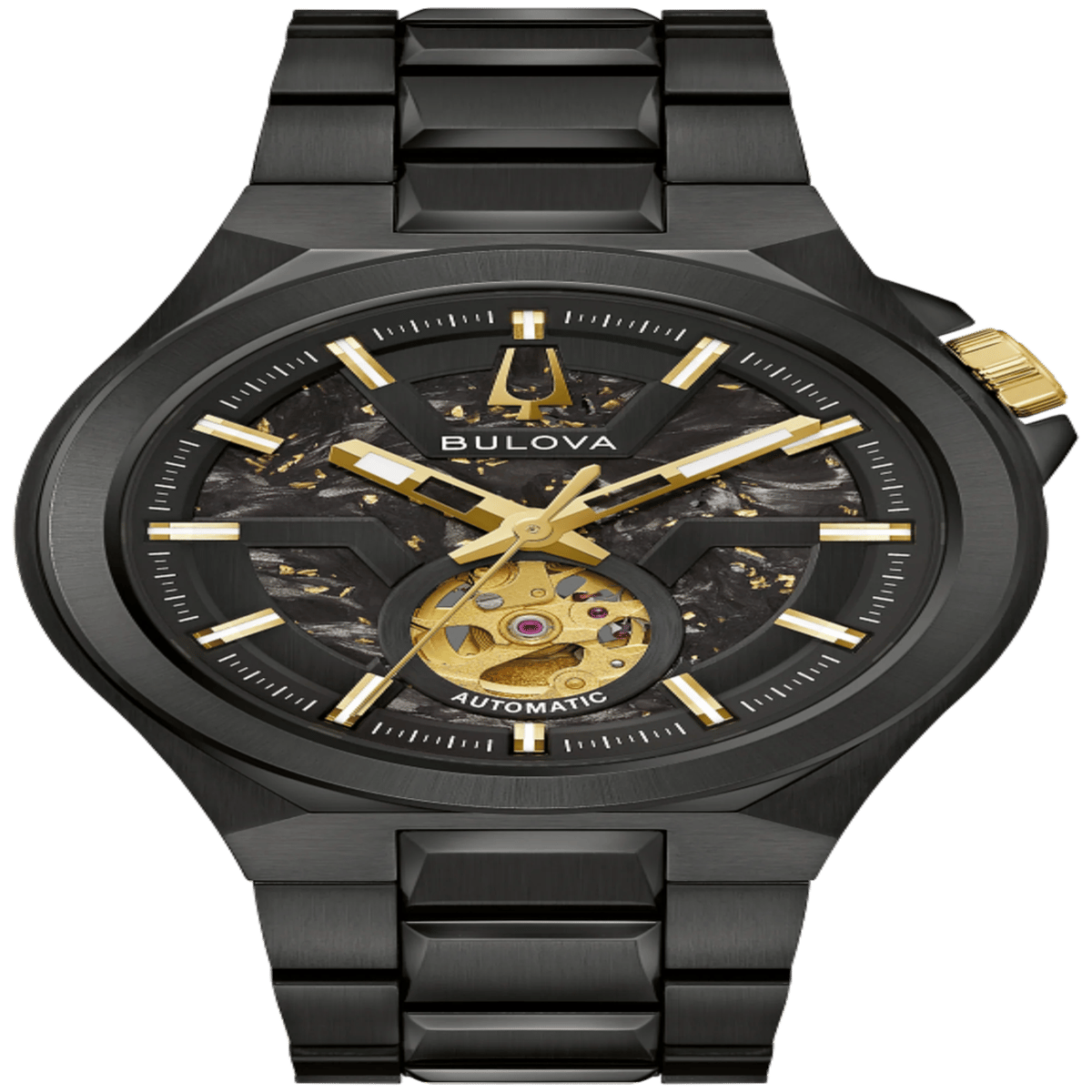
Bulova's Maquina line has one idea, and it commits to it: on this watch, the movement is the dial.
Why the Maquina exists at all
For most of the last decade the conversation in accessible steel watches has been about bracelets. Tapered links, integrated cases, the entire royal-oak-adjacent grammar that turned a seven-hundred-dollar Tissot into a status object. Bulova watched that happen and then went somewhere else entirely. The Maquina — the name means machine in Spanish and Portuguese, and Bulova has never been subtle about the metaphor — argues that the most interesting thing inside a watch ought to be visible from across a table.
That is a riskier proposition than an integrated bracelet, because it only works if the movement is worth looking at. Most automatics under a thousand dollars are not. Their calibers are stamped, undecorated, and sensibly hidden beneath opaque dials, and that is the correct engineering decision for a company trying to hit a price. Bulova's bet with the 98A340 is that an open-worked movement, cleanly executed and framed by a case with genuine architecture, can carry a watch on its own merits.
It helps that Bulova is owned by Citizen. The brand has access to Miyota movement manufacturing at cost, which means the money that would have gone into a Swiss-made stamp on the dial went instead into case finishing, bracelet engineering, and the cut-work on the face. That is the correct place to spend it.
A short history of a very American brand
Joseph Bulova opened his New York shop in 1875, and the company spent the next century behaving less like a jeweler and more like an industrial manufacturer. Bulova ran the first radio commercial in 1927 — a ten-second spot about a clock — and the first television advertisement in 1941. During the Second World War it produced instruments for the military on a scale that few watch houses could match.
Then came 1960 and the Accutron, the tuning-fork movement that hummed instead of ticked and briefly made Swiss watchmaking look old-fashioned. A decade later a Bulova chronograph rode to the moon on Apollo 15 with David Scott, an origin story the brand still trades on with the Lunar Pilot. Citizen acquired Bulova in 2008, and the modern company operates as a design studio with access to serious Japanese movement manufacturing. The Maquina is the clearest expression of that arrangement: American design instinct, Japanese engine, a price that reflects neither brand's pretensions.
The case is the second argument
Open-worked dials are easy to ruin. Cut too much away and you get visual noise; cut too little and you get a gimmick, a single window over a balance wheel pretending to be transparency. The Maquina avoids both failures by treating the dial as a frame rather than a surface. The hour markers and hands are reduced to thin, precise elements that float above the movement, and the resulting negative space is what you actually read — a layered field of bridges, wheels, and the constant motion of the balance.
The case does the rest of the work. Rather than a generic round barrel, Bulova shaped the Maquina with a cushion-leaning profile: brushed vertical flanks, a polished bevel running the length of the upper edge, and a bezel that steps down toward the crystal rather than sitting flat on top of it. From the side the watch looks machined. From above it looks deliberate. That is not a combination you find at this price often, where cases are usually either anonymous or overstyled.
The bracelet continues the line of the case instead of interrupting it. There is no awkward gap at the lugs, no visual seam where the watch stops and the strap begins — the links pick up the case's finishing language and taper cleanly toward the clasp. The deployant is the weak point. It functions perfectly well, and it will not embarrass you, but it does not have the machined solidity of the clasps on watches costing twice as much. Close the watch in your hand and it is the one component that tells the truth about the budget.
Living with the movement
The engine is a Miyota 8-series automatic — a compact, robust Japanese caliber beating at 21,600 vibrations per hour with roughly forty-two hours of reserve. It is not a chronometer, it is not decorated to Geneva standards, and Bulova does not claim otherwise. What it is, is one of the most serviceable automatic movements in production, found in watches on every continent and repairable by any competent watchmaker with a bench and a parts account.
For a young collector building a first serious mechanical watch, that matters more than a few seconds a day. The romance of an in-house caliber is real, but so is the experience of discovering that a service on a Swiss movement costs a meaningful fraction of the watch's value. The Miyota removes that anxiety entirely. You wear the watch, you enjoy the exposed geartrain, and if something goes wrong in five years you are not shipping it to another continent.
The design decision that follows from the movement is legibility. An open-worked dial will never read as cleanly as a matte black three-hander, and Bulova accepts that trade. In low light, with busy hands and a busy background, telling the time takes a half-second longer than it should. That is the price of the spectacle, and anyone buying a skeletonized watch has already agreed to pay it. It is worth noting that the face is deliberately kept free of a date window — the architecture is the point, and a cut-out numeral would only interrupt it.
On the wrist
The Maquina does not wear like a slab, which is the first thing that surprises people who associate skeletonized watches with bulky, top-heavy cases. The cushion-leaning silhouette distributes the mass evenly, the bevel catches light as you move, and the bracelet taper keeps the watch centered over the wrist bone rather than sliding toward the hand. It sits low enough to disappear under a shirt cuff and reads as sculpted rather than merely round from every angle.
It is a desk-to-dinner object, and it should be treated as one. This is not a watch for open water or a gravel road — the crystal is sapphire and the case is steel, but nobody at Bulova designed the Maquina around a depth rating, and buying it as a beater misses the point. Wear it to work, wear it to dinner, wear it on a flight. Take it off before you swim.
Presence is the interesting part. Up close the watch is undeniably mechanical and undeniably considered — the exposed balance ticking away gives it a pulse that a printed dial cannot match. Across a room, though, it does not shout. It is not a Submariner and it is not trying to be. The Maquina's appeal is intellectual rather than loud, which is exactly why it works for someone who wants a mechanical watch without wanting to look like they bought a status symbol on credit.
Accuracy and the honest numbers
Expect something in the region of minus ten to plus twenty seconds a day, with real-world variation depending on how you rest it at night and how active you are during the day. That is normal for the movement and normal for the price. Most examples settle into a tighter rhythm after a few weeks of regular wear, and a watchmaker can regulate one for very little money if the variance bothers you.
Practically, this is a watch you set once a week rather than once a month. If you need chronometer performance, you are shopping in a different category and should be looking at something with a certification to match. If you want a mechanical object that looks like a machine and keeps decent time, the 98A340 is entirely honest about what it offers.
The competition
The obvious rival is the Tissot PRX Powermatic 80, which offers an integrated bracelet, a Swiss label, and a longer power reserve for similar money. It is the safer purchase in every measurable way. But the PRX hides its movement under a textured dial — it is a watch about a bracelet. The Maquina is a watch about a mechanism, and if that is the thing you find compelling, nothing at this price does it better.
Hamilton's Jazzmaster Open Heart makes a similar argument with more restraint and a single aperture rather than a fully cut dial; it is the choice for someone who wants a hint of the movement rather than the whole story. Christopher Ward's The Twelve delivers noticeably sharper finishing and a better bracelet, but it costs more and plays in the integrated-case sandbox. And Maurice Lacroix's Aikon is the aspirational version of the same brief at roughly triple the money.
The honest secondary comparison is to Bulova's own back catalog. A Lunar Pilot or an Oceanographer Devil Diver will hold its charm longer and take more abuse, and both are more legible. The Maquina is the one you buy because you want to look at it.
What it is worth
Bulova automatics depreciate, and the Maquina is no exception. Retail buyers should expect to lose a meaningful percentage the moment they leave the store, which makes the secondary market the smart entry point — lightly used examples routinely trade well below retail, and there is no meaningful collector premium forming around the reference. This is not an appreciating asset and nobody should pretend otherwise.
What it is, is a lot of design for the money. The case architecture, the bracelet integration, the open-worked execution — those are the things that usually cost more than the movement, and Bulova spent on them deliberately. If you are building a collection and want one piece that makes a different argument from the usual steel sports watch, the Maquina earns its place. If you are buying it as an investment, buy something else.
The verdict
The Bulova Maquina 98A340 is the rare sub-four-figure watch with an actual point of view. It does not try to out-finish the Swiss; it out-designs them, turning an honest Japanese workhorse into the centerpiece of a case that looks considerably more expensive than it is. The trade-offs are real — modest accuracy, steep depreciation, a clasp that gives the game away — but none of them undermine the central idea.
Buy it because you want a mechanical object that looks like a machine. On those terms it quietly outperforms watches at twice the price.