Where the Marine Star sits in 2025
The Marine Star launched in the 1990s as Bulova's answer to the sport-watch boom — a line of steel, water-sports-adjacent watches with rotating-bezel DNA and a price that put them within reach of anyone with a paycheque. Over the years it has splintered into a family: three-hand quartz models, chronographs, two-tone variants, and more recently an automatic sub-line that has done a lot of the brand's heavy lifting with the enthusiast crowd.
The 98B466 is the mainstream article. It is the one Bulova puts in department-store cases and on the wrists of people who are not reading watch blogs. That is not a criticism; it is a job description. Somebody has to make the watch that a twenty-six-year-old buys when they get their first proper salary, and the Marine Star has been doing that job for a very long time.
What has changed is the context around it. Entry-level watchmaking has never been more competitive. Seiko's Prospex line, Citizen's Promaster family, Orient's automatics, and a wave of microbrands have all crowded into the space Bulova used to own unchallenged. The Marine Star is no longer the obvious choice. It is, however, still a coherent one — provided you understand what you are buying.
A brand that keeps rewriting its own origin story
Joseph Bulova opened a jewellery shop on Maiden Lane in lower Manhattan in 1875, and within a few decades he had built something closer to an industrial operation than a workshop. Bulova opened a factory in Biel, Switzerland, standardized components in an era when most watchmaking was still artisanal, and built a marketing machine that made the brand a household name: the first radio advertisement, the first television advertisement, the first watch brand to be genuinely mass-market and genuinely American at the same time.
Then came 1960 and the Accutron. A tuning fork vibrating at 360 hertz, no balance wheel, no escapement, an accuracy spec that embarrassed everything then on the market. It is one of the great hinge moments in watch history — the moment the Swiss establishment realized the ground could move under them. Bulova followed it with the Accuquartz in 1969 and then, like much of the industry, got flattened by the quartz crisis and spent decades as a licensing story more than an engineering one.
Citizen's acquisition in 2008 stabilized things. Since then Bulova has leaned hard into heritage reissues — the Lunar Pilot, the Oceanographer Devil Diver, the Super Seville — while the Marine Star quietly keeps the lights on. There is something pleasing about that arrangement: the archive gets the applause, the volume line pays the bills, and the volume line is genuinely decent.
What the 98B466 actually is
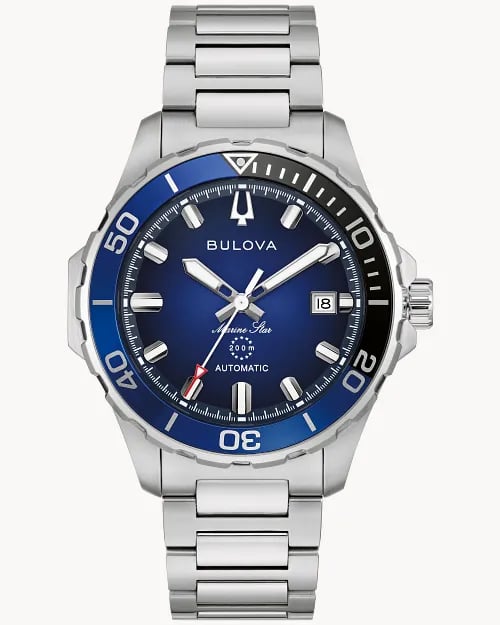
Strip away the branding and the 98B466 is a stainless-steel sport watch with a black dial, an applied-marker layout, a date at three o'clock, a mineral crystal and a three-link steel bracelet on a folding clasp. The design language is unapologetically dive-adjacent — the broad hands, the chunky indices, the polished-and-brushed mix on the case — without claiming to be a saturation diver.
The dial is the best part of the watch and the reason it photographs so well. The markers are applied rather than printed, which is a detail most watches at this price skip, and the hands are wide enough to read instantly. The polished bevels along the case sides catch light in a way that makes the watch look considerably more expensive than it is from across a table — the classic entry-level trick, and Bulova executes it well.
The bracelet is where the illusion thins out. Three-link steel, brushed outer links and polished centre links, a folding clasp with no micro-adjustment to speak of. It is fine. It is not the bracelet you get on a watch costing three times as much, and after a few years of desk work you will notice the scuffs on the clasp more than you would like. But it matches the case properly at the lugs, which is more than a lot of budget watches manage, and the whole assembly feels solid rather than hollow.
Crystal is mineral, not sapphire. Over five or ten years of daily wear that means scratches, and mineral cannot be polished back the way sapphire can be replaced. It is the single most obvious corner cut, and the one thing that would most improve this watch if Bulova changed it.
Water resistance and case dimensions are not published by Bulova in a consistent, verifiable way for this reference, so we are not going to quote numbers we cannot stand behind. What matters practically is that the Marine Star is built as a sport watch — it is meant for swimming pools, shower stalls and rainstorms, not saturation diving.
On the wrist
The Marine Star wears like a tool watch. There is real mass behind it, the case sits proud of the wrist rather than hugging it, and the bracelet is stiff enough out of the box that it takes a week or two to settle into shape. That stiffness is a feature for a sport watch and a nuisance for anyone hoping for a dress-watch drape — this is not a watch that disappears under a cuff.
Balance is decent. The head does not flop or rotate, and the bracelet taper keeps the whole thing from feeling like a shackle. On a smaller wrist the watch will read large and slightly top-heavy, which has always been the trade-off with the Marine Star formula: presence over proportion. If you have a narrow wrist, try one on before committing rather than ordering blind.
Legibility is excellent — a black dial, high-contrast markers, a date window that does not interrupt the symmetry. The lack of a published lume specification for this reference means you should treat it as a daytime watch; if you need to read the time at 3 a.m. in the dark, this is not the reference to buy for that purpose.
The movement, and living with quartz
Inside is a standard battery quartz module — Bulova does not publicly designate a caliber for this reference, and there is no exhibition caseback to admire. The movement is not the point. The point is what quartz buys you: a watch that holds roughly fifteen seconds a month in real-world conditions, needs no winding ritual, no positional awareness, no service every five to seven years, and no thought.
That is a genuine lifestyle feature, and it is underrated by enthusiasts. If you own one mechanical watch and want a second that simply works — that you can pick up after three weeks in a drawer and find still ticking and still correct — quartz is the correct answer, not a compromise. The date function means you will still correct the calendar at the end of short months, but that is a thirty-second job twice a year.
The trade-off is emotional rather than practical. There is no sweeping seconds hand, no rotor whirr, no sense of a machine doing work on your wrist. If that matters to you, save for something mechanical. If it does not, you have just saved yourself a lot of money and a decade of service bills.
The competition
The honest comparison set is brutal, because entry-level watchmaking in 2025 is the best it has ever been. Seiko's Prospex divers give you an automatic movement, an authentic dive-watch lineage and a community that will still be arguing about them in twenty years. Citizen's Promaster Dive — same parent company as Bulova — offers light-powered Eco-Drive technology and a stronger technical narrative for similar money. Tissot's Seastar 1000 Quartz brings a Swiss badge and sapphire crystal at a modest premium. Orient's Kamasu undercuts almost all of them with an in-house automatic and sapphire.
Where the Marine Star holds its ground is in pure looks and pure simplicity. It is more legible than most of the field, its dial is better finished than its price suggests, and it requires precisely nothing from its owner. It is also widely available, frequently discounted, and easy to try on in person — which sounds like damning with faint praise but genuinely matters when you are buying your first serious watch.
What it does not have is a story that collectors find compelling. Nobody is going to debate the 98B466 on a forum thread. Nobody is going to hunt a specific dial variant. That is the price of being a volume product, and it is worth being honest about it.
Money, resale and the honest math
List price sits in the mid-hundreds, street price is typically lower, and the secondary market is unforgiving: pre-owned Marine Stars trade for a fraction of retail, which means buying new is a commitment to owning rather than a position you can exit. Expect the value to fall the moment it leaves the counter and stay there.
That is not a reason not to buy it. It is a reason to buy it once, wear it hard, and stop thinking about what it is worth. The cost per year of ownership on a watch like this — purchase price minus nothing, divided by a decade of daily wear — is genuinely low, and the battery is the only recurring expense. There is no auction history to speak of and there never will be. Nobody is flipping Marine Stars.
The smarter play, if you are value-focused, is to buy pre-owned from a reputable seller: the depreciation has already happened, the watch is functionally identical, and you have removed the only real financial risk in the transaction.
Ownership and service
Living with the 98B466 is about as low-friction as watch ownership gets. A battery cell every few years, a gasket check when the case is opened, and you are done. Any competent local watchmaker can handle a cell swap for the price of lunch; going through an authorized Bulova service centre costs more but preserves the warranty and gives you a paper trail. There is no mechanical service interval to budget for, no lubricants drying out, no timing regulation to chase.
The one thing to keep an eye on is the crystal. Mineral glass accumulates hairline scratches, and at some point you will decide whether to live with them or have it replaced. Most owners live with them. It is that kind of watch.
The verdict
The Bulova Marine Star 98B466 is not trying to be a collector's watch, and judging it by that yardstick misses the point entirely. It is a well-proportioned steel sport watch that tells the time, survives daily life, costs almost nothing to run, and looks better on the wrist than its price tag suggests. The mineral crystal and the unremarkable bracelet are the honest compromises you make at this price, and neither is a dealbreaker.
Buy it as a first real watch. Buy it as a beater with dignity. Buy it as the one that lives in a desk drawer for the days you do not want to think about what is on your wrist. It will not appreciate, it will not impress a room full of collectors, and it will never appear at auction. It will simply be there, correct, every morning — which is more than a lot of far more expensive watches can promise.