Bulova Marine Star 98B471: American Sport, Honestly Priced
The steel sports watch under a thousand dollars is the most contested ground in horology. Every brand with a case-and-bracelet capability has a horse in this race, and most of them are competent. What separates the Bulova Marine Star 98B471 from the field is not novelty — it is the plain, unfashionable discipline of doing the fundamentals properly and pricing them honestly.
The Marine Star in Context
The Marine Star has been Bulova's sport-watch standard-bearer for decades. It is the line where the brand puts its water-sports ambitions rather than its historical nostalgia — you will not find a reissue movement or a heritage plaque here, and that is the point. The 98B471 is a modern expression of the idea: a stainless steel case, a rotating elapsed-time bezel, an applied-index dial under sapphire, and an automatic movement from Miyota.
That last detail is the one that matters most to a collector who plans to keep a watch rather than flip it. Bulova has been owned by Citizen Watch Company since 2008, and Miyota is Citizen's movement arm. So the caliber inside the 98B471 is not an orphan, not a rebadged unknown with a marketing story stapled to it. It is a mass-produced, globally supported industrial automatic — the same sort of engine that has powered millions of reliable watches for decades. In this bracket, provenance of service matters more than provenance of design.
Case, Bezel and Dial
The Marine Star reads immediately as a sports watch. The case is steel, the bezel is the dominant visual element, and the dial is designed to be legible at a glance rather than photographed at a desk. Bulova has been building this shape long enough that the proportions are settled: a strong, flat bezel surface, a case flank with enough definition to catch light without becoming a scratch magnet of decorative facets, and lugs that flow into the bracelet rather than sitting on top of it like an afterthought.
The dial is sunray-brushed, which is the correct choice at this price. A flat matte dial would look cheap; a heavily textured one would look like it was trying too hard. Sunburst brushing gives the dial a slow shift of tone as the wrist moves, which is the cheapest way to make a watch look more expensive than it is, and Bulova uses it well. Applied indices rather than printed ones are a meaningful tell — they sit proud of the surface and hold lume, and they catch light in a way that printed markers never will. The hands are broad enough to read instantly and filled with luminous material for low-light legibility.
The date window is the one concession to practicality that always divides opinion. Here it is small and sits where it should, framing a legible numeral without cutting a hole in the symmetry of the dial. It is not integrated into the design language the way a high-end watch might manage, but it does not commit the usual crimes either.
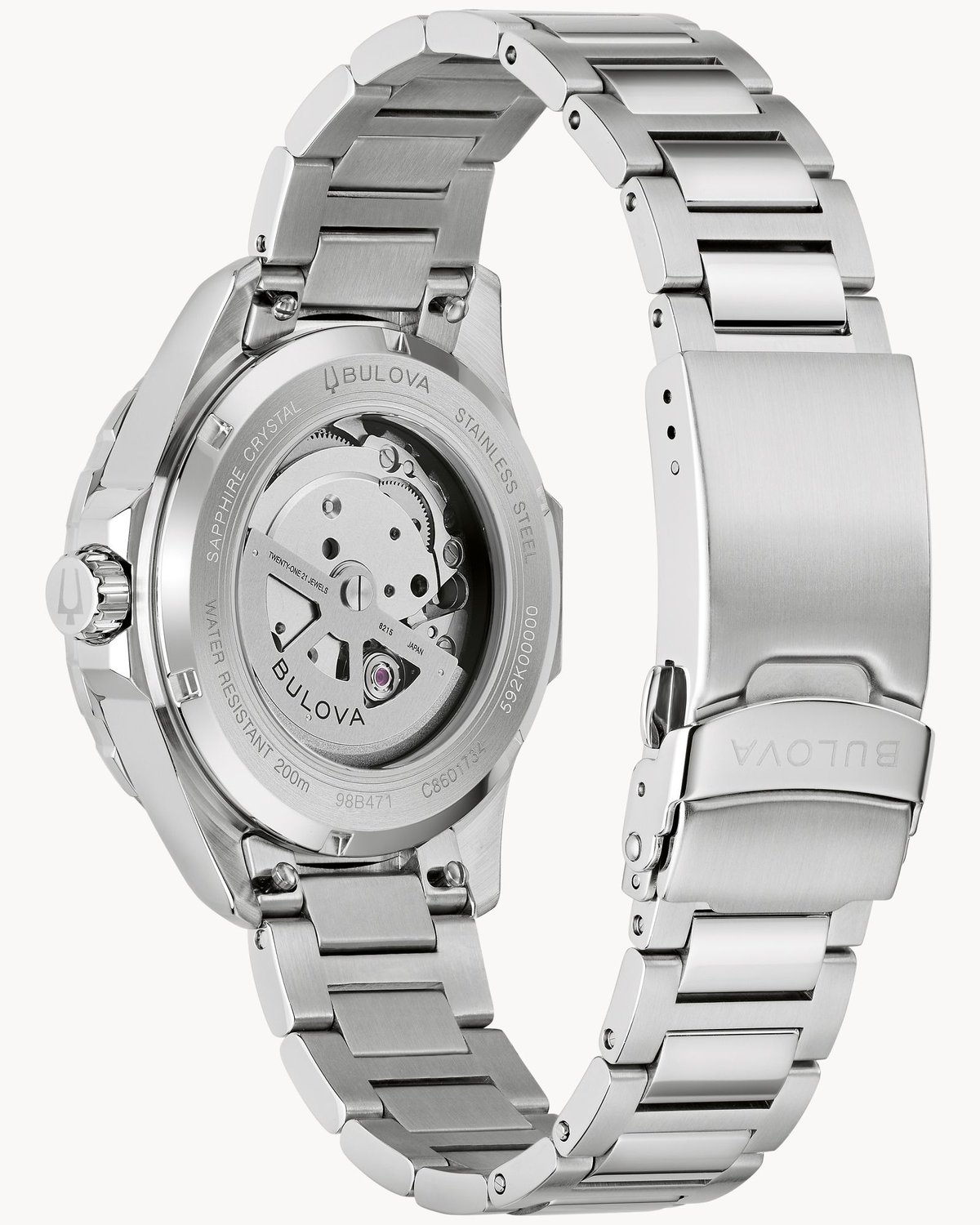
The crystal is sapphire, which is the single most important specification on this watch for anyone who intends to wear it daily. Mineral crystal on a sports watch is a slow accumulation of hairline scratches and eventual regret; sapphire simply removes that anxiety from your life. Bulova does not prominently document the luminous compound used on the dial, and the brand is equally quiet about the precise water-resistance rating of this reference, so the sensible approach is to treat the Marine Star as a watch built for swimming and surface water sports and to check the caseback marking before taking it deeper than a pool. The rotating bezel, properly used, is still a genuinely functional elapsed-time tool for everything from parking meters to pasta.
The Movement
The 98B471 is powered by Miyota's 8-series automatic, most commonly the 8215 — a caliber with a long, unromantic and thoroughly deserved reputation. It beats at 21,600 vibrations per hour, delivers roughly forty hours of power reserve, and carries a date complication. It is not a movement that will ever be photographed under a macro lens for a coffee-table book.
The architecture is conventional: a central rotor winding a mainspring, a standard going train, an escapement built for durability rather than rate stability under laboratory conditions. Finishing is industrial — clean, consistent, and entirely without hand-applied decoration. That is not a criticism; it is a description of a movement designed to a brief. What Miyota's 8-series buys you is robustness and the near-certainty that any competent watchmaker anywhere in the world has serviced one before. In some cases, replacing the movement outright is more economical than overhauling it, which is its own very practical form of peace of mind.
Two old-fashioned characteristics are worth flagging honestly. This movement family does not hack — the seconds hand keeps running while you set the time — and it does not hand-wind. You set the time by nudging the hands forward to the correct minute, and you keep the watch alive by wearing it or by giving it a gentle shake before it goes back in the box. Some collectors find this charming and mechanical; others find it irritating next to modern rivals with hacking and hand-winding. Both reactions are legitimate, but you should know which one you are before you buy.
On the Wrist
The Marine Star is a sports watch first, and it wears that way. There is enough visual mass in the case and bezel to sit convincingly under a shirt cuff, and enough tool-watch presence to look correct with a t-shirt. It does not attempt the chameleon trick of dressing up; it is what it is, and it is consistent about it.
The bracelet is the pleasant surprise. Three-link steel with brushed outer links and a polished centre run is exactly the configuration this genre demands, and Bulova has been building it long enough that the articulation is sorted. The links roll rather than rattle, and the folding clasp sits flat against the underside of the wrist instead of digging in during a long afternoon at a keyboard. Balance is what separates a wearable sports watch from a heavy one, and because the case is matched to a bracelet of proportionate mass rather than a token strap, the watch sits centred on the wrist rather than tipping forward. The crown does not press into the back of the hand, which sounds like a low bar until you have worn something that fails it.
On a smaller wrist, the bezel-heavy proportions will read as deliberate and sporty rather than subtle. That is the correct trade for this category. It is a watch you stop noticing by lunchtime, and that is the highest compliment a daily-wear steel watch can receive.
Accuracy and the Daily Grind
Miyota publishes a generous tolerance band for the 8-series — broadly in the range of minus twenty to plus forty seconds per day — and any honest review of an entry-level automatic has to start there. In practice most examples settle into something considerably tighter once broken in, and a well-regulated sample running within ten to fifteen seconds a day is entirely normal. What you should not expect is chronometer behaviour, and what you should also not do is regulate it obsessively.
This is a watch whose accuracy is a background fact rather than a hobby. Set it when you change the date at the start of the month and it will stay close enough to be useful. If you need a watch that is second-perfect every morning, buy quartz and be happy; if you want the mechanical ritual, accept the drift as part of the deal.
What It Competes With
The obvious alternative is Seiko's Prospex line, and specifically the cushion-cased divers that have become the default recommendation in this bracket. Seiko offers genuine dive-watch rating and its own in-house automatic, and the brand's service network is comparably deep. The Bulova's counterargument is finishing and wearability: the Marine Star's bracelet and case detailing feel a step more considered than Seiko's entry-level divers, which tend to prioritise specification over tactility.
Orient's Kamasu is the value play, offering sapphire and proper dive specification for less money, though the finishing is a clear step behind. Citizen's own Promaster Marine is the sibling rival — similar Miyota-based automatic heart, more aggressively tool-oriented styling, and the same corporate parent. And Tissot's Seastar 1000 with the Powermatic 80 offers a longer power reserve and Swiss branding for a modest premium, with a more urban silhouette that trades some of the Bulova's tool-watch honesty for polish.
What the Bulova offers against all of them is a combination rather than a single specification: an automatic movement with global service support, sapphire crystal, a properly articulated steel bracelet, and a design that does not look like it is apologising for its price. That combination is rarer than the spec sheets suggest.
Ownership, Service and Value
Service is the least glamorous part of any review and the most important for a watch at this price. The Miyota 8-series is one of the most widely serviced automatics on earth, which means you are not tied to a single authorised service centre or a single country. Any competent independent watchmaker can handle it, and because the movement is inexpensive, a full replacement is a realistic option when an overhaul would cost more than the watch is worth in parts. That is a genuinely liberating position for an owner.
On value, be realistic. Entry-level automatics from large-volume brands settle well below retail on the secondary market within a couple of years, and there is no collector narrative around the Marine Star to reverse that. Buy it to wear. The value is entirely in the wearing — in the fact that a watch costing less than a set of tyres can be worn every day for a decade without a second thought, and still look correct doing it.
Verdict
The Bulova Marine Star 98B471 is not a watch that wins arguments on paper. It wins them on the wrist, at seven in the morning, when you put it on without thinking and it disappears into the day. The Miyota automatic is unglamorous and utterly dependable, the case and bracelet are built to a standard that embarrasses the price, and the sapphire crystal removes the one daily anxiety that plagues cheaper sports watches.
It is a tool in the best sense of the word, and it makes no apology for being one. For a young collector building a first serious stable, that is precisely the right place to start — not because it is a masterpiece, but because it is honest, and honest watches get worn.