The short version
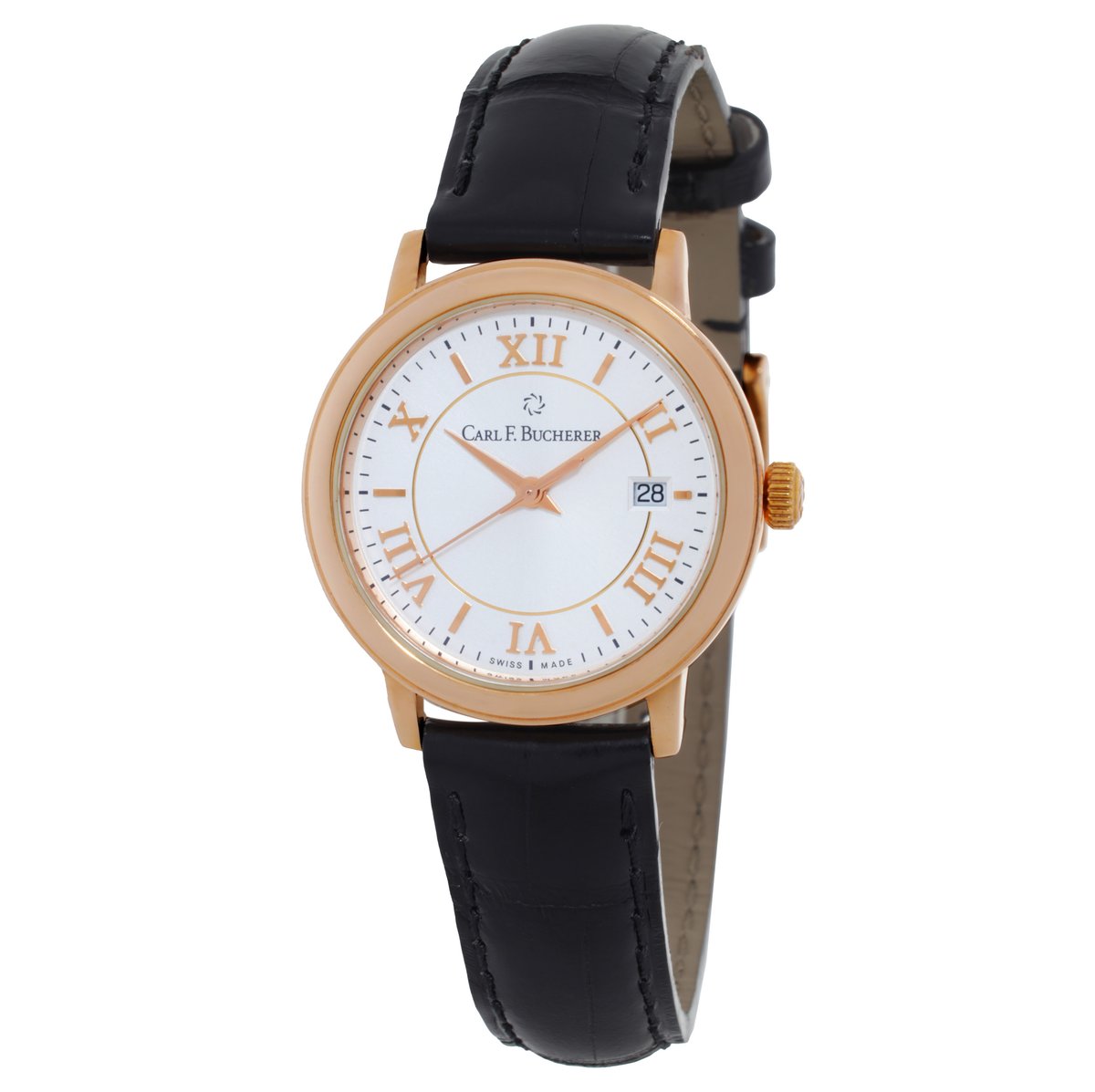
The Adamavi is Carl F. Bucherer's answer to a question the market stopped asking somewhere around 2012: what does a serious person wear under a shirt cuff when they are not trying to signal anything? It is a three-hand automatic dress watch with a polished case, a clean dial, a date at three, and no pretence of being a tool. Reference 00.10314.08.55.21 pairs a light silver dial with a black alligator strap, which is the most conservative and arguably the most useful configuration in the line.
Here is the uncomfortable part, and we may as well get it out of the way in the first three hundred words. As an investment, this watch is a poor one. Carl F. Bucherer's secondary market is thin, brand recognition outside enthusiast circles is limited, and dress watches from mid-tier independents depreciate hard. As a watch, it is quietly excellent — comfortable, legible, mechanically conventional in the best sense, and now available pre-owned at prices that make the depreciation somebody else's problem. Those two facts have to be held simultaneously, and this review will keep holding them.
Where the Adamavi sits in the catalogue
Carl F. Bucherer is a house with two personalities. One personality builds peripheral-rotor tourbillons and the Manero Peripheral — technically ambitious, expensive, and fascinating to collectors who enjoy the engineering. The other personality builds dress watches for people who want a Lucerne-made alternative to the usual suspects. The Adamavi belongs entirely to the second camp, sitting below the Manero in both price and ambition.
That positioning matters when you are assessing value. The Adamavi is not a platform for the brand's in-house calibres; it is a well-executed, commercially sensible watch built on a proven ébauche. The upside is reliability and easy servicing. The downside is that it lacks the technical talking point that gives a watch a second life on the collector market. Nobody has ever bought an Adamavi because of what is behind the caseback, and Carl F. Bucherer has never pretended otherwise.
The family stretches across a few configurations — time-and-date, a power reserve variant, an annual calendar, and a ladies' line — which tells you the designers treated the Adamavi as a design language rather than a single reference. That is good news for buyers who want options and mildly bad news for anyone hoping for scarcity.
The movement: conventional, and that is the point
Under the dial sits the CFB 1965, Carl F. Bucherer's designation for the thin automatic time-and-date caliber used across the Adamavi AutoDate range. It runs at 28,800 vibrations per hour with roughly a 42-hour power reserve, which is standard-issue modern Swiss performance — enough to survive a weekend off the wrist without a reset ritual, not enough to compete with the 70- and 80-hour movements now common at similar money.
It is not an in-house movement, and it is not COSC certified. Both facts are worth stating plainly because they are frequently glossed over in brand copy. What the CFB 1965 is, is a known quantity: an ébauche-based architecture with a long service record, parts availability that is not a problem for any competent watchmaker, and finish quality that is commercial rather than decorative. The rotor is signed, the bridges are lightly decorated, and none of it is meant to be looked at.
Buyers should confirm the caliber stamping on the rotor of the specific watch they are considering. Carl F. Bucherer has revised movements across this line over the years, and a serial-number check with the brand or an authorized dealer is cheap insurance on a pre-owned purchase. If a seller cannot tell you which caliber is inside, that is information about the seller.
Case, dial and the way it actually wears
The Adamavi's case is the most convincing argument the watch makes. It is polished, restrained, and shaped to sit low — a dress-watch case in the classical sense, with a slim bezel that gives the dial maximum real estate and minimal visual noise. There is no crown guard drama, no mixed finishing to distract the eye, no design gesture that will look dated in five years. It is the kind of case that reads as expensive in a photograph and invisible in a room, which is exactly what a dress watch should do.
On the wrist, the balance is the standout. The watch sits close and does not roll, which is rarer than it sounds among thin dress pieces on stiff leather. The alligator strap is supple out of the box and tapers properly, and the whole assembly reads as a single object rather than a case bolted to a strap. The weak point is the pin buckle, which feels like a component chosen by a purchasing department rather than a designer. It is the first thing we would change.
The dial is where the Adamavi earns its keep. Applied indices, simple baton hands, a date window at three that is neither integrated cleverly nor offensively placed, and a light silver surface that shifts from near-white in daylight to a warmer grey under artificial light. Legibility is excellent at every angle. There is no lume, which is correct for the category and worth flagging for anyone who wears a watch to bed or works nights.
Water resistance is modest, as it is on virtually every leather-strapped dress watch, and the sapphire crystal is the right call for a modern piece at this level. We are deliberately not quoting case dimensions here, because published figures vary by source for this reference and a wrong number is worse than no number. Measure the watch, or try it on, before you commit — especially if your wrist sits at either extreme.
Accuracy and daily behaviour
This is not a chronometer, and it should not be sold as one. In real-world use, the CFB 1965 family settles into roughly +5 to +10 seconds per day, with meaningful positional variation — a night dial-up on the nightstand will produce a different rate than a day on the wrist. That is normal for a movement at this level and completely acceptable for a dress watch that is worn a few days a week.
The more relevant daily behaviour is the reset ritual. With a 42-hour reserve, an Adamavi left in a drawer from Friday evening to Monday morning will stop. If you rotate watches, expect to set the time and date before you put it on, and expect the date change to be functional rather than instantaneous. None of this is a fault. It is simply the specification of a thin automatic, and the trade-off buys you a case that disappears under a cuff.
Regulation at service will materially improve the rate. A good watchmaker can bring a well-kept example comfortably inside chronometer tolerance without swapping parts, which is one of the quiet benefits of a conventional ébauche movement.
The market: what it is worth, and what to do about it
Let us talk numbers the way a collector actually does. The Adamavi has historically retailed in the low-to-mid three-thousand-dollar range depending on year and configuration, and it has never held that money. Pre-owned examples trade for well under half of original retail, and the spread between a tired example and a boxed, recently serviced one is smaller than the spread you would see on a comparable Omega or Tudor. That is the definition of an inefficient market at the bottom end, and it is where the opportunity sits.
The trend is depreciating, and it will stay that way. There is no auction history to point to, no waiting list, no cultural moment waiting to reprice this reference. Carl F. Bucherer's 2023 move into the Rolex-owned Bucherer group gives the brand a stable parent and a clearer retail story, but it does not manufacture collector demand for a three-hand dress watch. Anyone modelling appreciation into this purchase is modelling fiction.
The hold-versus-sell judgment is therefore straightforward. If you already own one and do not wear it, sell — the money is doing nothing and the depreciation curve has already flattened, so there is no advantage in waiting. If you are buying, buy pre-owned, buy the best-condition example you can find, and buy it because you want a dress watch rather than because you want an asset. The Adamavi is one of the few remaining ways to own a well-made Swiss automatic with a genuine manufacture name on the dial for four figures, and that is a real, if unglamorous, form of value.
What else to consider
The obvious competitor is the Nomos Tangente 38, which offers an in-house caliber, German restraint, and a secondary market that treats sellers considerably better. The Omega De Ville Prestige Co-Axial costs more but brings a stronger movement story and genuine liquidity. The Tudor 1926 and the Longines Master Collection both undercut the Adamavi on price with wider service networks behind them.
Where the Adamavi wins is in the wearing. It is softer and more classical than the Tudor, less austere than the Nomos, and less ubiquitous than the Omega. If you have already owned the obvious dress watch and found it wanting, this is a legitimate alternative rather than a compromise.
For buyers on a tighter budget, the Orient Bambino and the Tissot Le Locle Powermatic 80 deliver the genre's proportions for a fraction of the money. They are not substitutes — the case finishing, the strap quality, and the dial execution are a different category — but they make the same point about what a dress watch is for, and they make it for two hundred and fifty dollars.
Servicing and ownership
Because the movement is ébauche-based, service is not a specialist problem. Any competent independent watchmaker can strip, clean, and regulate this caliber, and the cost sits well below what you would pay for an in-house manufacture movement of similar complexity. Authorized service centres cost more but give you parts access, a warranty, and a paper trail that matters at resale time — modestly, in this price bracket.
Our advice: find a watchmaker you trust before you need one, keep the service paperwork, and do not skip a service because the watch is running fine. Thin automatic movements with modest reserves punish neglect in the form of worn pivots and expensive rebuilds.
The verdict
The Carl F. Bucherer Adamavi 00.10314.08.55.21 does exactly what a dress watch should do: it disappears under tailoring, reads instantly, and never asks to be discussed. It is not a collector's instrument, it will not appreciate, and its brand story is more complicated today than it was five years ago. None of that changes the fact that a good pre-owned example is one of the better value propositions in Swiss watchmaking for someone who already owns the loud stuff.
Buy it second-hand, wear it on the days that call for a cuff, and judge it by how often you reach for it rather than by what it is worth. On that measure, the Adamavi earns its place — quietly, which is the whole point.