The watch that refuses the assignment
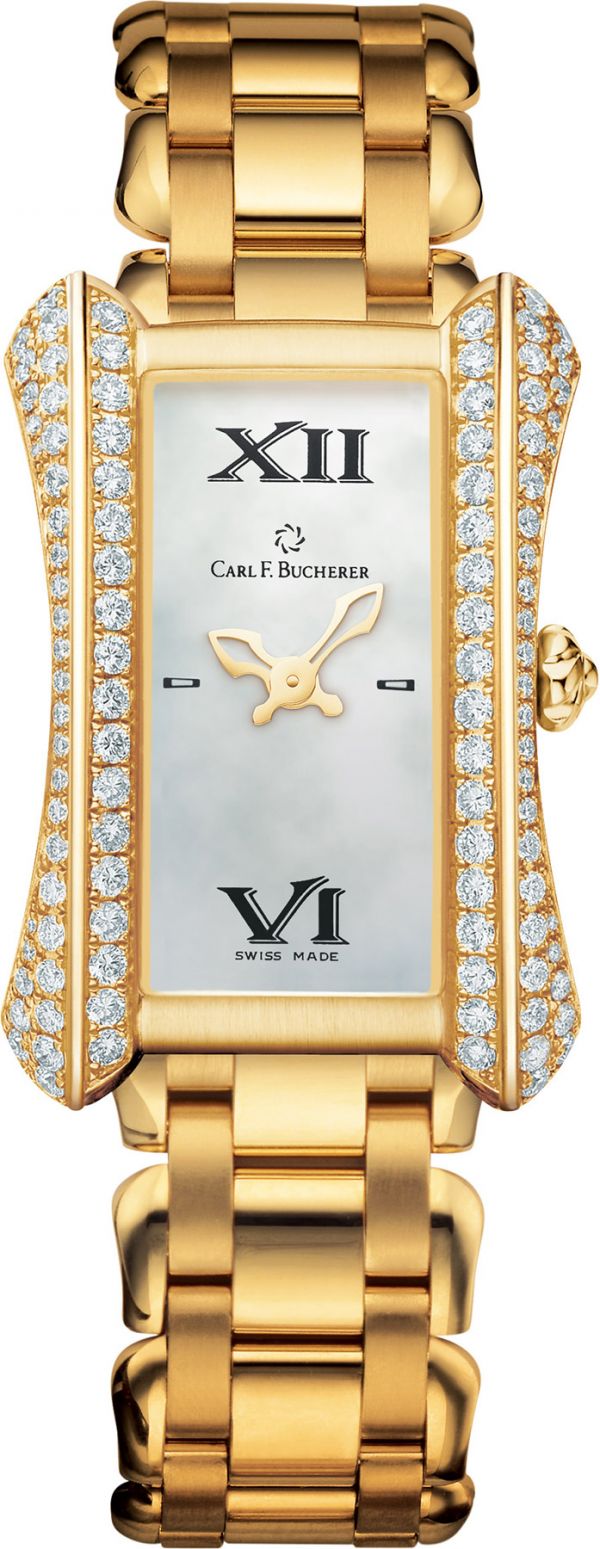
There is a certain kind of collector — and you know the type — who can recite the hammer price of a steel chronograph from three seasons ago but can't remember the last time they wore something to dinner that wasn't a flex. The Carl F. Bucherer Alacria is not built for them. It's built for the person who has run the hype math and arrived at a different answer: a curved, barrel-shaped case, a clean two-hand dial, and a Swiss quartz heart that never asks to be wound.
Reference 00.10701.01.71.31 sits inside CFB's women's pillar, a line that has spent a generation treating jewelry-watch design as a first-class discipline rather than a pink-dial afterthought. There's no flyback here, no peripheral rotor, no triple time zone. The Alacria's argument is architectural — how the case wraps the wrist, how light runs down its flanks — and architectural arguments have never fit in a spec table.
The context, though, is very much part of the story. In 2023 Rolex acquired Bucherer AG, the Lucerne retail group that also owned Carl F. Bucherer, and the industry has been speculating ever since about what that means for a mid-size manufacture with real technical heritage and a narrow distribution footprint. Whatever you decide about that, it should be the first thing you price in. It's also the reason this watch is more interesting right now than its spec sheet suggests.
Lucerne, 1888: the house behind the case
Carl Friedrich Bucherer opened a jewelry and watch shop in Lucerne in 1888, and by 1919 the family name was going on watches of its own. For most of the twentieth century the house was a regional jeweler with a watchmaking arm; the modern CFB identity was built in the last two decades on a handful of genuine technical statements. The Patravi TravelTec's three-time-zone display is one. The Manero's peripheral rotor, which put a winding mass around the edge of the movement instead of on top of it and let the bridges show through, is another — a piece of engineering that collectors who wouldn't otherwise look at a Lucerne brand had to respect.
Then there's the Alacria, which has anchored the women's side of the catalogue for a generation. It doesn't get the magazine covers the TravelTec does, but it's the line that keeps CFB in front of a customer who buys jewelry first and complications second — and in the current market, that customer is the most reliable one in the building.
The ownership chapter matters here too. Rolex's purchase of Bucherer moved both the retailer and the watch brand under the crown, and the watch world has spent two years arguing about what a mid-size manufacture looks like inside that portfolio. For a buyer, that translates into a simple rule: buy the Alacria because you want to wear it, not because you're betting on a corporate roadmap you can't read.
The design: the case is the whole argument
The Alacria's silhouette is a barrel — a soft-shouldered tonneau that narrows toward the strap and curves through the profile so the watch reads as one continuous piece of metal rather than a box strapped to a wrist. It's the kind of shape that photographs badly and wears beautifully, because the whole point is the way the case rolls over the wrist bone instead of sitting on it.
CFB has always treated the family as jewelry first. Across Alacria references you'll find diamond-set bezels and lugs, mother-of-pearl dials, applied markers, and straps that lean satin rather than sporty. Ref. 00.10701.01.71.31 carries that DNA in a restrained key — this is the version that reads as taste rather than occasion. The polishing does the heavy lifting, and polish is a maintenance commitment: this is not a watch that shrugs off a doorframe.
Where a sports watch earns its price in engineering you can see through a caseback, the Alacria earns it in finishing you can see in a mirror: the transition from bezel to flank, the way the dial catches a candle rather than a spotlight. It's a design object that happens to tell time, and pretending otherwise is how reviewers write bad reviews of jewelry.
The movement: quartz, and why that isn't an apology
The Alacria runs on a Swiss quartz caliber. CFB doesn't publish the kind of architecture detail it reserves for its mechanical work, and for this category that's the right call: nobody buying a barrel-case jewelry watch is asking about the Geneva stripes on a movement they'll never see.
Quartz buys three things that matter here. It keeps the case slim enough to sit under a cuff without a bump. It removes the winding ritual, the date reset, and the setting crown entirely from the ownership experience. And it makes ownership cheap: a battery cell every few years versus a mechanical service interval that would cost a meaningful fraction of the watch. As a second, third, or fifth watch in a rotation, that's not a compromise — it's a spec.
If you want CFB's mechanical muscle, it lives elsewhere in the catalogue: the Manero Peripheral, the Patravi TravelTec, the Heritage BiCompax Annual. The Alacria's job is to be the watch you grab without thinking, and quartz is the honest way to do that job.
On the wrist
This is where the Alacria wins. The curved case and short, flowing strap integration mean it settles into the wrist rather than floating on top of it, and the absence of a heavy caseback lip means no pressure point at the base of the hand. On a smaller wrist it reads as a piece of jewelry that happens to have hands; on a larger wrist it reads as a deliberate, almost vintage-scaled choice rather than a watch that's too small.
Weight is minimal — you'll forget it's there, then catch it in a shop window and remember. The strap does most of the daily-fit work, so try it on before you buy: leather and satin options behave very differently against the skin, and a bracelet version will transform the watch's presence entirely.
What it doesn't do is announce itself from across a room. Presence here is reflective, not volumetric. If you want a wrist that starts conversations from ten feet away, this isn't it. If you want a wrist that rewards the person sitting next to you at dinner, this is exactly it.
Living with it: accuracy, service, water
Quartz accuracy is a solved problem: expect the hands to track the indices and the watch to run within a handful of seconds a month, well inside anything you'd notice in daily use. There's no positional variation to learn, no power reserve to manage, no reason to own a winder for it.
Servicing is straightforward and, by luxury standards, cheap: an authorized watchmaker handles the battery, gaskets, and case reseal, and CFB doesn't publish an official service interval we'd repeat as gospel for this reference. Treat it as authorized-only for anything involving the case, and don't let a mall kiosk near a diamond-set bezel.
Water resistance is the one place to be conservative. CFB doesn't publish a figure we'd stake a claim on for this reference, and a jewelry watch with a polished case belongs away from the pool, the shower, and the beach regardless. Wash your hands with it on, not your car.
The market: what it's worth, what it isn't
We're not going to invent a sticker price for you. Alacria pricing varies substantially by case material, diamond content, and strap versus bracelet, and CFB's distribution runs through a relatively small authorized network, so published numbers move. Confirm the current retail with an authorized dealer for the exact configuration before you make a decision.
What can be said with confidence is the shape of the secondary market. Carl F. Bucherer as a whole trades at a steep discount to retail on the pre-owned market, and small quartz jewelry watches depreciate harder than mechanical sports pieces because the buyer pool is narrower and the emotional premium is lower. Expect thin liquidity and few public comps — this is not a reference you'll find in an auction calendar, and there's no major auction history to cite. That's not a scandal; it's the normal condition of a jewelry-first line.
Which makes the buying logic simple: buy pre-owned if you can find the configuration you want, buy the diamond-set version only if the stones are the reason you're buying, and never buy it as an investment. The one scenario where that changes is brand-level: if CFB's identity under Rolex ownership shifts decisively — consolidation, discontinuation, repositioning — the collector conversation around the back catalogue could get louder. That's a possibility, not a thesis. Own it for the wrist, not for the vault.
What else to try on
The competition here isn't other quartz watches; it's other jewelry-watch shapes. The Panthère de Cartier is the obvious benchmark, and it beats the Alacria on resale and cultural recognition while charging for both. The Jaeger-LeCoultre Reverso One offers a flipping case and a mechanical option for buyers who want heritage with their geometry. Chopard's Happy Sport brings moving diamonds and a sportier attitude. Longines' DolceVita delivers a similar barrel-adjacent elegance for a fraction of the money, if the brand cachet isn't the point. Try all four before you commit — the Alacria has to win on the wrist, because it won't win on the spec sheet or the resale chart.
Verdict
The Carl F. Bucherer Alacria ref. 00.10701.01.71.31 is a genuinely well-resolved piece of design in a category where design is the entire product. It is not a value play, it is not a collector's trophy, and it is not going to appreciate while you sleep. What it is: a curved, beautifully finished, effortless watch that looks like it cost more than it did and asks nothing of you but a battery every few years.
Buy it if you're building a rotation around how things feel rather than how they score. Skip it if you need the market to agree with you. In a hobby increasingly organized around validation, there's something quietly radical about a watch that simply wants to be worn.